
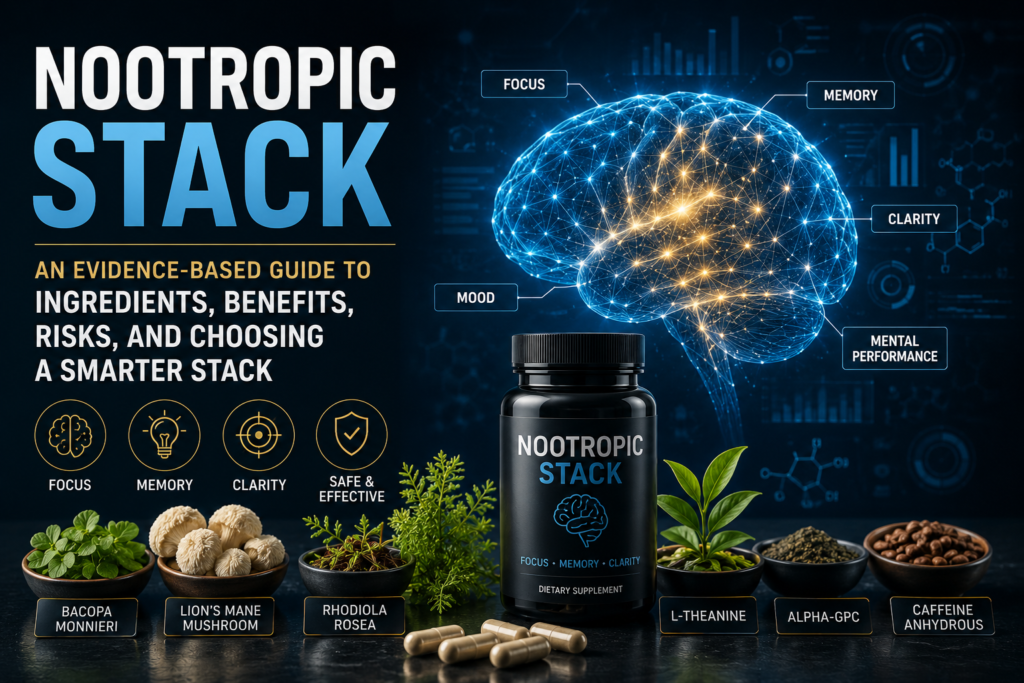
A nootropic stack is a combination of two or more substances used with the goal of supporting cognitive functions such as attention, memory, alertness, mental energy, or stress resilience. The idea is appealing: instead of relying on one ingredient, combine complementary compounds that may address different aspects of cognitive performance.
But stacking also introduces a problem that supplement marketing often glosses over. More ingredients do not automatically mean better results. Combining multiple active substances can increase uncertainty, create overlapping effects, complicate dosing, and raise the possibility of side effects or interactions.
That distinction is central to TestoVerdict’s approach.
Rather than asking, “Which stack has the longest ingredient list?”, consumers should ask a more useful question:
Does each ingredient have a defensible purpose, an appropriate evidence base, a disclosed amount, and a reasonable safety profile—and is there evidence that the combination itself makes sense?
This guide examines that question using available human research and current regulatory guidance.
What Is a Nootropic Stack?
The term nootropic is commonly used for substances marketed or used to support aspects of mental performance. These can include dietary ingredients such as caffeine, L-theanine, creatine and botanical extracts, while the broader online use of the term sometimes extends to pharmaceutical or unapproved substances.
A nootropic stack simply combines multiple cognitive-oriented ingredients.
For example, a relatively simple stack might combine:
caffeine + L-theanine
while a commercial multi-ingredient formula could contain caffeine, L-theanine, Bacopa monnieri, Rhodiola rosea, choline-related ingredients, vitamins and several botanical extracts.
These two products should not automatically be treated as equivalent merely because both call themselves “nootropic stacks.”
The U.S. Department of Defense’s Operation Supplement Safety notes that products marketed as nootropics may contain mixtures of substances promoted for memory, focus, motivation, concentration and attention. It also cautions that many dietary-supplement ingredients lack sufficient reliable evidence establishing cognitive benefits, and multi-ingredient formulas may contain combinations whose interactions have not been adequately studied.
That makes ingredient-by-ingredient evaluation essential.
Why Do People Use a Nootropic Stack?
Different consumers want very different things from cognitive supplements.
Someone working late may primarily want alertness.
A student may be interested in sustained attention.
Another consumer may be more concerned about memory, while someone else may be looking for mental energy without feeling excessively stimulated.
Those are not interchangeable objectives.
Common reasons people investigate nootropics include:
- attention and concentration
- alertness
- memory
- learning
- perceived mental energy
- motivation
- reaction time
- stress resilience
- reducing perceived mental fatigue
- maintaining performance during demanding periods
This is why the phrase “best nootropic stack” can be misleading.
There may not be one universally “best” combination because different ingredients have been studied for different outcomes, in different populations, over different periods.
More importantly, evidence supporting an individual ingredient does not automatically prove that a commercial mixture containing that ingredient will produce the same result.
How Does a Nootropic Stack Work?
The theory behind stacking is relatively straightforward.
Instead of expecting one substance to influence every dimension of cognition, a formula combines ingredients with different proposed functions.
A hypothetical stack might contain:
| Ingredient Type | Intended Role |
|---|---|
| Stimulant | Alertness/attention |
| Calming compound | Balance stimulant effects |
| Botanical extract | Memory or stress-related support |
| Nutrient | Correct or prevent inadequate intake |
| Energy-related compound | Cellular energy availability |
That looks logical on paper.
The difficulty is proving that the entire combination works as intended.
Research on individual ingredients is substantially more common than high-quality randomized trials evaluating the exact multi-ingredient formulations sold commercially.
A systematic review examining dietary-supplement ingredients marketed for cognitive performance in healthy adults identified dozens of ingredients, yet only nine had enough studies to meet the review’s inclusion threshold. The authors concluded that overall certainty remained low and that weighing risks and benefits was difficult.
That is an important reality check for anyone considering a complicated nootropic stack.
Nootropic Stack Ingredients: What Does the Evidence Actually Say?
There are dozens of substances marketed as cognitive enhancers. They do not all have equivalent evidence.
Below are several frequently discussed ingredients with human research behind them.
Caffeine
Caffeine is probably the world’s most familiar psychoactive stimulant.
Its acute effects on alertness and attention are well established compared with many substances marketed as nootropics.
A broad systematic review of plant-derived nootropics found evidence that caffeine can enhance attention and executive-function measures, although effects naturally depend on factors such as dose, habitual caffeine consumption, timing and individual response.
That makes caffeine an understandable component of many focus-oriented formulas.
However, caffeine also illustrates why stacking requires restraint.
Combining coffee, energy drinks, pre-workout products and a caffeinated nootropic supplement can unintentionally increase total stimulant exposure.
Possible unwanted effects can include jitteriness, sleep disruption, anxiety-like symptoms or cardiovascular effects in susceptible individuals.
A consumer evaluating a stimulant-containing product therefore needs to consider total daily caffeine exposure, not merely what appears in one supplement.
L-Theanine
L-theanine is an amino acid naturally associated with tea and is frequently paired with caffeine.
This pairing is one of the more interesting combinations in the nootropic space because it has actually received randomized-trial attention.
A 2025 systematic review and meta-analysis covering 50 randomized controlled trials examining tea, L-theanine, or L-theanine plus caffeine found some small-to-moderate differences favoring the combination for certain cognition and mood outcomes, although confidence intervals often reflected uncertainty.
A 2026 meta-analysis of 31 randomized trials likewise reported a short-term benefit for L-theanine on an attention-related outcome, while noting that effects on stress, anxiety, fatigue and other measures were less consistent.
Another systematic review concluded that caffeine plus L-theanine showed promising cognitive-enhancing effects, particularly around attention-related performance.
This doesn’t mean every caffeine-theanine product works equally well.
It means the combination itself has considerably more direct human research than many arbitrary multi-ingredient stacks.
Caffeine + L-Theanine: A Rational Simple Stack?
For consumers researching a nootropic stack for focus, caffeine and L-theanine are frequently discussed together.
The attraction is understandable.
Caffeine supplies stimulant activity, while L-theanine has been investigated for effects involving attention and mood.
But TestoVerdict would make an important distinction:
“Evidence exists” is not the same statement as “guaranteed to work.”
Research results vary according to study design, dose, participant characteristics, cognitive test and timing.
A recent meta-analysis specifically examining L-theanine concluded that benefits could not be confirmed across all cognitive tests and called for larger standardized trials.
That is a much more useful interpretation than marketing language such as “clinically proven brain enhancement.”
Bacopa Monnieri
Bacopa monnieri is a botanical ingredient commonly found in natural nootropic formulas.
Its evidence profile differs from caffeine.
Rather than being primarily an acute stimulant, Bacopa has typically been studied over longer supplementation periods.
A systematic review of randomized controlled human trials found that included Bacopa studies generally lasted around 12 weeks, with memory being the cognitive domain most consistently investigated.
A broader systematic review of plant-derived nootropics also identified Bacopa as having evidence related to learning and memory, while emphasizing inconsistencies across the wider nootropic literature.
More recent comparative research continues to examine Bacopa alongside Ginkgo biloba, illustrating that these botanicals remain active areas of research rather than settled science.
What consumers should understand
Bacopa should not be evaluated like caffeine.
If a commercial review claims that a Bacopa-containing product produces dramatic mental stimulation within 30 minutes, that claim does not reflect how much of the existing human research has been conducted.
Different ingredients can have different expected time courses.
Creatine as a Cognitive Ingredient
Creatine is usually associated with sports nutrition rather than nootropics, but researchers have also investigated its cognitive effects.
A systematic review of randomized controlled trials in healthy individuals reported evidence suggesting possible improvements in short-term memory and reasoning, while findings for attention, executive function, reaction time and several other domains were conflicting.
This illustrates another useful principle:
An ingredient doesn’t need to be marketed primarily as a “brain supplement” to have cognitive research behind it.
At the same time, promising evidence should not be exaggerated into a universal cognitive-enhancement claim.
Natural Nootropics vs Synthetic Cognitive Enhancers
The word natural carries enormous marketing power.
It should not be interpreted as synonymous with:
safe, effective, clinically proven, interaction-free, or appropriate for everyone.
Botanical extracts are biologically active substances.
The FDA specifically advises consumers that supplements can have strong effects in the body, interact with medications, interfere with laboratory testing and create problems around surgery.
A sensible evaluation therefore focuses on evidence and formulation quality rather than whether the front label says “natural.”
Nootropic Stack for Focus vs Memory
This is one of the most important distinctions for buyers.
Focus-oriented stack
A focus-oriented product may emphasize ingredients associated with:
- alertness
- attention
- reaction time
- perceived mental energy
Caffeine-containing formulas commonly fall into this category.
Memory-oriented stack
A memory-oriented formulation may contain ingredients studied over longer periods rather than ingredients designed primarily for immediate stimulation.
Bacopa is an example.
This distinction helps consumers avoid a common mistake:
Buying an ingredient because it is called a nootropic rather than because its research corresponds to the outcome they actually want.
Nootropic Stack for Motivation: What Should Consumers Expect?
Motivation is especially difficult to evaluate.
Feeling stimulated can sometimes be interpreted subjectively as feeling more motivated.
But alertness, motivation, mood and executive function are distinct outcomes.
A product that increases wakefulness should not automatically be marketed as improving motivation.
Consumers should therefore be cautious about dramatic claims such as:
- “eliminates procrastination”
- “unlocks unlimited motivation”
- “instant drive”
- “laser focus all day”
These are far stronger claims than the typical conclusions of controlled cognitive-supplement research.
Nootropic Stack for Mood
Some compounds marketed as nootropics are also promoted for mood or stress.
Again, the evidence must be evaluated outcome by outcome.
For example, the recent L-theanine meta-analysis found some encouraging results but inconsistent findings across stress, anxiety, fatigue and other outcomes.
A product shouldn’t turn a limited finding into a sweeping mental-health claim.
Consumers experiencing persistent anxiety, depression, cognitive decline or other concerning symptoms should not use an over-the-counter nootropic stack as a substitute for professional assessment.
The Biggest Problem With Multi-Ingredient Nootropic Stacks
Suppose Ingredient A has supportive evidence.
Ingredient B also has supportive evidence.
Ingredient C has supportive evidence.
Does that prove:
A + B + C = superior cognitive performance?
No.
That conclusion requires evidence about the combination itself.
Interactions can be:
- additive
- neutral
- antagonistic
- unpredictable
The Department of Defense’s supplement-safety program specifically warns that multi-ingredient nootropic products may contain mixtures without evidence showing how the ingredients interact.
This is why TestoVerdict does not automatically award higher marks to formulas containing 15 or 20 ingredients.
Sometimes simpler is easier to evaluate.
Proprietary Blends: A Major Transparency Problem
Imagine this label:
“Neuro Performance Matrix — 1,200 mg”
followed by seven ingredients.
You know the combined weight.
You don’t necessarily know how much of each ingredient is present.
That creates a major analytical problem.
Even if research supports a particular ingredient, consumers cannot easily compare the product with the research if its individual amount isn’t disclosed.
Operation Supplement Safety specifically highlights proprietary blends as a concern because consumers may not know how much of each ingredient they are receiving.
TestoVerdict preference
When comparing two otherwise similar products, we generally favor:
fully disclosed ingredient amounts
over:
opaque proprietary blends.
Transparency doesn’t prove efficacy, but it makes evidence-based evaluation possible.
More Ingredients Do Not Mean a Better Nootropic Stack
Consider:
Product A: 4 clearly disclosed ingredients
versus
Product B: 19 ingredients inside several blends
Product B may look more impressive.
But the longer label creates more questions:
Are meaningful amounts present?
Are ingredients redundant?
Has the combination been studied?
Does it unnecessarily increase exposure?
Are there interactions?
Can the consumer identify which ingredient caused an adverse effect?
A long supplement facts panel can be a marketing advantage without being a scientific advantage.
Ingredients That Should Trigger Extra Scrutiny
The online nootropic marketplace extends beyond conventional dietary ingredients.
Consumers should pay close attention to unfamiliar chemical names.
DMHA
FDA states that DMHA does not meet the statutory definition of a dietary ingredient and considers dietary supplements containing it adulterated because DMHA is an unsafe food additive.
DMHA may appear under alternative names including octodrine and 2-aminoisoheptane.
Picamilon
FDA states that picamilon does not qualify as a dietary ingredient and is not approved as a drug in the United States.
Phenibut
FDA has also stated that phenibut does not meet the definition of a dietary ingredient.
These aren’t theoretical concerns.
In April 2026, FDA warned consumers about Addall-branded products after laboratory testing identified unlawful and undeclared substances including phenibut, DMHA and DMAA. FDA described potentially serious health risks associated with the products.
For TestoVerdict, this is one of the strongest reasons to treat unknown or aggressively marketed “hardcore” nootropic formulas with caution.
How to Evaluate a Nootropic Stack Before Buying
Instead of beginning with star ratings or influencer recommendations, work through the formulation systematically.
1. Define the intended outcome
Ask what you actually want:
Focus? Memory? Alertness? Mental fatigue?
A product cannot be intelligently evaluated without defining the goal.
2. Read every active ingredient
Don’t stop at the front label.
Read the Supplement Facts panel.
3. Check individual amounts
Prefer products that disclose how much of each active ingredient is present.
4. Compare ingredients with human evidence
Animal experiments and mechanistic theories can be interesting, but human randomized trials are more relevant when evaluating claims about human cognitive performance.
5. Examine the population studied
An effect found in sleep-deprived adults does not automatically apply to rested adults.
An effect observed in older adults may not apply equally to college students.
6. Look at duration
Some ingredients are investigated acutely.
Others are studied for weeks or months.
7. Consider your other caffeine sources
Coffee, tea, energy drinks, pre-workouts and supplements all count toward total stimulant exposure.
8. Investigate testing and manufacturing transparency
Look for credible quality-control information and accessible testing documentation where appropriate.
9. Look for extreme marketing claims
Claims that sound pharmaceutical in magnitude deserve skepticism.
10. Consider medications and medical circumstances
FDA advises consumers to discuss supplements with a healthcare professional because supplements can interact with medicines and have other clinically important effects.
What Makes a High-Quality Nootropic Supplement?
TestoVerdict would evaluate a commercial nootropic using at least these criteria:
| Criterion | What We Want to See |
|---|---|
| Ingredient transparency | Every active ingredient clearly identified |
| Amount transparency | Individual amounts disclosed |
| Human evidence | Relevant research on key ingredients |
| Form relevance | Ingredient/extract resembles studied material where relevant |
| Purpose | Each ingredient has a defensible reason for inclusion |
| Safety | Sensible warnings and contraindications |
| Stimulant disclosure | Caffeine clearly quantified |
| Testing | Credible quality-control/testing information |
| Marketing | Realistic rather than exaggerated claims |
| Value | Price justified by formulation and evidence |
A formula can score poorly even if it contains fashionable ingredients.
What About Nootropic Dosage?
This is where responsible consumer information needs restraint.
Research papers often use specific experimental amounts, but that does not mean those amounts constitute individualized dosing recommendations.
Appropriate intake can depend on:
- age
- body size
- caffeine tolerance
- medications
- medical conditions
- other supplements
- diet
- pregnancy or breastfeeding
- sensitivity to stimulants
- ingredient standardization
TestoVerdict may report doses used in published research when they help readers understand the evidence, but we do not treat study protocols as personalized medical instructions.
That distinction is especially important with multi-ingredient products.
Can You Take Multiple Nootropic Supplements Together?
This is where the word “stack” can become misleading.
Someone might take:
a nootropic capsule
- coffee
- an energy drink
- a pre-workout
- another adaptogen supplement.
Technically, that person’s real stack is the combined exposure from all of those products.
FDA specifically identifies combining supplements and mixing supplements with medicines as situations where problems can occur.
Consumers should therefore evaluate their total intake, not each bottle in isolation.
Are Nootropic Stacks Safe?
There is no responsible universal yes-or-no answer.
Safety depends on:
- ingredients
- amounts
- combination
- frequency
- product quality
- individual physiology
- medications
- underlying health conditions
A simple product containing familiar dietary ingredients is a fundamentally different proposition from an online formula containing obscure stimulants.
The supplement category also differs from prescription medicines in an important regulatory respect.
Dietary supplements are not evaluated like prescription drugs for premarket approval of effectiveness.
This means consumers need to pay particularly close attention to formulation transparency and manufacturer quality.
Who Should Be Especially Careful?
Professional guidance becomes particularly important for people who:
- take prescription medications
- have cardiovascular concerns
- are sensitive to caffeine or stimulants
- are pregnant or breastfeeding
- are preparing for surgery
- take multiple supplements simultaneously
- have persistent cognitive or psychiatric symptoms
- experience unexplained changes in memory or concentration
A supplement should not delay medical evaluation of concerning symptoms.
Nootropic Stack Side Effects
Potential adverse effects vary widely because different stacks contain different substances.
Depending on the ingredients, possible problems could include:
- jitteriness
- headaches
- gastrointestinal discomfort
- sleep disturbance
- changes in heart rate
- anxiety-like symptoms
- dizziness
- medication interactions
- allergic reactions
Consumers should never assume that an adverse effect is impossible because the label says “natural.”
FDA advises stopping a supplement and seeking medical advice if an adverse event occurs.
Nootropic Stack vs Single-Ingredient Supplement
There are advantages and disadvantages to both approaches.
| Single Ingredient | Multi-Ingredient Stack |
|---|---|
| Easier to identify effects | Multiple potential mechanisms |
| Easier to assess tolerance | More convenient than several bottles |
| Easier evidence comparison | May combine complementary ingredients |
| Fewer interaction variables | Greater interaction uncertainty |
| Simple dosing assessment | Harder to determine what caused an effect |
For a first-time consumer, simplicity can have significant analytical value.
If six ingredients are introduced simultaneously and the user feels different, determining which ingredient was responsible becomes difficult.
Nootropic Stack vs Coffee
Coffee is not a complete substitute for every nootropic formula, but it provides an important benchmark.
If someone’s primary objective is simply alertness, a complicated $60 monthly supplement should demonstrate meaningful value beyond what a familiar caffeine source already provides.
That doesn’t mean coffee is automatically superior.
It means commercial nootropic formulas should justify their additional complexity and cost.
Nootropic Stack vs Energy Drinks
Energy drinks often prioritize stimulation.
Nootropic formulas may attempt to combine stimulants with ingredients aimed at other cognitive outcomes.
But consumers should examine caffeine carefully because using both together can substantially increase total intake.
A label reading “one serving” does not mean one serving is appropriate in combination with every other caffeinated product consumed that day.
How Long Does a Nootropic Stack Take to Work?
There is no single answer.
Some stimulant effects can occur relatively quickly.
Other ingredients have been studied over substantially longer periods.
Bacopa trials in one systematic review, for example, generally involved 12 weeks of supplementation, illustrating why it is misleading to treat every nootropic ingredient as an instant cognitive enhancer.
A trustworthy review should therefore discuss ingredient-specific time horizons rather than promising that an entire formula “kicks in” after a fixed number of minutes.
Does a Nootropic Stack Really Work?
The best evidence-based answer is:
Some ingredients and combinations show promising effects for specific cognitive outcomes, but the evidence does not support treating all nootropic stacks as proven cognitive enhancers.
A systematic review of common cognitive-performance supplement ingredients concluded that the overall state of evidence had a low level of certainty.
At the same time, there are areas of more encouraging evidence.
Caffeine and L-theanine have randomized-trial and meta-analytic evidence supporting certain attention and cognitive outcomes.
Bacopa has evidence particularly related to memory-oriented outcomes.
Creatine has shown possible cognitive benefits in some domains, although results are inconsistent across others.
The scientifically responsible conclusion is therefore neither:
“Nootropics don’t work.”
nor:
“Nootropic stacks work.”
The better question is:
Which ingredient, for which outcome, in which population, at what studied exposure, with what quality of evidence?
How TestoVerdict Will Review Nootropic Products
This is where we want to do things differently.
We will not rank a product #1 simply because:
- it pays the highest commission
- it has the longest ingredient list
- it uses impressive-looking scientific language
- influencers promote it
- its manufacturer calls it “clinically formulated”
Our reviews will examine:
Evidence
Do key ingredients have relevant human evidence?
Transparency
Can consumers see the amount of each meaningful ingredient?
Safety
Are stimulants, warnings and potentially problematic ingredients clearly disclosed?
Formulation logic
Does combining these ingredients make scientific sense?
Testing
Does the manufacturer provide meaningful quality-control information?
Value
Is the formulation worth its price compared with simpler alternatives?
Claims
Does the marketing accurately reflect what research actually demonstrates?
This is the standard we intend to apply across the TestoVerdict nootropics category.
Frequently Asked Questions About Nootropic Stacks
What is the best nootropic stack?
There is no evidence-based universal best stack. The appropriate formulation depends on the intended outcome, ingredient evidence, individual circumstances and safety considerations. A transparent, purpose-built formula is generally easier to evaluate than a large proprietary blend.
What is a good nootropic stack for beginners?
Rather than starting with a complicated formula, beginners may find simpler formulations easier to assess because there are fewer variables. Anyone taking medication or managing a health condition should discuss supplement use with an appropriate healthcare professional.
Are natural nootropics better?
Not automatically. “Natural” describes origin, not efficacy or safety. Botanical substances can still produce biological effects, side effects and interactions.
Can nootropics improve focus?
Some ingredients have evidence involving attention or alertness. Caffeine is well established in this context, while research on caffeine combined with L-theanine has produced encouraging results for certain cognitive outcomes.
Can nootropics improve memory?
Some ingredients, including Bacopa monnieri, have been studied for memory-related outcomes, but evidence varies by ingredient and population.
Can I combine nootropics with coffee?
Potentially overlapping caffeine or stimulant exposure needs to be considered. Consumers should check all labels and total daily intake rather than treating each product separately.
Are proprietary blends bad?
Not necessarily, but they make independent evaluation harder when individual ingredient amounts are hidden.
Should a nootropic contain 10 or 20 ingredients?
Not simply for the sake of having them. Formula complexity should have a scientific rationale. More ingredients can also mean more uncertainty.
Are nootropic supplements FDA approved?
Dietary supplements are regulated differently from drugs and should not be interpreted as FDA-approved treatments simply because they are sold legally as supplements.
What should I avoid in a nootropic stack?
Consumers should be cautious about undisclosed amounts, unexplained proprietary blends, extreme medical-style claims and unfamiliar stimulant-like substances. FDA has specifically identified substances such as DMHA, phenibut and picamilon as problematic in the dietary-supplement context.
TestoVerdict Conclusion: Our Position on the Nootropic Stack
A nootropic stack can be a rational concept, but the word “stack” itself tells consumers almost nothing about product quality.
The strongest products should not be judged by how many ingredients fit on the label.
They should be judged by whether:
the ingredients have a reason to be there, the amounts are transparent, the evidence relates to the claimed benefit, the combination is sensible, safety concerns are addressed, and the manufacturer provides enough information for independent scrutiny.
Current research gives us reasons for cautious interest in certain ingredients and combinations. It does not justify treating every commercial brain supplement as a proven cognitive enhancer.
That distinction will guide TestoVerdict’s reviews.
Our role is not to convince every reader to buy a supplement. It is to help readers distinguish evidence from marketing, useful formulation from unnecessary complexity, and transparent products from formulas that raise more questions than they answer.
Before TestoVerdict recommends a nootropic product, we want to know what is inside it, why it is there, what human evidence supports it, what the limitations are, and whether the manufacturer has earned consumer trust.
That is the TestoVerdict standard.
Sources
- U.S. Food and Drug Administration — FDA 101: Dietary Supplements. Consumer guidance covering supplement risks, interactions and adverse events.
FDA Dietary Supplements Guidance - Operation Supplement Safety, U.S. Department of Defense — Nootropics: Drugs vs Dietary Supplements for Brain Health. Guidance on nootropic supplements, proprietary blends and evidence limitations.
Operation Supplement Safety Nootropics Guide - Dietary Supplement Ingredients for Optimizing Cognitive Performance Among Healthy Adults: A Systematic Review. Review evaluating evidence for commonly marketed cognitive-supplement ingredients.
PubMed systematic review - Effects of Tea, L-Theanine, or L-Theanine Plus Caffeine on Cognition, Sleep, and Mood: Systematic Review and Meta-Analysis. Randomized-trial evidence examining L-theanine and caffeine combinations.
PubMed L-theanine and caffeine meta-analysis - Cognitive and Affective Effects of L-Theanine: Systematic Review and Meta-Analysis of 31 Randomized Trials. Recent evidence examining cognitive and affective outcomes.
PubMed L-theanine meta-analysis - Plant-Derived Nootropics and Human Cognition: A Systematic Review. Review of human research involving botanical nootropics.
PubMed plant-derived nootropics review - The Cognitive-Enhancing Effects of Bacopa monnieri: A Systematic Review of Randomized Controlled Human Clinical Trials. Evidence relating particularly to memory outcomes.
PubMed Bacopa systematic review - Effects of Creatine Supplementation on Cognitive Function of Healthy Individuals: A Systematic Review of Randomized Controlled Trials. Review of cognitive outcomes associated with creatine.
PubMed creatine cognitive review - FDA — DMHA in Dietary Supplements. FDA’s position on DMHA as an unsafe food additive in dietary supplements.
FDA DMHA guidance - FDA — Picamilon in Dietary Supplements. FDA’s position that picamilon does not qualify as a dietary ingredient.
FDA Picamilon guidance - FDA — Dietary Supplements Containing DMHA and Phenibut. Regulatory information concerning DMHA and phenibut.
FDA DMHA and Phenibut notice - FDA — April 2026 Addall XR/XL Safety Alert. FDA laboratory testing identified unlawful and undeclared ingredients in products marketed as dietary supplements.
FDA 2026 nootropic-product safety alert
Medical disclaimer: This article is for general educational and consumer-information purposes and is not medical advice. Dietary supplements can cause side effects and interact with medications. People with medical conditions, those taking medication, and people who are pregnant or breastfeeding should seek appropriate professional guidance before using supplements.