
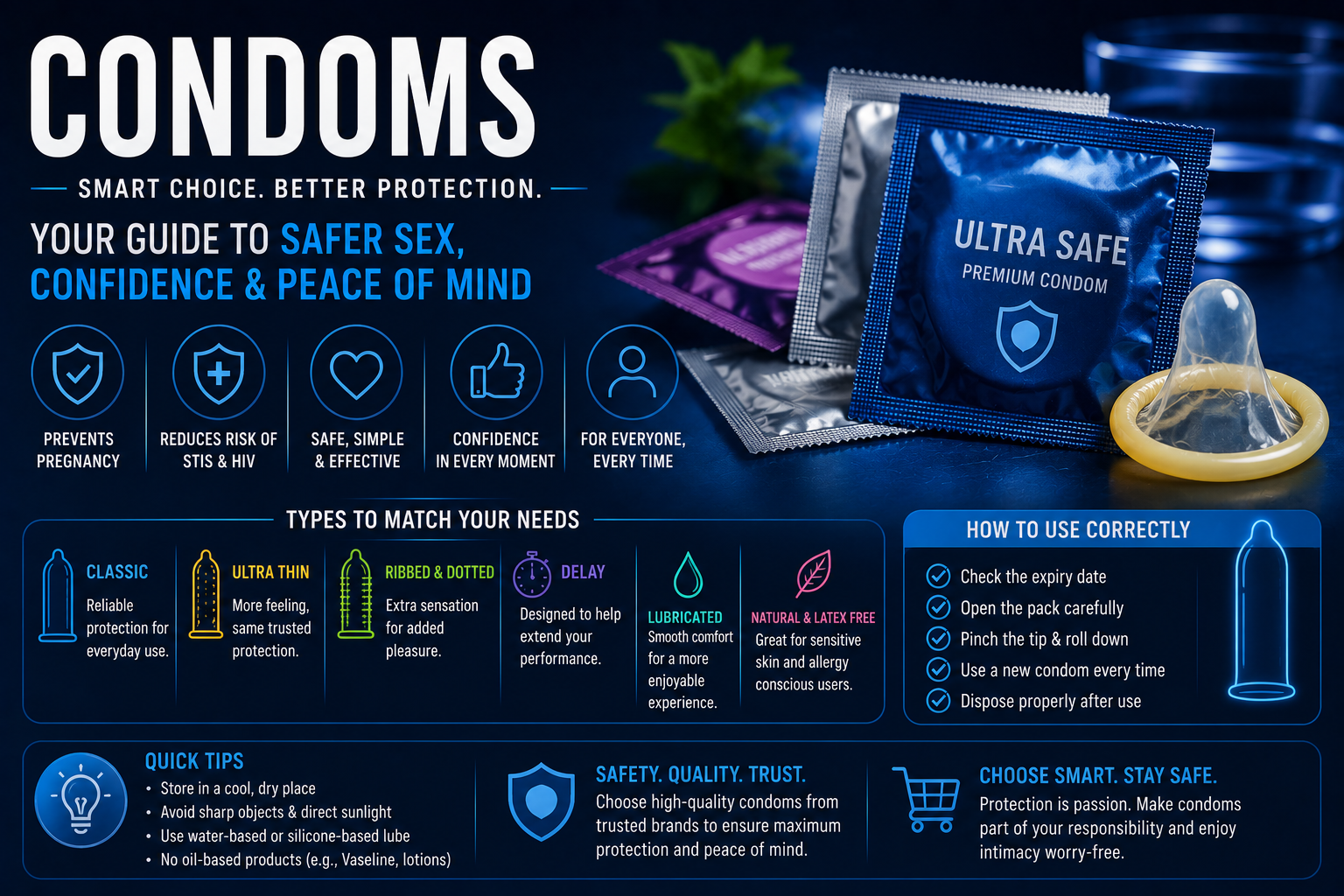
Better Protection Starts With the Right Condom
Condoms may look simple, but choosing the right one involves much more than picking a familiar brand.
Material, size, fit, thickness, lubrication, sensitivity, allergies, storage, and correct use can all influence comfort and protection.
At TestoVerdict, we independently examine condoms through the evidence that matters: safety, materials, fit, sensitivity, comfort, product quality, and value.
Whether you’re looking for thin condoms, condoms for sensitive skin, non-latex alternatives, better-fitting condoms, or simply trying to understand which type is right for you, this hub brings together our condom research and buying guides.
Protection first. Comfort matters. Evidence decides.
Start Here: Understanding Condoms
External condoms create a physical barrier intended to help prevent pregnancy and reduce transmission of many sexually transmitted infections when used correctly and consistently.
But condoms are not all identical.
Products can differ by:
- Material
- Nominal width and fit
- Thickness
- Shape
- Lubrication
- Texture
- Reservoir-tip design
- Added ingredients
- Latex versus non-latex construction
The right choice therefore depends on more than the name printed on the box.
Condom Materials Explained
Latex Condoms
Natural rubber latex remains one of the most common condom materials.
Latex condoms are widely available, flexible, and compatible with many water-based and silicone-based personal lubricants.
However, oil-based products can weaken latex, increasing the risk of condom failure.
People with latex allergy or sensitivity may need an alternative material.
Polyisoprene Condoms
Synthetic polyisoprene provides a non-latex option and can offer a soft, flexible feel.
It may be particularly interesting for people who cannot comfortably use natural rubber latex.
However, consumers should still follow the manufacturer’s instructions regarding compatible lubricants.
Polyurethane Condoms
Polyurethane is another synthetic non-latex material.
It can be useful for people with latex allergy and differs from latex in feel, elasticity, and heat transfer.
Fit becomes especially important because different materials do not necessarily behave identically during use.
Natural Membrane Condoms
Natural membrane condoms are sometimes chosen for sensation or personal preference.
However, there is a critical distinction consumers need to understand:
Natural membrane condoms should not be treated as equivalent to latex or appropriate synthetic condoms for STI/HIV prevention.
Always check the specific product’s intended protection and labeling.
Thin Condoms
One of the biggest consumer questions is:
Are thin condoms less safe?
Not simply because they are thin.
Condom performance depends on far more than thickness.
Important factors include:
- Manufacturing quality
- Material
- Correct size
- Appropriate lubrication
- Storage
- Expiration
- Correct application
- Correct use throughout sex
A properly manufactured thin condom used correctly should not automatically be considered inferior simply because the material is thinner.
For consumers prioritizing sensation, thin condoms can therefore be worth investigating.
Explore our Thin Condoms Guide →
Condoms for Sensitive Skin
Burning, itching, irritation, or discomfort during condom use can have multiple causes.
Possible contributors include:
- Latex sensitivity or allergy
- Lubricant ingredients
- Fragrances
- Flavors
- Spermicides
- Friction
- Poor fit
- Other unrelated medical conditions
Switching brands without understanding the cause may not solve the problem.
For sensitive users, simpler formulations and appropriate non-latex materials may be worth considering.
Explore our Condoms for Sensitive Skin Guide →
Latex vs Non-Latex Condoms
Neither category is automatically best for everyone.
Latex may be preferable when:
- You tolerate latex comfortably
- You want broad product availability
- You want many size and texture options
- Cost matters
Non-latex may be preferable when:
- Latex allergy is present
- Latex sensitivity is suspected
- A different material feel is preferred
The important question is not simply:
“Which material is best?”
It is:
“Which appropriate condom provides the best combination of protection, fit and comfort for you?”
Condom Size and Fit
Fit is one of the most overlooked parts of condom selection.
A condom that is excessively tight may feel uncomfortable.
A condom that is too loose may be more likely to slip.
Consumers should therefore pay attention to actual sizing information rather than relying entirely on labels such as:
- Regular
- Large
- XL
- Snug
Nominal width measurements can be more useful when comparing products.
Why Condom Fit Matters
Good fit can influence:
- Comfort
- Sensation
- Slippage
- Ease of application
- Confidence during use
The goal is not to buy the largest condom possible.
It is to find a condom that fits appropriately.
Lubricant and Condoms
Lubrication can improve comfort and reduce friction.
But lubricant compatibility matters.
For latex condoms, water-based and appropriately compatible silicone-based lubricants are generally the safer categories to consider.
Oil-based products can damage latex.
Examples can include certain:
- Oils
- Lotions
- Petroleum-based products
- Oil-containing massage products
Always check the instructions for both the condom and lubricant.
Explore our Best Lubricant for Condoms Guide →
Water-Based vs Silicone Lubricant With Condoms
Both categories can have advantages.
Water-Based Lubricant
Usually:
- Easy to clean
- Widely available
- Versatile
- Compatible with many condoms and toys
The main disadvantage is that some formulations may require reapplication.
Silicone Lubricant
Usually:
- Longer lasting
- Highly slippery
- Useful when prolonged lubrication is wanted
- Less likely to dry quickly
However, compatibility with some silicone toys should be checked.
For condoms, the specific product’s compatibility instructions always take priority.
Explore Water Based vs Silicone Lubricant →
Spermicidal Condoms
Some condoms have historically been marketed with spermicide, particularly nonoxynol-9.
Consumers should not assume that more ingredients automatically mean more protection.
Nonoxynol-9 can cause irritation, and repeated exposure can be particularly problematic.
TestoVerdict therefore evaluates spermicidal products separately rather than assuming they represent an automatic upgrade.
Textured Condoms
Ribbed, dotted, studded, and differently shaped condoms are designed primarily to alter sensation.
Whether they feel better is highly subjective.
Texture should never substitute for evaluating:
- Material
- Fit
- Lubrication
- Product quality
- Appropriate use
A more elaborate design is not automatically a better condom.
Flavored Condoms
Flavored condoms can be designed primarily with oral sex in mind.
Ingredients and intended uses vary between products.
Consumers with sensitive skin should pay particular attention to:
- Flavoring agents
- Sweeteners
- Fragrances
- Lubricants
- Other additives
Always follow the manufacturer’s intended-use instructions.
Condom Effectiveness
Condom effectiveness depends heavily on correct and consistent use.
Real-world outcomes differ from perfect-use conditions because mistakes happen.
Examples include:
- Putting the condom on after sexual contact has already begun
- Removing it before sex has finished
- Incorrect application
- Reusing a condom
- Using two condoms simultaneously
- Using damaged or expired condoms
- Using incompatible lubricant
- Poor storage
- Slippage
- Breakage
The product matters.
How you use it matters too.
How to Use a Condom Correctly
Basic external-condom use involves:
- Check the package and expiration date.
- Open the wrapper carefully.
- Determine the correct direction before application.
- Place the condom on before genital contact.
- Pinch air from the reservoir tip where applicable.
- Roll it fully down the erect penis.
- Use appropriate compatible lubricant if needed.
- After ejaculation, hold the condom at the base during withdrawal.
- Remove and dispose of it appropriately.
- Use a new condom every time.
Never reuse a condom.
Common Condom Mistakes
Even a high-quality condom cannot compensate for incorrect use.
Common mistakes include:
- Using the wrong size
- Using an expired condom
- Opening wrappers with sharp objects
- Storing condoms in excessive heat
- Using oil with latex
- Putting the condom on incorrectly and then flipping it
- Failing to leave appropriate space at the tip
- Using the same condom twice
- Wearing two external condoms simultaneously
Consumer education is therefore part of condom safety.
Condom Storage
Condoms should generally be kept away from conditions that can damage the material.
Avoid prolonged exposure to:
- Excessive heat
- Direct sunlight
- Sharp objects
- Damaging friction
Check packaging before use.
If a wrapper appears damaged or the condom itself seems unusual, use another one.
How TestoVerdict Evaluates Condoms
We don’t rank condoms based solely on brand recognition or packaging.
Our reviews consider:
1. Material
What is the condom made from?
2. Intended Protection
What does the manufacturer state the product is designed to help protect against?
3. Fit Options
Are useful size choices available?
4. Comfort
Does the design reasonably support comfortable use?
5. Thickness and Sensation
What does the specification actually show?
6. Lubrication
What type of lubricant is supplied?
7. Added Ingredients
Are spermicide, flavoring, fragrance, or other additives present?
8. Sensitive-Skin Considerations
Are latex-free or simpler options available?
9. Label Transparency
Can consumers easily understand the material, size, instructions, and warnings?
10. Value
Does the price make sense relative to quality and features?
Choosing the Right Condom
Before buying, ask:
What material is it made from?
Do I have latex sensitivity?
What nominal width does it use?
Does the size match me appropriately?
Is it lubricated?
Does it contain spermicide?
Are fragrances or flavors included?
Which lubricants are compatible with it?
What protection is the product intended to provide?
Is the product within its expiration date?
These questions are more useful than simply buying whichever box makes the biggest marketing promise.
Condom Red Flags
Be cautious of products that:
- Do not clearly identify material
- Provide vague sizing information
- Lack clear instructions
- Make unrealistic “zero risk” claims
- Have questionable packaging
- Are sold without clear manufacturer information
- Make unsupported medical claims
- Arrive damaged or improperly stored
For a protective product, transparency is not optional.
Explore Our Condom Guides
Thin Condoms
Learn how thickness, material, fit, lubrication, and manufacturing quality influence sensitivity and protection.
Read: Thin Condoms →
Condoms for Sensitive Skin
Compare latex sensitivity, non-latex materials, lubrication, additives, and irritation considerations.
Read: Condoms for Sensitive Skin →
Best Lubricant for Condoms
Understand which lubricant types work with condoms and why oil-based products can create problems with latex.
Read: Best Lubricant for Condoms →
Water Based vs Silicone Lubricant
Compare longevity, cleanup, condom compatibility, sensitive-skin considerations, and everyday use.
Read: Water Based vs Silicone Lubricant →
As TestoVerdict publishes additional condom investigations, this page will become the central directory for all of them.
Frequently Asked Questions
What type of condom is best?
There is no universal best condom. Material, fit, comfort, sensitivity, allergies, intended protection, and personal preference all matter.
Are thin condoms safe?
Thin does not automatically mean unsafe. Proper manufacturing, appropriate fit, correct storage, compatible lubrication, and correct use are critical.
Which condoms are best for sensitive skin?
People with latex allergy may need appropriate non-latex condoms. Irritation can also come from lubricants, spermicide, fragrances, or friction, so identifying the cause matters.
Can I use lubricant with condoms?
Yes, but compatibility matters. Water-based and appropriately compatible silicone-based lubricants are commonly used with latex condoms. Oil-based products should not be used with latex.
Can condoms expire?
Yes. Always check the expiration date and package condition before use.
Should I wear two condoms for extra protection?
No. Using two external condoms simultaneously is not recommended. Friction between them can create additional problems.
Can condoms completely eliminate STI risk?
No protective method should be described as providing zero risk. Condoms can substantially reduce the risk of many sexually transmitted infections when used correctly and consistently, but protection varies depending on the infection and exposure.
Are natural membrane condoms the same as latex condoms?
No. Material matters, particularly for STI prevention. Consumers should check the intended protection stated for the specific product.
The TestoVerdict Verdict
Choosing a condom should not be complicated by exaggerated marketing.
For most consumers, the fundamentals matter most:
appropriate material + correct fit + compatible lubrication + proper storage + correct use.
Thinness can affect sensation.
Material can affect comfort.
Size can affect fit.
Lubrication can affect friction.
But none of these features should be evaluated in isolation from protection and correct use.
TestoVerdict’s Condom section exists to make those decisions easier.
We independently investigate materials, sizing, sensitivity, lubrication, product claims, and consumer value so readers can make better-informed choices without depending entirely on advertising.
Protection first. Comfort matters. Evidence decides.
That is the TestoVerdict standard.
Sexual Health Disclaimer
TestoVerdict provides general consumer education and does not replace individualized medical advice. Anyone experiencing persistent genital irritation, allergic symptoms, pain, unusual discharge, sores, or concerns about pregnancy or sexually transmitted infections should seek appropriate professional healthcare.
This one also gives us a very clean internal-linking hub because we already have several relevant articles ready to connect to it: Thin Condoms, Condoms for Sensitive Skin, Best Lubricant for Condoms, and Water Based vs Silicone Lubricant.