
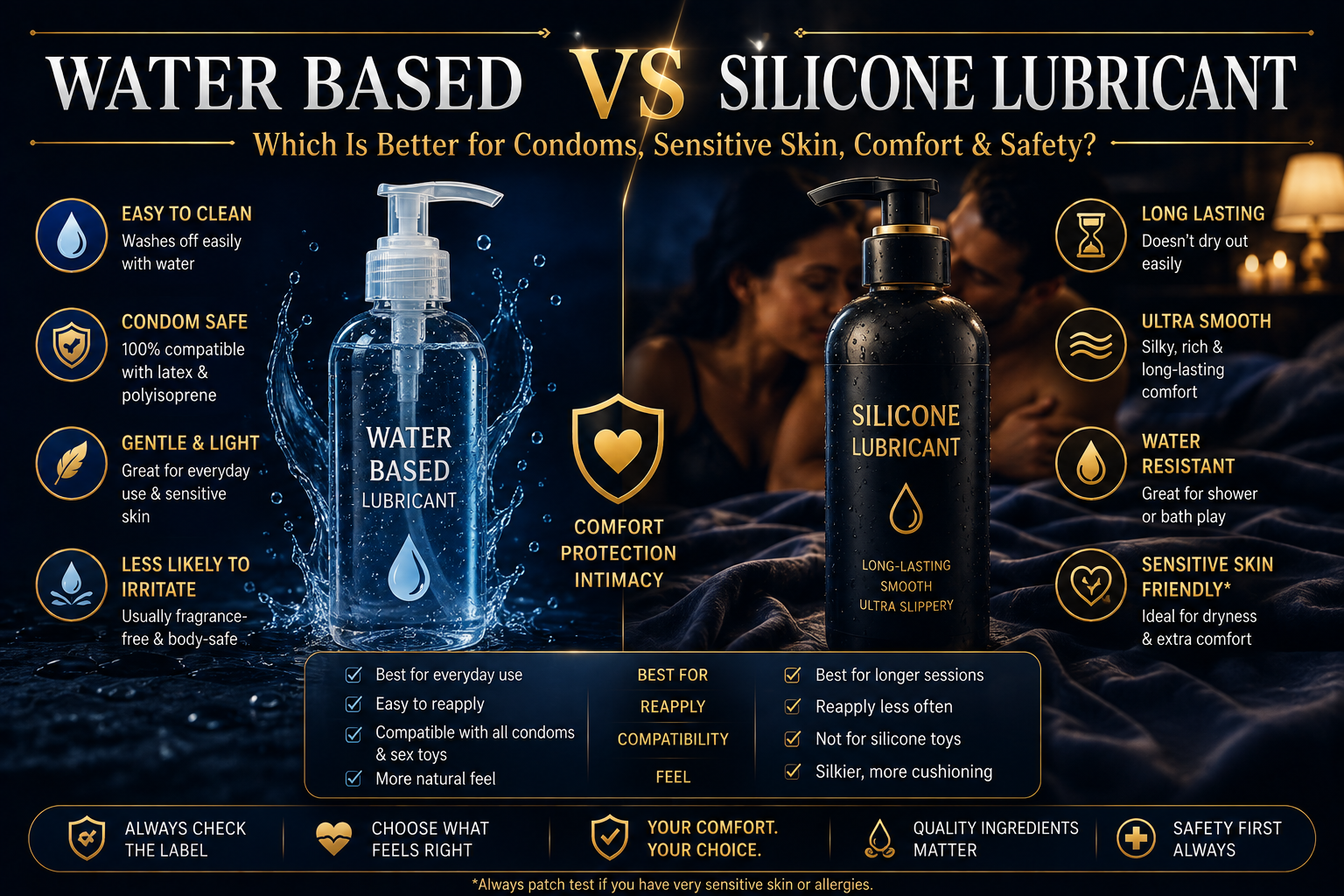
Water Based vs Silicone Lubricant is one of the most useful comparisons to understand before buying a personal lubricant. Both types can reduce friction and improve comfort during sexual activity, and both can be compatible with condoms when the specific product is appropriately formulated and labeled. But they behave very differently when it comes to longevity, reapplication, cleanup, sex-toy compatibility, sensitive skin and price.
For many people, water-based lubricant is the easiest all-purpose starting point. Silicone lubricant usually stays slippery for longer and can be especially useful when prolonged lubrication is needed. Neither category is automatically safer, healthier or better for every person.
WHO recommends making lubricants available for sexual activity and specifically recognizes water- and silicone-based lubricants as condom-compatible options, while warning against oil-based lubricants with condoms because oils can contribute to condom breakage and slippage.
FDA makes another important point: a personal lubricant may or may not be compatible with natural-rubber latex, polyisoprene or polyurethane condoms. In other words, knowing that a product is water- or silicone-based is useful, but consumers should still check the individual product’s labeling.
So the real TestoVerdict question in Water Based vs Silicone Lubricant is not “Which one wins?”
It is:
Which formulation is better for the way you actually intend to use it?
Water Based vs Silicone Lubricant: Quick Verdict
For most first-time users, water-based lubricant is the easiest general-purpose choice.
For people who want longer-lasting lubrication with less frequent reapplication, silicone lubricant often has the advantage.
ACOG similarly describes water-soluble lubricant as a good option for people experiencing irritation or sensitivity, while noting that silicone-based products tend to stay slippery for longer.
| Factor | Water-Based Lubricant | Silicone Lubricant |
|---|---|---|
| Condom use | Usually suitable when labeled compatible | Usually suitable when labeled compatible |
| Longevity | Moderate | Longer |
| Reapplication | More common | Less frequent |
| Cleanup | Easier | More persistent |
| Sensitive-skin options | Excellent selection | Excellent selection |
| Silicone sex toys | Usually safest starting choice | Compatibility needs checking |
| Anal sex | Useful but may dry/reapply | Often excellent due to longevity |
| Vaginal sex | Excellent general option | Excellent when longer slip is desired |
| Shower/water use | Washes away faster | Longer-lasting around water |
| Price | Usually lower | Usually higher |
| Ingredient complexity | Varies | Often relatively simple |
| Osmolality concern | Relevant to water-based formulations | Not evaluated the same way |
TestoVerdict summary
Choose water-based when: versatility, easy cleanup and broad toy compatibility matter most.
Choose silicone when: longevity and sustained slipperiness matter most.
That simple distinction explains much of the Water Based vs Silicone Lubricant decision.
What Is Water-Based Lubricant?
Water-based lubricants use water as the major formulation base.
They commonly contain additional ingredients that control:
- viscosity
- texture
- moisture retention
- preservation
- spreadability
- evaporation rate
WHO’s technical guidance notes that water-based lubricants commonly contain water-soluble polymers, humectants, moisturizers, viscosity modifiers and preservatives.
Common ingredients may include:
- water
- glycerin
- propylene glycol
- cellulose derivatives
- carbomers
- preservatives
- pH-adjusting ingredients
- botanical ingredients in some formulas
The presence of any one ingredient does not automatically determine whether the lubricant is good or bad.
The finished formulation matters.
What Is Silicone Lubricant?
Silicone-based lubricants rely primarily on silicone fluids rather than water.
Common silicone ingredients can include forms of:
- dimethicone
- dimethiconol
- cyclomethicone or related volatile silicones
WHO’s lubricant specifications describe silicone lubricants as containing polydimethylsiloxane and require condom compatibility within the procurement framework.
Silicone does not evaporate like water.
That is why silicone lubricant generally remains slippery significantly longer.
This single physical difference explains many of the practical differences in Water Based vs Silicone Lubricant.
Water Based vs Silicone Lubricant for Condoms
For condom users, both categories can work well.
WHO currently recommends water- or silicone-based lubricants with condoms and warns against oil-based alternatives.
WHO technical guidance also notes that silicone fluids have minimal effect on natural-rubber latex film, while water-based lubricants are widely used as additional condom lubricants.
However, FDA adds an important consumer safeguard.
The agency’s current personal-lubricant classification says the individual lubricant may or may not be compatible with latex, polyisoprene and polyurethane condoms.
Therefore:
Water based = not automatically compatible with every condom.
Silicone based = not automatically compatible with every condom.
Always check the label.
Water Based vs Silicone Lubricant With Latex Condoms
When natural-rubber latex condoms are involved, both water-based and silicone lubricants are generally the preferred categories.
The category to avoid is oil.
WHO notes that latex rapidly loses strength when exposed to oil-based lubricants. It specifically identifies household products such as coconut oil, baby oil, petroleum jelly and body lotion as unsuitable for latex condoms.
This means that for most latex-condom users, the Water Based vs Silicone Lubricant decision comes down to comfort and practicality rather than fundamental latex safety.
Water-based gives easier cleanup.
Silicone gives greater longevity.
Water Based vs Silicone Lubricant for Sensitive Skin
Sensitive-skin users should look beyond the base alone.
ACOG says water-soluble lubricants are a good option for people who experience vaginal irritation or sensitivity and notes that silicone lubricants last longer and remain more slippery.
That doesn’t mean water-based lubricant is always gentler.
A water-based product may contain:
- fragrance
- flavoring
- warming ingredients
- cooling ingredients
- multiple humectants
- preservatives
A silicone formula may have a relatively short ingredient list.
Therefore, the Water Based vs Silicone Lubricant choice for sensitive skin should include the full ingredient profile.
TestoVerdict sensitive-skin preference
For someone with unexplained lubricant irritation, we would generally start with:
- fragrance-free
- unflavored
- no warming/cooling effects
- clearly disclosed ingredients
- straightforward formulation
Then evaluate individual tolerance.
Which Causes More Irritation?
Neither base universally causes more irritation.
Individual reactions vary.
Water-based products have one additional consideration: because they contain substantial water, they generally require a preservation system to prevent microbial contamination. WHO explicitly requires suitable preservation for water-based lubricant formulations.
That is not inherently a bad thing.
Preservation is necessary for product safety.
But any ingredient—including preservatives—can potentially be poorly tolerated by a particular individual.
Silicone formulas may avoid some ingredients found in conventional water-based gels, but silicone itself should not be marketed as universally hypoallergenic.
Water Based vs Silicone Lubricant for Vaginal Dryness
Both can help reduce friction associated with vaginal dryness.
ACOG recommends lubricants as one option for dryness during sexual activity and notes that water-based products are commonly preferred while silicone options last longer.
The difference is mainly practical.
Water-based
Can feel natural and lightweight but may dry out during longer activity.
Silicone-based
Provides sustained lubrication and may reduce the need for repeated application.
For persistent vaginal dryness, however, lubricant may not address the underlying cause.
Dryness can be associated with:
- menopause
- postpartum hormonal changes
- breastfeeding
- medications
- insufficient arousal
- medical treatment
- genitourinary conditions
So Water Based vs Silicone Lubricant answers a comfort question, not every medical question related to dryness.
Water Based vs Silicone Lubricant for Anal Sex
Silicone often has a practical advantage here.
The anus does not naturally provide the same lubrication available during vaginal sexual activity. WHO recommends plenty of lubricant during anal sex and says adequate lubrication helps reduce condom breakage and slippage.
Because silicone lubricant stays slippery for longer, it can be especially useful during activities involving sustained friction.
Water-based products can also work very well, but some may require more frequent reapplication.
TestoVerdict verdict for anal sex
Silicone has the practical edge for longevity.
But condom and toy compatibility should still be verified.
Water Based vs Silicone Lubricant for Sex Toys
Here water-based lubricant usually has the broadest simplicity advantage.
Water-based products are commonly compatible with many toy materials.
Silicone lubricant can potentially interact with some silicone toys.
The extent depends on the specific materials and manufacturers.
Therefore, if you use silicone toys and do not want to investigate compatibility product by product, water-based lubricant is generally the easier starting option.
The Water Based vs Silicone Lubricant decision changes when toys enter the equation because you now need to consider:
body + condom + lubricant + toy material
rather than only the lubricant itself.
Can Silicone Lubricant Damage Silicone Toys?
Potentially, depending on the product.
Some silicone lubricants and silicone toy materials may interact.
This is not a reason to assume that every silicone lubricant damages every silicone toy.
It is a reason to follow manufacturer instructions.
Some brands recommend spot testing or using water-based lubricant with silicone toys.
TestoVerdict’s rule is straightforward:
When both lubricant and toy contain silicone, check compatibility rather than guessing.
Water Based vs Silicone Lubricant: Which Lasts Longer?
Silicone.
This is its most obvious advantage.
Water-containing lubricants gradually lose water through absorption and evaporation.
Silicone does not behave the same way and therefore usually maintains slipperiness longer.
This means silicone may be preferable for:
- long sexual sessions
- anal sex
- shower sex
- users who dislike reapplying
- situations involving sustained friction
Water-based lubricant remains perfectly suitable when longevity isn’t a major issue.
Water Based vs Silicone Lubricant: Which Is Easier to Clean?
Water-based lubricant usually wins.
It is generally easier to wash from:
- skin
- bedding
- clothing
- toys
Silicone is more persistent.
That longevity is useful during sex but less convenient afterward.
Some consumers love the durable slickness.
Others find the cleanup annoying.
This is one of those Water Based vs Silicone Lubricant differences that has no medical winner—only a preference winner.
Water Based vs Silicone Lubricant in the Shower
Silicone usually performs better around water.
Water-based lubricant can wash away or dilute rapidly in a shower or bath.
Silicone remains slippery because it is not water-soluble in the same way.
Therefore:
Shower / bath use → silicone advantage
But take care with slippery surfaces. A product that remains highly slippery can increase the chance of falls outside the intended body area.
What Is Osmolality?
Osmolality is one of the biggest technical differences in Water Based vs Silicone Lubricant.
It primarily matters for water-based formulations.
Osmolality describes the concentration of dissolved particles relative to water.
WHO guidance notes that vaginal secretions are roughly 260–290 mOsm/kg and semen approximately 250–380 mOsm/kg. WHO historically identified 380 mOsm/kg as a desirable upper target but adopted an interim practical ceiling of 1,200 mOsm/kg because many commercial lubricants substantially exceeded the physiologic range.
WHO’s 2025 consultation specifications likewise specify water-based lubricant osmolality below 1,200 mOsm/kg.
This matters because highly hyperosmolar water-based products may interact differently with epithelial tissue.
Silicone lubricants do not have water-based osmolality in the same sense.
Does That Mean Silicone Lubricant Is Automatically Safer?
No.
Avoid turning one technical metric into a universal safety ranking.
Osmolality is one aspect of water-based lubricant evaluation.
It does not account for:
- allergies
- irritation
- ingredient sensitivity
- condom compatibility
- toy compatibility
- product contamination
- appropriate intended use
A properly formulated water-based lubricant can be an excellent product.
The Water Based vs Silicone Lubricant debate should not become “osmolality means water-based is bad.”
That would misrepresent the evidence.
Water Based vs Silicone Lubricant and pH
pH is another specification most relevant to water-containing formulations.
WHO’s 2025 draft technical specifications for water-based lubricant call for pH within 4.0–7.0, with a stated tolerance, in the procurement context.
But consumers should avoid another oversimplification:
One pH number is not universally perfect for every anatomical use.
Product formulation, intended use and testing matter together.
If a manufacturer markets its product as “pH balanced,” TestoVerdict wants to know:
Balanced to what?
Specific technical transparency is more valuable than reassuring advertising language.
Water Based vs Silicone Lubricant for Men
Both categories work for penile lubrication.
The better choice usually depends on:
- desired longevity
- condom material
- cleanup preference
- masturbation use
- partner use
- sensitivity
- sex toys
Water-based may feel lighter and clean away quickly.
Silicone may remain slicker during longer use.
There is no biological reason that one type is inherently a “men’s lubricant.”
Water Based vs Silicone Lubricant for Women
Again, both can work.
Water-based lubricants are especially common for vaginal use, and ACOG describes water-soluble lubricants as a good choice for vaginal irritation or sensitivity. Silicone-based products stay slippery longer.
For someone with recurring dryness during intercourse:
Water-based → simple first option
Silicone → strong option when water-based dries too quickly
Persistent pain or dryness deserves evaluation rather than assuming the only solution is a different lubricant.
Water Based vs Silicone Lubricant During Menopause
Menopause-related hormonal changes can contribute to vaginal dryness and painful intercourse.
Lubricants can reduce friction during sexual activity, while vaginal moisturizers are used differently for ongoing dryness.
ACOG specifically discusses both water-based and silicone-based lubricants in this context.
The practical decision remains similar:
- water-based for easy everyday use
- silicone for greater longevity
Neither treats every underlying cause of genitourinary symptoms of menopause.
Water Based vs Silicone Lubricant When Trying to Conceive
This is a special situation.
Neither water-based nor silicone-based automatically means sperm-friendly.
FDA maintains a separate classification for personal lubricants that have been demonstrated to be compatible with sperm, oocytes and embryos and are intended for couples trying to conceive.
Therefore:
Condom-compatible ≠ fertility-compatible
and:
Water-based ≠ automatically fertility-friendly
If conception is the goal, select a product specifically intended and appropriately cleared for that use.
Water Based vs Silicone Lubricant With Thin Condoms
Condom thickness does not fundamentally change the lubrication rule.
The condom material matters more.
If a thin condom is latex, a compatible water-based or silicone lubricant is generally appropriate.
If it is polyisoprene or polyurethane, check the specific manufacturer’s instructions.
This connects directly to TestoVerdict’s broader condom research:
material first, thickness second.
Water Based vs Silicone Lubricant With Polyisoprene Condoms
FDA explicitly notes that lubricant compatibility can differ with polyisoprene condoms.
Do not assume:
non-latex = compatible with everything.
For polyisoprene, use lubricant that the condom manufacturer specifically identifies as compatible.
Water-based is often the easiest conservative choice, but product-level guidance wins.
Water Based vs Silicone Lubricant With Polyurethane Condoms
Polyurethane behaves differently from latex.
Again, compatibility should be verified rather than inferred.
FDA’s current device classification recognizes that individual lubricants may or may not be compatible with polyurethane.
This is why TestoVerdict avoids simplistic blanket statements such as:
“All silicone lubricants work with all condoms.”
That goes beyond what consumers should assume.
Are Water-Based Lubricants Safer Than Oil-Based Lubricants?
For latex-condom use, yes in the important sense of condom compatibility.
Oil-based lubricants can compromise latex.
WHO specifically recommends water- or silicone-based products and warns against oil-based lubricants when condoms are being used.
For people not using latex barriers, the comparison becomes more individual.
But natural oil should never be assumed safer merely because it is familiar.
Is Silicone Lubricant “Chemical”?
Yes.
So is water.
So is everything else.
“Chemical-free lubricant” is scientifically meaningless marketing.
The appropriate question in Water Based vs Silicone Lubricant is not whether one sounds more natural.
It is:
- Is the formulation appropriate?
- Is it properly manufactured?
- Is it compatible with the intended condom?
- Is it well tolerated?
- Does it provide effective lubrication?
Is Water-Based Lubricant More Natural?
Not necessarily.
Water-based describes the base, not the source of every ingredient.
A water-based formula may contain:
- plant-derived ingredients
- synthetic ingredients
- preservatives
- humectants
A silicone product may contain only a few ingredients.
“Naturalness” does not predict overall quality.
Glycerin in Water-Based Lubricant
Glycerin is frequently used as a humectant.
Some online guides tell everyone to avoid it.
That oversimplifies formulation science.
WHO notes that glycerol and propylene glycol can contribute substantially to lubricant osmolality at higher concentrations.
The more useful question is therefore:
What is the osmolality and overall formulation?
rather than:
Does the bottle contain glycerin?
A well-formulated product should be evaluated as a finished system.
Preservatives in Water-Based Lubricant
Water-based lubricants need protection against microbial contamination.
WHO’s technical requirements explicitly state that water-based lubricants should contain suitable preservatives.
That means “preservative-free” is not automatically an advantage.
Preservatives can occasionally irritate sensitive individuals, but inadequate microbial protection is not a desirable alternative.
The goal is effective and well-tolerated preservation, not zero preservation at all costs.
Silicone Lubricant Ingredients
Silicone lubricants can sometimes have remarkably simple formulas.
Products may contain combinations of silicone fluids designed to create:
- slipperiness
- spread
- different thickness
- longer wear
WHO procurement specifications require a minimum percentage of polydimethylsiloxane for silicone formulations within that program and require relevant safety and compatibility criteria.
For consumers, a shorter ingredient list can make the product easier to evaluate, but it doesn’t prove that every user will tolerate it perfectly.
Water Based vs Silicone Lubricant for Long-Lasting Sex
Silicone has the clear practical advantage.
It typically requires less reapplication.
That can help avoid interruptions during longer sessions.
Water-based products can still perform very well, particularly thicker formulas, but frequent reapplication is more common.
Verdict
Winner for longevity: Silicone
Water Based vs Silicone Lubricant for Easy Cleanup
Water-based wins.
It washes away more readily and is less likely to leave the persistent slippery feeling some users dislike.
Verdict
Winner for cleanup: Water-based
Water Based vs Silicone Lubricant for Beginners
For most beginners:
Water-based.
Why?
It is:
- widely available
- easy to clean
- generally straightforward with condoms when labeled compatible
- generally simple with sex toys
- available in many textures
- usually affordable
If the user later decides they want more longevity, silicone is an easy second category to explore.
Water Based vs Silicone Lubricant for Sensitive Skin: Final Comparison
Neither base wins automatically.
TestoVerdict would rather compare two actual ingredient labels.
For example:
Product A
Water-based but heavily fragranced with warming compounds.
Product B
Silicone-based with three straightforward ingredients and no sensory additives.
Product B might be easier for an irritation-prone person.
Now reverse the situation:
Product A
Simple fragrance-free water-based gel.
Product B
Silicone lubricant containing an ingredient a particular person already knows they cannot tolerate.
Then Product A wins.
This is why Water Based vs Silicone Lubricant should never replace individual product evaluation.
Common Mistakes When Choosing Lubricant
Choosing by “natural” marketing
Natural does not prove better compatibility.
Using oil with latex condoms
One of the most important avoidable mistakes.
Assuming all non-latex condoms tolerate oil
Not necessarily.
Ignoring sex-toy materials
Particularly relevant with silicone lubricant.
Assuming burning is normal
Significant burning or irritation is not something to tolerate simply because the product is marketed as warming or premium.
Using too little lubricant
Friction itself can cause discomfort.
Treating persistent pain as a lubricant-shopping problem
Recurring genital pain deserves appropriate medical evaluation.
How to Choose Between Water Based vs Silicone Lubricant
Use this simple decision tree.
Do you use latex condoms?
Both water- and silicone-based products can work when explicitly compatible.
Do you use silicone sex toys?
Water-based is usually the easier choice unless compatibility is confirmed.
Do you want very long-lasting lubrication?
Silicone.
Do you want easy cleanup?
Water-based.
Do you have sensitive skin?
Start with the simplest fragrance-free formulation in either category.
Are you trying to conceive?
Use a product specifically demonstrated to be fertility-compatible.
Will you use it in the shower?
Silicone usually lasts better.
Is price important?
Water-based products are generally more affordable.
TestoVerdict Buying Checklist
Before choosing Water Based vs Silicone Lubricant, check:
- Is the base clearly disclosed?
- Is the full ingredient list available?
- Is it compatible with my condom material?
- Is it compatible with my sex toys?
- Is it fragrance-free if I’m sensitivity-prone?
- Are warming/cooling ingredients necessary?
- Is pH information available where relevant?
- Is osmolality disclosed for a water-based product?
- Is the product adequately preserved?
- Is fertility compatibility relevant?
- Are manufacturer claims realistic?
- Does the formula provide enough longevity?
- Is the price justified?
Red Flags
TestoVerdict would be cautious with products that:
- fail to disclose ingredients
- claim universal condom compatibility without clarification
- say oil is safe with every condom
- promise zero irritation
- make disease-treatment claims
- market themselves as “chemical-free”
- claim all synthetic ingredients are dangerous
- advertise fertility safety without evidence
- provide no manufacturer information
- hide basic product instructions
Transparency should be a minimum requirement.
Frequently Asked Questions About Water Based vs Silicone Lubricant
Which is better: Water Based vs Silicone Lubricant?
Neither is universally better. Water-based lubricant is generally easier to clean and broadly versatile. Silicone lubricant usually lasts longer and requires less reapplication.
Is water-based lubricant safe with condoms?
Water-based lubricant is commonly recommended for condom use, but check the individual product’s compatibility labeling. WHO recommends water- or silicone-based lubricant with condoms.
Is silicone lubricant safe with condoms?
Many silicone lubricants are compatible with latex condoms, and WHO recognizes silicone-based lubricant as a condom-compatible category. Product-specific labeling should still be checked.
Which lasts longer?
Silicone lubricant generally lasts longer.
Which is easier to clean?
Water-based lubricant.
Which is better for sensitive skin?
Either can work. ACOG identifies water-soluble lubricants as a good choice for vaginal irritation or sensitivity, while silicone lubricants offer greater longevity.
Which is better for anal sex?
Silicone often has an advantage because it remains slippery longer. Plenty of compatible lubricant is particularly important during anal sex.
Which is better for silicone toys?
Water-based lubricant is generally the easier choice because some silicone lubricants may interact with silicone toys.
Does silicone lubricant dry out?
It generally lasts much longer than water-based lubricant because it does not evaporate in the same way.
Does water-based lubricant get sticky?
Some formulations can become tacky as water evaporates. This varies considerably by product.
Can you use water-based lubricant in the shower?
Yes, but it may wash away quickly.
Can you use silicone lubricant in the shower?
Yes, and it usually remains slippery longer around water.
Is silicone lubricant natural?
Silicone is a manufactured material. However, “natural” is not a useful safety ranking by itself.
Does water-based lubricant contain preservatives?
Many do because water-containing products require microbial protection. WHO technical specifications specifically require suitable preservation in water-based lubricants.
Can water-based lubricant have high osmolality?
Yes. WHO guidance has specifically addressed osmolality in water-based formulations and uses an interim ceiling of 1,200 mOsm/kg in procurement specifications.
Which lubricant is best when trying to conceive?
Neither base alone determines fertility compatibility. FDA maintains a separate classification for lubricants demonstrated to be compatible with sperm, oocytes and embryos.
Can silicone lubricant cause irritation?
Any lubricant can potentially be poorly tolerated by a particular person. Significant or persistent irritation is a reason to discontinue use.
Can water-based lubricant cause irritation?
Yes. Individual ingredients can sometimes cause irritation or sensitivity even though the product is water-based.
The TestoVerdict Verdict: Water Based vs Silicone Lubricant
The most useful conclusion to the Water Based vs Silicone Lubricant debate is that both are excellent lubricant technologies serving somewhat different consumer needs.
For most people starting out, water-based lubricant wins on versatility.
It is widely available, easy to clean, available in countless textures, commonly suitable for condom use when appropriately labeled, and generally straightforward with sex toys. ACOG also identifies water-soluble lubricant as a good option for people experiencing vaginal sensitivity or irritation.
For people who prioritize long-lasting slip, silicone has a real advantage.
It does not dry out as quickly, typically requires fewer applications and can be especially useful during anal sex, extended sexual activity or use around water.
From a condom perspective, both can be good choices.
WHO recommends water- or silicone-based lubricant with condoms and warns against oils, which can increase condom breakage and slippage.
But FDA’s current classification provides the consumer safeguard we consider most important: individual lubricants may or may not be compatible with latex, polyisoprene and polyurethane condoms.
So TestoVerdict does not approve a lubricant simply because it belongs to the “correct” base category.
We still want to know:
What condom materials has it been tested with?
What ingredients are present?
Does it irritate sensitive tissue?
Does the water-based formulation disclose useful pH or osmolality information?
Is the silicone formula compatible with the user’s toys?
Does it last long enough for the intended activity?
Does the company make realistic claims?
For water-based formulas, osmolality deserves special attention. WHO’s current technical work continues to specify an osmolality below 1,200 mOsm/kg for water-based lubricant procurement.
For silicone formulas, longevity is their defining consumer advantage.
So our final decision is:
Choose WATER-BASED if you want:
easy cleanup, broad versatility, easy toy compatibility and an excellent everyday lubricant.
Choose SILICONE if you want:
longer-lasting lubrication, fewer interruptions for reapplication and stronger performance during sustained friction or around water.
Neither one wins every category.
And that is exactly why TestoVerdict will judge individual lubricants rather than simply declaring one base superior.
Formula first. Compatibility second. Comfort third. Marketing last.
Research. Compare. Buy Smart.
Sources & References
- World Health Organization — Condoms: Questions and Answers. WHO explains that lubricant can reduce condom breakage and slippage and recommends water- or silicone-based lubricant.
WHO — Condoms and Lubricant Guidance - World Health Organization — Recommendations on Self-Care Interventions: Availability of Lubricants During Sexual Activity. WHO recommends condom-compatible lubricants and advises against oil-based products with condoms.
WHO — Lubricants During Sexual Activity - WHO/UNFPA/FHI360 — Use and Procurement of Additional Lubricants With Male and Female Condoms. Technical guidance covering water-based and silicone lubricants, preservatives, condom compatibility, osmolality and the effects of oil on latex.
WHO — Technical Lubricant Guidance - World Health Organization — Technical Requirements for Water-Based and Silicone Lubricants. WHO requirements covering ingredient safety, preservatives, silicone composition and condom-compatibility testing.
WHO — Water and Silicone Lubricant Technical Requirements - World Health Organization — WHO Drug Information, Volume 39, Number 2 (2025). Consultation specifications covering water-based lubricant composition, osmolality below 1,200 mOsm/kg and pH specifications.
WHO — 2025 Water-Based Lubricant Specifications - U.S. Food and Drug Administration — Personal Lubricant Product Classification (NUC). FDA defines personal lubricants and states that individual products may or may not be compatible with natural-rubber latex, polyisoprene and polyurethane condoms. The FDA page was updated August 17, 2026.
FDA — Personal Lubricant Classification - American College of Obstetricians and Gynecologists — When Sex Is Painful. ACOG notes that water-soluble lubricants can be a good option for irritation or sensitivity and that silicone lubricants generally remain slippery longer.
ACOG — When Sex Is Painful - American College of Obstetricians and Gynecologists — Experiencing Vaginal Dryness? Here’s What You Need to Know. Discusses water-based and silicone lubricant use for vaginal dryness and cautions about oil-based lubricants.
ACOG — Vaginal Dryness and Lubricants - U.S. Food and Drug Administration — Gamete, Fertilization and Embryo-Compatible Personal Lubricant (PEB). FDA’s specific classification for lubricants demonstrated to be compatible with sperm, oocytes and embryos for people trying to conceive. The FDA page was updated August 24, 2026.
FDA — Fertility-Compatible Personal Lubricants
Medical & Sexual Health Disclaimer: This article provides general consumer education and is not individualized medical advice. Stop using a lubricant that causes significant burning, swelling, itching, rash or persistent discomfort. Persistent vaginal or penile irritation, genital pain, unusual discharge, sores, bleeding or recurrent pain during sex should be evaluated by an appropriately qualified healthcare professional. Condoms reduce but do not eliminate pregnancy or STI risk, and the specific lubricant should always be confirmed compatible with the condom material being used.