
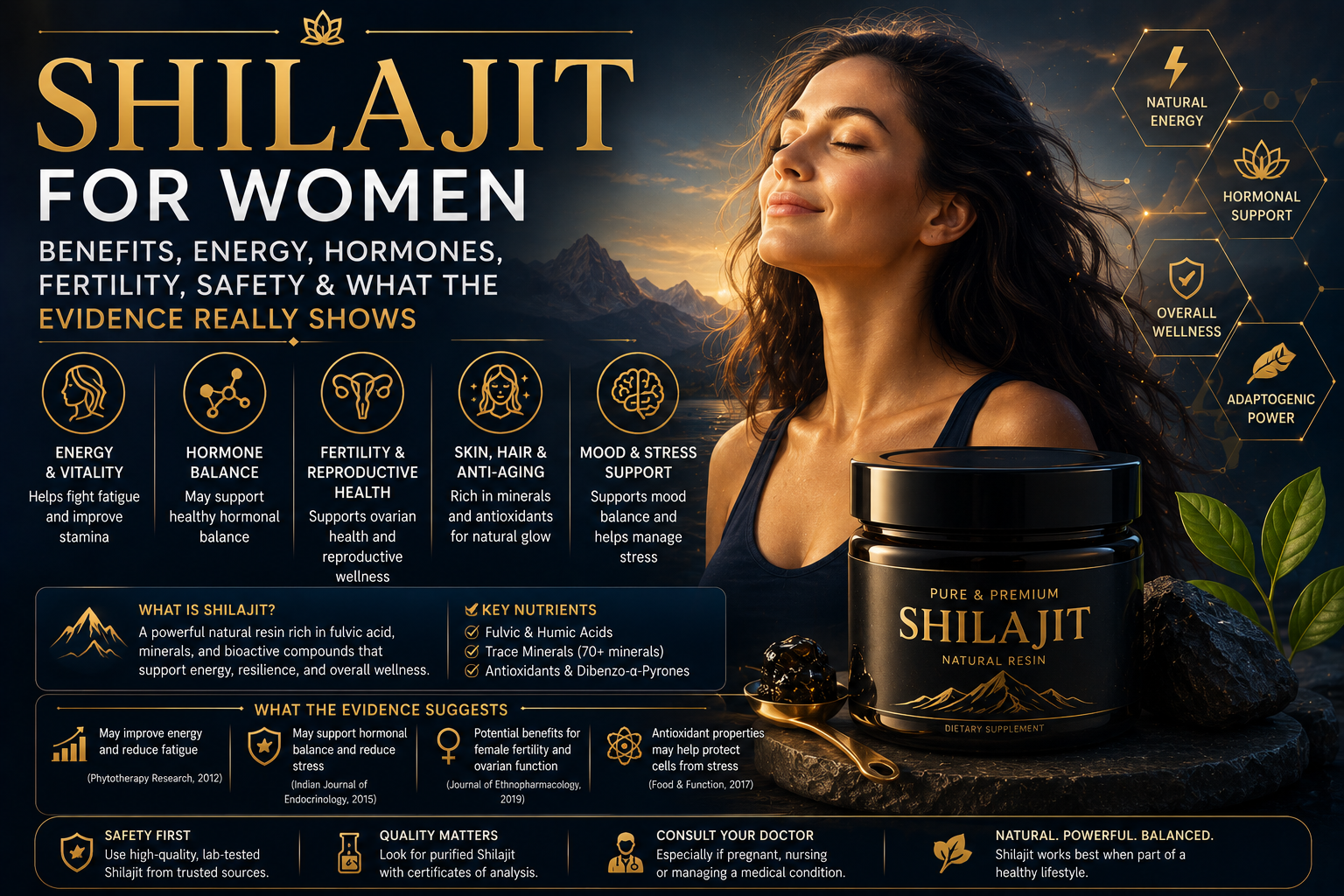
Shilajit for Women has become increasingly visible in the supplement market, with products promoted for energy, vitality, hormonal balance, fertility, iron support, healthy aging and mental performance. The problem is that many of these claims are extrapolated from traditional use, animal studies, biochemical theory, or research conducted primarily in men.
That does not mean Shilajit has no potential value for women. It means the evidence needs to be interpreted carefully.
Shilajit is a complex phyto-mineral substance containing humic compounds, minerals and numerous organic constituents. Reviews describe potential antioxidant, anti-inflammatory and adaptogenic properties, but also emphasize that relatively few well-controlled human studies exist and that more standardized clinical research is needed.
So the most useful question is not:
“Is Shilajit good for women?”
It is:
“Which claims about Shilajit for Women are actually supported by human evidence, which are still theoretical, and what safety issues should women understand before buying it?”
That is the TestoVerdict approach.
Shilajit for Women: Quick Verdict
The current evidence base is much stronger for general Shilajit research and certain male outcomes than for female-specific benefits.
There is not yet strong clinical evidence showing that Shilajit reliably:
- balances female hormones
- increases estrogen
- improves female fertility
- treats PCOS
- treats menopause symptoms
- corrects anemia
- improves libido in women
- causes weight loss
There is some broader evidence suggesting possible roles in fatigue, physical performance and general physiological support, but several recent human studies were conducted only in men. For example, a 2026 pilot study of Shilajit resin reported improvements in several physical-performance and fatigue measures, but all 25 participants were male.
TestoVerdict quick evidence table
| Claim | Current evidence for women |
|---|---|
| Energy/fatigue | Possible, but female-specific evidence is limited |
| Testosterone support | Not an appropriate female conclusion from male studies |
| Hormonal balance | Not established |
| Female fertility | Not established clinically |
| Menopause support | Not established |
| Iron/anemia support | Not established treatment |
| Cognitive support | Preliminary overall evidence |
| Exercise performance | Interesting general evidence, but recent human study was male-only |
| Healthy aging | Not proven |
| Heavy-metal safety | Important for everyone |
That makes Shilajit for Women a category where marketing currently runs ahead of female-specific clinical science.
What Is Shilajit?
Shilajit is a naturally occurring dark, semi-solid substance associated with mountainous regions and used traditionally in South Asian systems of medicine.
It is not one isolated molecule.
Rather, it is a chemically complex material containing:
- humic substances
- fulvic acids
- minerals
- organic compounds
- other naturally occurring constituents
That complexity is important because products can differ according to:
- geographical source
- purification
- processing
- standardization
- contaminant levels
A review of the scientific literature notes that Shilajit remains incompletely characterized and that traditional claims have historically exceeded the amount of rigorous human evidence available.
When evaluating Shilajit for Women, the specific finished product matters just as much as the ingredient name.
Why Is Shilajit for Women Becoming Popular?
Shilajit was previously marketed far more heavily toward men.
That is changing.
Women-focused products now commonly promise support for:
- energy
- stamina
- hormonal balance
- stress resilience
- fertility
- libido
- iron levels
- menopause
- mental clarity
- skin health
- hair health
- healthy aging
Commercially, that makes sense.
Scientifically, each claim has to stand on its own evidence.
A study involving testosterone in middle-aged men does not prove a female hormonal benefit.
A study involving sperm production does not establish improved ovarian function.
A biochemical antioxidant effect does not prove better skin or slower aging.
This is where many Shilajit for Women articles become misleading.
Shilajit for Women and Energy
Energy is one of the more plausible areas of interest.
A review of Shilajit’s safety and efficacy describes animal and human research relating to fatigue, physical performance and ATP-related mechanisms, while also calling for more standardized controlled research.
A 2026 open-label pilot study evaluated 500 mg/day of Shilajit resin for 28 days and reported improvements in strength, endurance, fatigue scores and several other outcomes. However, the study involved only 25 healthy male participants and had no placebo group.
That means it can support the idea that Shilajit deserves further investigation for fatigue.
It cannot prove the same effect in women.
TestoVerdict evidence grade: Energy
LIMITED / PLAUSIBLE
Women interested in Shilajit for Women because of fatigue should also remember that persistent low energy can be caused by:
- iron deficiency
- thyroid disease
- sleep disorders
- low calorie intake
- pregnancy
- depression
- medication effects
- chronic illness
A supplement should not replace evaluation of unexplained fatigue.
Does Shilajit Increase Energy in Women?
There is not enough female-specific controlled research to answer confidently.
Some of Shilajit’s proposed mechanisms could plausibly be relevant regardless of sex.
But clinical outcomes matter more than mechanisms.
Until trials specifically include sufficient numbers of women, claims that Shilajit for Women increases energy should be described as possible rather than established.
That distinction protects consumers from exaggerated advertising.
Shilajit for Women and Hormonal Balance
“Hormonal balance” is one of the most vague phrases in supplement marketing.
Female endocrine physiology involves:
- estrogen
- progesterone
- testosterone
- thyroid hormones
- insulin
- cortisol
- prolactin
- FSH
- LH
A product cannot meaningfully be said to “balance hormones” unless the claim identifies which hormone, in which population, and based on which evidence.
There is no strong clinical evidence establishing broad hormonal balancing effects of Shilajit for Women.
This is especially important because the most famous human hormonal study of purified Shilajit investigated healthy men aged 45–55, not women.
It would be scientifically inappropriate to take a male testosterone finding and convert it into a generalized women’s-hormone claim.
Does Shilajit Increase Testosterone in Women?
We do not have enough evidence to conclude this.
Research involving male testosterone should not be generalized to women.
Women naturally produce testosterone, but the normal physiological ranges and clinical implications differ substantially from men.
A woman should not take Shilajit specifically to manipulate testosterone without a clear medical reason and appropriate guidance.
That is particularly important for women with conditions in which androgen levels may already be relevant, such as certain cases of PCOS.
Shilajit for Women and PCOS
There is not sufficient clinical evidence to recommend Shilajit as a treatment for polycystic ovary syndrome.
PCOS can involve:
- irregular ovulation
- insulin resistance
- elevated androgens
- fertility difficulties
- acne
- excess hair growth
- metabolic risk
Because hormonal and metabolic patterns vary substantially between women with PCOS, using a poorly studied supplement to “balance hormones” is not an evidence-based substitute for evaluation and treatment.
TestoVerdict verdict on PCOS
Not established.
Marketing Shilajit for Women with PCOS as a treatment would go beyond current evidence.
Shilajit for Women and Fertility
This is another area where male evidence is often misused.
Shilajit has been studied in men with oligospermia, and the broader review literature discusses spermatogenic effects.
That is male fertility research.
It does not establish:
- improved ovulation
- improved egg quality
- higher female fertility rates
- increased pregnancy rates
- improved ovarian reserve
There is not enough female clinical evidence to call Shilajit for Women a proven fertility supplement.
Women trying to conceive should be particularly cautious with poorly tested supplements because product purity, medications, underlying fertility conditions and pregnancy exposure all matter.
Can Shilajit Improve Egg Quality?
There is no strong human evidence demonstrating that Shilajit improves egg quality.
This claim appears frequently in supplement marketing and wellness content.
But a plausible antioxidant mechanism is not enough to establish an effect on:
- oocyte quality
- ovarian reserve
- fertilization
- implantation
- live birth rates
Those outcomes would require properly designed reproductive trials.
TestoVerdict evidence grade
UNPROVEN
Shilajit for Women During Pregnancy
This is one area where caution should outweigh experimentation.
There is insufficient high-quality safety evidence establishing Shilajit use during pregnancy.
NIH’s Dietary Supplement Label Database shows that some commercial Shilajit products specifically advise pregnant women to consult a healthcare professional or state that the product is not intended for pregnant or nursing women.
Product warnings are not the same thing as clinical evidence.
But they illustrate the uncertainty.
TestoVerdict position
Do not treat Shilajit as routinely appropriate during pregnancy.
Pregnancy is not the time to assume that a natural product is automatically safe.
Shilajit While Breastfeeding
The same caution applies.
There is not enough evidence to establish routine safety during breastfeeding.
Several Shilajit products listed in NIH’s Dietary Supplement Label Database advise pregnant or nursing women to consult a healthcare practitioner, while some explicitly state that the product is not intended for nursing mothers.
That uncertainty matters because a breastfed infant represents an additional exposure consideration.
TestoVerdict verdict
Avoid self-directed supplementation while breastfeeding without professional advice.
Shilajit for Women and Menopause
Menopause-related marketing has begun appearing around Shilajit.
Claims may include:
- improved energy
- hormonal balance
- libido support
- better mood
- reduced fatigue
- healthy aging
But female menopause-specific clinical trials are lacking.
A woman experiencing menopause symptoms has evidence-based options depending on the symptom and medical context.
Shilajit for Women should not be positioned as a proven menopause treatment.
That does not mean future research could not identify benefits.
It means current claims should remain proportional to current evidence.
Shilajit for Women Over 40
Women over 40 may be interested in Shilajit for:
- energy
- stress
- exercise
- healthy aging
- perimenopause
- libido
But this is precisely the age range where other causes of fatigue and hormonal symptoms become common.
Examples include:
- perimenopause
- thyroid disorders
- iron deficiency
- sleep disruption
- medication effects
A supplement should not become a substitute for determining why symptoms changed.
The evidence for Shilajit for Women over 40 remains too limited for broad outcome claims.
Shilajit for Women Over 50
The same principle applies even more strongly.
Medication use and chronic health conditions become increasingly relevant with age.
Women over 50 considering Shilajit should particularly examine:
- medication interactions
- kidney/liver health
- cardiovascular health
- iron status
- contaminant testing
- overall supplement burden
There is no strong evidence that every woman over 50 benefits from Shilajit.
Shilajit for Women and Iron
Shilajit is sometimes marketed as a mineral-rich product and then implicitly presented as useful for iron deficiency.
That is not a safe conclusion.
Iron deficiency should ideally be established by appropriate laboratory testing.
The amount and bioavailability of iron in Shilajit are not equivalent to a standardized iron supplement prescribed or recommended for deficiency.
Furthermore, Shilajit’s mineral complexity is one reason contaminant testing is important.
TestoVerdict verdict
Do not use Shilajit as a substitute for appropriate diagnosis and treatment of iron deficiency anemia.
Shilajit for Women and Anemia
Anemia has many possible causes.
These include:
- iron deficiency
- vitamin B12 deficiency
- folate deficiency
- blood loss
- chronic disease
- inherited disorders
Symptoms such as:
- fatigue
- dizziness
- weakness
- shortness of breath
can overlap with claims used to market Shilajit.
That creates a risk: someone may treat “low energy” with a supplement when the underlying problem requires medical evaluation.
TestoVerdict position
Shilajit is not an established anemia treatment.
Shilajit for Women and Libido
Shilajit has a long traditional association with vitality and sexual health.
But human evidence specifically demonstrating increased female libido is limited.
A product should not claim that Shilajit for Women reliably improves:
- sexual desire
- arousal
- orgasm
- vaginal lubrication
without appropriate female clinical research.
Low libido can involve:
- hormonal changes
- stress
- relationship factors
- medication effects
- pain
- mood disorders
- menopause
- medical conditions
It is too complex for broad aphrodisiac promises.
Shilajit for Women and Exercise Performance
This is an area worth researching further.
Shilajit has been studied for fatigue and physical performance, including a 2026 pilot study that reported improvements in strength, endurance and fatigue outcomes. But the trial was small, uncontrolled and involved only men.
Therefore, women should not assume identical results.
Still, this is one of the more plausible future research areas for Shilajit for Women.
TestoVerdict evidence grade
PROMISING CONCEPT, INSUFFICIENT FEMALE DATA
Shilajit for Women and Muscle Recovery
Marketing sometimes extends exercise studies into claims about recovery, collagen, joints or muscle growth.
Those should be separated.
An improvement in one exercise measure does not automatically prove:
- faster muscle recovery
- less soreness
- stronger joints
- increased muscle mass
- injury prevention
The strongest claim should always match the strongest measured outcome.
That is particularly important when applying male research to Shilajit for Women.
Shilajit for Women and Cognitive Health
Shilajit has attracted interest for possible neurological effects, but the evidence remains preliminary overall.
A critical review of traditional Shilajit claims noted that several purported biological activities lacked substantial evidence and required much more rigorous investigation.
Therefore, claims that Shilajit:
- prevents dementia
- dramatically improves memory
- treats brain fog
- reverses cognitive decline
are not established.
Women experiencing new or persistent cognitive symptoms should not assume they simply need a nootropic or mineral supplement.
Shilajit for Women and Stress
Although Shilajit is sometimes called an adaptogen, female-specific controlled evidence for stress outcomes is limited.
That distinguishes it from supplements such as Ashwagandha, which have a broader modern evidence base for stress-related outcomes.
If stress is the primary goal, Shilajit for Women is not currently one of the strongest evidence-based choices solely on that outcome.
Shilajit for Women and Weight Loss
There is no strong clinical evidence establishing Shilajit as a weight-loss supplement for women.
Claims that it:
- burns fat
- speeds metabolism dramatically
- suppresses appetite
- causes hormonal weight loss
should be treated skeptically.
Weight management depends on many variables, and a mineral-rich supplement does not bypass energy balance or underlying metabolic conditions.
TestoVerdict verdict
Not established for weight loss.
Shilajit for Women and Skin
Shilajit’s antioxidant reputation has led to beauty-related marketing.
Claims may include:
- glowing skin
- slower aging
- collagen support
- reduced wrinkles
But antioxidant activity in laboratory research does not establish visible dermatological outcomes in women.
There is insufficient clinical evidence to recommend Shilajit for Women specifically for skin improvement.
Shilajit for Women and Hair
Similarly, Shilajit is sometimes promoted for hair growth because of its mineral content.
There is not strong evidence that Shilajit treats:
- female-pattern hair loss
- telogen effluvium
- alopecia
- postpartum hair loss
Hair loss in women can involve thyroid disease, iron deficiency, hormonal changes, genetics and many other factors.
Treating it blindly with Shilajit could delay diagnosis.
Shilajit for Women and Healthy Aging
“Anti-aging” is far too broad a term.
Shilajit has a traditional reputation as a rejuvenating substance, and reviews discuss potential antioxidant and adaptogenic activity.
But current evidence does not establish that it:
- slows biological aging
- extends lifespan
- prevents age-related diseases
- reverses menopause
- rejuvenates skin or organs
The phrase healthy aging support should therefore be used cautiously.
Fulvic Acid in Shilajit for Women
Fulvic acids are major components highlighted in Shilajit marketing.
Some products advertise very high percentages.
But a high fulvic-acid number does not tell you:
- whether the product is authentic
- whether the amount matches the label
- whether it contains heavy metals
- whether purification was adequate
- whether women were included in relevant clinical trials
That makes fulvic acid a useful standardization marker—not a complete quality score.
Raw vs Purified Shilajit for Women
For TestoVerdict, purification is a positive quality consideration.
“Raw” sounds traditional and authentic.
But Shilajit originates in natural geological environments and can contain many metals.
A 2024 review reported around 65 metals in Shilajit literature, including potentially toxic metals such as lead, arsenic, cadmium and mercury. Most reported concentrations were below referenced limits, but some studies found exceedances, and the authors explicitly warned against consuming Shilajit without knowing metal concentrations.
That makes raw, untested product particularly difficult to recommend.
TestoVerdict rule
For Shilajit for Women, choose:
purified + documented + tested
over:
raw + mysterious + “authentic.”
Heavy Metals: The Biggest Buying Issue
This is probably the most important consumer-protection issue in the category.
Shilajit’s mineral composition is not automatically beneficial simply because it is “natural.”
Potential contaminants can include:
- lead
- arsenic
- cadmium
- mercury
- other metals
The 2024 heavy-metal review concluded that consumption without knowledge of permissible metal levels could pose health risks.
This issue applies to women and men alike.
But it is particularly important for:
- pregnancy planning
- pregnancy
- breastfeeding
- long-term daily use
A premium label does not replace a Certificate of Analysis.
What Should Shilajit Lab Testing Include?
At minimum, TestoVerdict wants meaningful testing relevant to:
- lead
- arsenic
- cadmium
- mercury
- product identity
- microbial contamination where applicable
Even better:
batch-specific testing.
A generic report showing that one production batch passed several years ago is less informative than a recent report tied to the product currently being sold.
Shilajit Resin vs Capsules for Women
The form does not determine effectiveness.
Resin
Potential advantages:
- traditional presentation
- flexible serving amount
Disadvantages:
- messy
- harder to measure precisely
- authenticity impossible to judge visually
Capsules
Potential advantages:
- convenient
- standardized serving
- easier travel
Disadvantages:
- extract quality still matters
- fillers/excipients may differ
Powder
Potential advantages:
- easy mixing
Disadvantages:
- quality cannot be determined by appearance
Gummies
Potential advantages:
- convenient
- pleasant taste
Disadvantages:
- limited ingredient capacity
- added sweeteners
- actual Shilajit amount may be small
The best Shilajit for Women is therefore not determined by resin versus gummy.
It is determined by quality, dose transparency and testing.
How Much Shilajit Should Women Take?
There is no evidence-based universal female dose.
That is important.
Many online articles copy doses from male trials and present them as if they were female recommendations.
That is not scientifically justified.
A 2026 male-only pilot study used 500 mg/day.
But that does not establish the ideal amount for women.
Commercial product labels vary widely. NIH’s Dietary Supplement Label Database includes Shilajit products with very different suggested serving sizes and formulation strengths.
TestoVerdict rule
Do not convert male research doses into universal female dosing advice.
When Is the Best Time to Take Shilajit for Women?
There is no strong evidence showing a universally superior time of day.
Morning-use recommendations are common, but that does not establish better outcomes.
Timing may depend on:
- formulation
- product instructions
- individual tolerance
- other supplements
- medications
Consistency and product quality are more important than a supposed “magic” dosing hour.
How Long Does Shilajit Take to Work for Women?
There is no female-specific universal answer.
Human Shilajit studies have typically evaluated outcomes over weeks or months rather than immediate effects.
That means marketing such as:
“Feel your hormones balance within hours”
should immediately raise skepticism.
Clinical outcomes do not work that way.
Shilajit for Women Side Effects
Reliable female-specific adverse-event data are limited.
Possible concerns include:
- gastrointestinal discomfort
- headache
- individual intolerance
- allergic reaction
- contamination
- unknown medication interactions
- inappropriate use during pregnancy/breastfeeding
The much larger issue may be product variability.
A purified standardized preparation used in a study is not necessarily comparable with an unknown raw resin purchased online.
Who Should Be Particularly Careful?
Women should seek appropriate professional advice before using Shilajit if they:
- are pregnant
- are breastfeeding
- are trying to conceive
- have kidney disease
- have liver disease
- take prescription medications
- have known hormonal disorders
- are being evaluated for infertility
- have unexplained anemia
- have significant chronic illness
Several current Shilajit product labels in NIH’s database specifically advise pregnant or nursing women to consult a healthcare professional, while some advise against use altogether.
Shilajit for Women vs Ashwagandha
This comparison is useful.
If the primary goal is stress, Ashwagandha currently has a much stronger female-relevant human evidence base.
If the goal is Shilajit’s traditional vitality positioning, Shilajit may still be of interest.
But the evidence gap matters.
TestoVerdict verdict
For stress-focused women:
Ashwagandha currently has stronger evidence.
For general Shilajit-specific claims:
Evidence remains developing.
Shilajit for Women vs Iron Supplements
These are not interchangeable.
If iron deficiency is confirmed, a standardized iron product may be used according to appropriate medical guidance.
Shilajit’s mineral content does not make it a controlled iron therapy.
Using Shilajit for Women instead of evaluating iron deficiency could delay proper treatment.
Shilajit for Women vs Multivitamins
Again, different purposes.
A multivitamin is designed to provide known amounts of specified vitamins and minerals.
Shilajit is a complex natural substance whose elemental profile varies.
If the goal is meeting a known nutrient requirement, a transparent standardized nutrient product is easier to evaluate.
What Marketing Doesn’t Tell Women About Shilajit
“Female hormone support” often lacks female trials
Claims may be borrowed from general or male research.
“Mineral-rich” does not mean ideal mineral balance
It also raises contaminant-testing questions.
“Himalayan” does not prove purity
Geography is not a lab test.
“Natural” does not prove pregnancy safety
Natural substances can still affect physiology.
“Fulvic acid” does not prove effectiveness
It is one compositional characteristic.
“Ancient women’s remedy” is not clinical evidence
Traditional use and modern clinical proof are different categories of evidence.
Red Flags When Buying Shilajit for Women
TestoVerdict would be cautious if a product:
- guarantees hormone balancing
- promises fertility improvement
- claims to treat PCOS
- promises menopause relief
- claims to cure anemia
- does not provide heavy-metal testing
- has no batch documentation
- fails to disclose Shilajit amount
- relies primarily on “Himalayan” branding
- claims pregnancy safety without evidence
- uses vague “female detox” language
- makes rapid weight-loss claims
The more specific the medical claim, the stronger the evidence should be.
How TestoVerdict Will Evaluate Shilajit for Women
When we review individual brands, our scoring framework will emphasize:
Purification
Is the product clearly purified?
Heavy-metal testing
Are lead, arsenic, cadmium and mercury addressed?
Batch transparency
Is testing tied to the actual product lot?
Shilajit amount
Is the serving amount clear?
Standardization
Is fulvic acid or another marker explained properly?
Female-specific claims
Does the company cite actual female research?
Pregnancy warnings
Are vulnerable populations addressed responsibly?
Marketing accuracy
Does the brand distinguish traditional use from established clinical evidence?
Value
Is premium pricing supported by measurable quality?
This is particularly important because the market for Shilajit for Women is growing faster than the female-specific evidence.
TestoVerdict Buying Checklist
Before buying Shilajit for Women, check:
- Purified Shilajit is clearly identified
- Actual serving amount is disclosed
- Heavy-metal report is available
- Lead is tested
- Arsenic is tested
- Cadmium is tested
- Mercury is tested
- Batch or lot is identifiable
- Fulvic-acid standardization is explained
- Claims are proportional to evidence
- Pregnancy/breastfeeding warnings are provided
- Manufacturer identity is clear
- No claims to treat PCOS, infertility or anemia
- Price is supported by quality documentation
Frequently Asked Questions About Shilajit for Women
Is Shilajit good for women?
Possibly for some general wellness goals, but female-specific clinical evidence remains limited. Most strong claims regarding hormones, fertility and menopause are not established.
What are the main Shilajit benefits for women?
Energy and fatigue are plausible areas for further research, but current female-specific human evidence is limited. Claims involving hormone balance, fertility, menopause and weight loss remain unproven.
Can women take Shilajit?
Healthy adult women may encounter Shilajit supplements marketed for general use, but safety depends on product quality, medications, health status and life stage. Pregnant or breastfeeding women require particular caution.
Does Shilajit balance female hormones?
There is not strong clinical evidence establishing broad hormone-balancing effects in women.
Does Shilajit increase estrogen?
There is insufficient evidence to conclude that Shilajit meaningfully increases estrogen in women.
Does Shilajit increase testosterone in women?
Female-specific evidence is insufficient. Male testosterone studies should not be applied directly to women.
Is Shilajit good for PCOS?
There is not enough clinical evidence to recommend Shilajit as a treatment for PCOS.
Is Shilajit good for female fertility?
There is insufficient female clinical evidence. Male fertility findings do not establish improved female fertility.
Does Shilajit improve egg quality?
This is not established in human clinical research.
Can pregnant women take Shilajit?
Routine safety during pregnancy has not been established. Several commercial Shilajit labels advise pregnant women to consult a healthcare professional or avoid use.
Can breastfeeding women take Shilajit?
Safety during breastfeeding is inadequately established. Some commercial labels specifically caution nursing women.
Is Shilajit good for menopause?
There is insufficient clinical evidence to consider it a proven menopause treatment.
Does Shilajit help women with low iron?
Shilajit should not replace evaluation or treatment of iron deficiency.
Does Shilajit help with female energy?
Possibly, but stronger female-specific trials are needed. A recent Shilajit performance study reported fatigue improvements but included only men.
Does Shilajit help with weight loss?
Not established.
Does Shilajit improve female libido?
There is insufficient female clinical evidence.
Which Shilajit is best for women?
TestoVerdict would prioritize purified products with batch-specific heavy-metal testing, transparent serving amounts and realistic claims—not products simply labeled “for women.”
Why is heavy-metal testing important?
Shilajit can contain many naturally occurring metals, including potentially toxic elements. A recent review warned that consumption without knowing metal concentrations can pose risks.
The TestoVerdict Verdict on Shilajit for Women
The central problem with Shilajit for Women is not that the ingredient has no scientific interest.
It does.
Shilajit has a long history of traditional use, a chemically complex composition and a growing body of research involving fatigue, physical performance and other biological effects. Reviews describe potentially interesting antioxidant, anti-inflammatory and adaptogenic properties.
The problem is that female-specific evidence has not kept pace with female-focused marketing.
Many of the strongest commercial claims now aimed at women—hormonal balance, fertility, menopause, libido, anemia, weight loss and beauty benefits—do not yet have the level of human clinical support that consumers might assume from the advertising.
That distinction matters enormously.
A study showing testosterone changes in men does not establish female hormonal benefits.
A male fertility study does not prove improved ovarian function.
A small male-only performance trial does not prove the same effects in women. The 2026 Shilajit resin pilot study, for example, reported improvements in several physical-performance outcomes but enrolled only 25 men and had no placebo group.
So TestoVerdict’s position is:
Shilajit for Women is scientifically interesting, but currently under-researched.
There is another reason we would never recommend it casually:
quality control.
Shilajit originates from complex geological environments, and research has documented a wide range of metals in the material. A 2024 review identified potentially toxic elements including lead, arsenic, cadmium and mercury and concluded that consuming Shilajit without knowing contaminant concentrations can pose health risks.
For women—especially those planning pregnancy, pregnant, breastfeeding or using Shilajit long term—that issue should matter more than whether the product comes in a premium jar or claims to be “Himalayan.”
Before TestoVerdict recommends a specific Shilajit for Women product, we want to see:
purification → batch testing → heavy-metal results → transparent amount → realistic female claims → responsible warnings
And perhaps most importantly, we want companies to stop borrowing evidence from men and presenting it as though women were studied.
Women deserve direct evidence too.
Until that evidence becomes stronger, the responsible consumer position is neither to dismiss Shilajit nor to treat it as a miracle female wellness supplement.
It is to recognize what we know, what we don’t know, and what must be tested before buying.
Evidence before marketing. Testing before trust.
That is the TestoVerdict verdict.
Sources & References
- Stohs SJ — Safety and Efficacy of Shilajit (Mumie, Moomiyo). Phytotherapy Research. Review discussing available human and animal evidence relating to fatigue, physical performance, spermatogenesis and proposed biological activity while emphasizing the need for additional standardized controlled studies.
PubMed — Safety and Efficacy of Shilajit - Yadav et al. — Safety and Efficacy of Shilajit Resin Supplementation on Physical Performance and Blood Biomarkers in Healthy Adults. 2026 open-label pilot study evaluating 500 mg/day of Shilajit resin for 28 days in 25 healthy male participants; useful emerging evidence but limited by the male-only, uncontrolled design.
PubMed — 2026 Shilajit Resin Pilot Study - Hussain A, Saeed A — Hazardous or Advantageous: Uncovering the Roles of Heavy Metals and Humic Substances in Shilajit. Biological Trace Element Research. Comprehensive review of Shilajit’s metal profile, including potentially toxic elements and the importance of knowing contaminant concentrations before consumption.
PubMed — Shilajit Heavy Metals Review - Review on Shilajit Used in Traditional Indian Medicine. Critical review concluding that many traditional Shilajit bioactivity claims lacked substantial evidence and required stronger scientific evaluation.
PubMed — Critical Review of Shilajit Evidence - NIH Office of Dietary Supplements — Dietary Supplement Label Database: Shilajit Products. Provides real-world examples of current Shilajit product labeling, including precautions advising pregnant or nursing women to consult healthcare professionals or avoid use.
NIH DSLD — Shilajit Product Label Example - NIH Office of Dietary Supplements — Additional Shilajit Product Label Records. Examples illustrating wide variation in commercial dose, extract strength, pregnancy warnings and nursing precautions.
NIH DSLD — Shilajit Label Database
Medical Disclaimer: This article provides general consumer education and is not individualized medical advice. Women who are pregnant, breastfeeding, trying to conceive, taking prescription medication, undergoing fertility treatment, managing hormonal or thyroid conditions, or experiencing unexplained fatigue, anemia, irregular periods or other persistent symptoms should seek advice from an appropriately qualified healthcare professional before using Shilajit.