
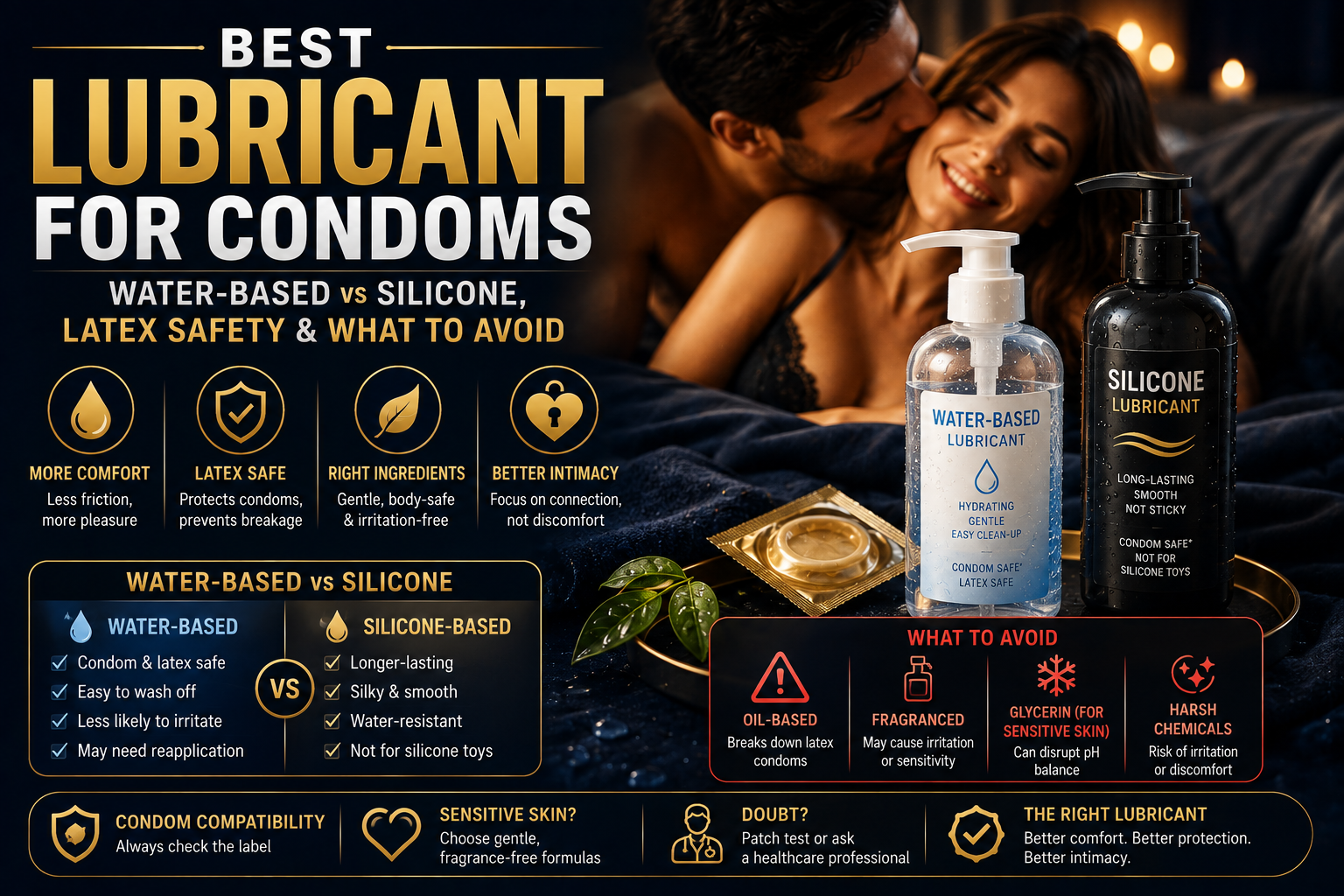
The best lubricant for condoms is not simply the slickest product or the one with the most appealing packaging. It is a lubricant that reduces friction, works with the specific condom material being used, does not unnecessarily irritate sensitive tissue, and supports correct condom use rather than increasing the chance of breakage or slippage.
That distinction matters because personal lubricants are not universally compatible with every condom. FDA’s current device classification explicitly states that a personal lubricant may or may not be compatible with natural-rubber latex, polyisoprene, and polyurethane condoms.
WHO likewise recommends correct and consistent condom use with condom-compatible lubricants and advises using water- or silicone-based products rather than oil-based lubricants with condoms.
So when TestoVerdict evaluates the best lubricant for condoms, we start with one question before anything else:
What is the condom made from?
That answer determines which lubricants make sense and which should be avoided.
Best Lubricant for Condoms: Quick Verdict
For most people using latex condoms, the easiest choices are:
Water-based lubricant — versatile, easy to clean, widely available.
Silicone-based lubricant — longer-lasting and often useful when more durable lubrication is needed.
For latex condoms, oil-based products should be avoided because they can weaken latex and increase the risk of condom failure. WHO specifically states that oil-based lubricants should not be used with condoms because they can contribute to breakage and slippage.
TestoVerdict quick comparison
| Lubricant Type | Latex Condoms | Longevity | Cleanup | Best Use |
|---|---|---|---|---|
| Water-based | Generally suitable when labeled compatible | Moderate | Easy | Everyday/general use |
| Silicone-based | Generally suitable when labeled compatible | Long | More persistent | Longer sessions, anal sex |
| Oil-based | Avoid with latex | Long | More difficult | Only when barrier compatibility is confirmed |
| Hybrid | Product-specific | Variable | Variable | Check exact formulation |
The best lubricant for condoms should always be chosen according to the actual barrier material, not by assuming one lube works with everything.
Why Lubricant Matters With Condoms
Lubricant serves a practical function: it reduces friction.
That can improve comfort and may also reduce the chance of condom slippage or breakage when an appropriate lubricant is used.
WHO states that using lubricant makes condoms less likely to break, slip or fall off and recommends water- or silicone-based lubricants.
This is why lubrication is not merely a pleasure accessory.
When used correctly, it can form part of the condom-use system.
The best lubricant for condoms therefore contributes to:
- comfort
- reduced friction
- easier penetration
- less dryness
- improved condom stability
- potentially lower risk of friction-related condom failure
But only when the lubricant is compatible with the condom.
Best Lubricant for Latex Condoms
For natural-rubber latex condoms, water-based and silicone-based lubricants are the safest general categories to investigate.
WHO technical guidance reports that water- and silicone-fluid-based lubricants have either no effect or can reduce condom failure rates, while oil-based lubricants cause latex to lose strength rapidly.
That makes the decision relatively straightforward.
Good starting options
- water-based lube
- silicone-based lube
- a product explicitly labeled compatible with natural-rubber latex condoms
Avoid
- petroleum jelly
- baby oil
- coconut oil
- cooking oil
- mineral oil
- body lotion
- massage oil
- other oil-based products
WHO’s technical guidance specifically lists multiple household oil-based products that should not be used with latex condoms.
Why Oil-Based Lubricants Damage Latex Condoms
Latex is vulnerable to oils.
WHO notes that natural-rubber latex condoms can rapidly lose strength when exposed to oil-based lubricants, increasing the risk of breakage.
This includes many products people sometimes use as improvised lubricants:
- petroleum jelly
- baby oil
- coconut oil
- palm oil
- cooking oil
- body lotion
- butter
- massage oils
So even if a product feels extremely slippery, that does not make it the best lubricant for condoms.
A lubricant that compromises the barrier defeats the purpose.
Water-Based Lubricant for Condoms
Water-based lubricant is often the easiest first choice.
Potential advantages include:
- broad availability
- easy cleanup
- relatively light feel
- compatibility with many condom materials
- broad range of viscosities
- good compatibility with many sex toys
WHO describes water-based lubricant as a common condom-compatible option.
The main downside is that some water-based formulations dry more quickly than silicone lubricants and may require reapplication.
That does not make them inferior.
For many consumers, water-based products remain the most practical best lubricant for condoms candidate.
Best Water-Based Lubricant for Condoms: What to Look For
A high-quality water-based product should ideally provide:
- clear condom-compatibility information
- full ingredient disclosure
- enough slip to reduce friction
- minimal unnecessary fragrance for sensitive users
- practical viscosity
- appropriate preservation
- clear instructions
For people prone to irritation, TestoVerdict generally prefers simpler formulations without unnecessary warming, cooling, fragrance or flavor.
The marketing word “natural” matters less than how the finished product actually performs.
Silicone-Based Lubricant for Condoms
Silicone-based lubricants generally last longer than water-based lubricants.
That makes them useful for situations involving:
- longer sexual activity
- anal sex
- repeated friction
- users who dislike frequent reapplication
WHO technical documentation describes silicone fluids as commonly used with condoms and notes that they have minimal effect on latex-film properties.
For many consumers, silicone is therefore an excellent candidate for the best lubricant for condoms.
The main caution involves silicone sex toys.
Some silicone-based lubricants may interact with some silicone toy materials, so users should check product-specific instructions.
Water-Based vs Silicone Lubricant for Condoms
This is the comparison most buyers actually need.
| Feature | Water-Based | Silicone-Based |
|---|---|---|
| Latex condom compatibility | Usually good | Usually good |
| Longevity | Moderate | Longer |
| Cleanup | Easier | More persistent |
| Reapplication | More common | Less common |
| Sensitive-skin options | Many | Many |
| Toy compatibility | Generally broad | Check silicone toys |
| Anal sex | Useful, may require reapplication | Often preferred for longevity |
| Price | Often lower | Often higher |
TestoVerdict verdict
For general use:
Water-based = best starting point
For longer-lasting slip:
Silicone-based = strong alternative
There is no universal winner.
The best lubricant for condoms depends on comfort, activity, sensitivity and the barrier material.
Best Lubricant for Polyisoprene Condoms
This is where consumers need more caution.
Non-latex does not automatically mean oil-compatible.
FDA specifically states that lubricant compatibility can differ across natural-rubber latex, polyisoprene and polyurethane condoms.
WHO technical guidance also notes that some synthetic condom materials can have their own lubricant-compatibility considerations.
Therefore, for polyisoprene condoms:
Do not assume. Check the condom manufacturer’s instructions.
A water-based lubricant is often the easiest conservative starting point.
Best Lubricant for Polyurethane Condoms
Polyurethane behaves differently from latex.
Some lubricant options that are unsuitable for latex may be compatible with polyurethane.
But again, the FDA makes the broader regulatory point that compatibility is product-specific.
So the best lubricant for condoms made from polyurethane should be chosen using:
- the condom labeling
- the lubricant labeling
- explicit compatibility statements
Do not rely on a general internet rule if both manufacturers provide more specific instructions.
Does Lubricant Make Condoms Safer?
Lubricant can reduce friction and can help reduce breakage or slippage when the lubricant is appropriate for the condom material.
WHO explicitly recommends condom-compatible lubricant and says lubrication can help reduce failure during use.
But lubricant does not make condom use foolproof.
Correct use still matters:
- use a new condom every time
- check expiration
- open carefully
- put it on correctly
- leave room at the tip
- use compatible lubricant
- hold the base during withdrawal
The best lubricant for condoms improves the system; it does not replace correct technique.
Can Too Much Lubricant Cause a Condom to Slip?
Potentially.
Lubrication reduces friction, which is beneficial, but an excessive amount in the wrong location could potentially contribute to unwanted movement.
The goal is adequate external lubrication—not creating so much internal slipperiness that the condom moves excessively.
Follow condom and lubricant instructions.
A correct fit remains essential.
No lubricant can compensate for a condom that is obviously too loose.
Best Lubricant for Condoms and Sensitive Skin
Sensitive-skin users need to solve two problems simultaneously:
- condom compatibility
- tissue tolerance
A fragrance-free, straightforward water-based or silicone-based formula is often a sensible starting point.
Possible irritants can include:
- fragrance
- flavors
- warming agents
- cooling agents
- certain preservatives
- individual formulation ingredients
Someone using the best lubricant for condoms from a barrier-compatibility perspective can still have a poor experience if the formula irritates their skin.
This is why TestoVerdict evaluates compatibility and sensitivity separately.
Best Lubricant for Condoms With Latex Allergy
If latex allergy is the concern, changing lubricant alone will not solve the problem.
The condom material itself may need to change.
Non-latex options include synthetic materials such as polyurethane and polyisoprene, depending on the product.
Then the lubricant must be matched to the new condom material.
This is another reason the phrase best lubricant for condoms cannot be answered without identifying the condom first.
Condom-Safe Lubricant vs “Personal Lubricant”
These phrases are not automatically equivalent.
FDA’s current classification explicitly says a personal lubricant may or may not be compatible with different condom materials.
Therefore:
personal lubricant ≠ automatically condom-safe
Look for explicit compatibility information.
If the label says nothing about condoms, do not assume.
Best Lubricant for Condoms During Anal Sex
Anal sex generally requires generous lubrication because the anus does not produce adequate natural lubrication for intercourse.
WHO specifically recommends plenty of lubricant during anal sex and notes that lubrication can help reduce condom breakage and slippage.
For latex-condom use, water- or silicone-based lubricants are the preferred general categories.
Silicone often has an advantage because it lasts longer.
So for anal sex, the best lubricant for condoms is often a long-lasting condom-compatible formula rather than the thinnest or lightest lubricant available.
Best Lubricant for Condoms During Vaginal Sex
For vaginal intercourse, either water- or silicone-based lubricant can work well.
The choice depends on:
- natural lubrication level
- sensitivity
- desired texture
- duration
- condom material
- ease of cleanup
If dryness is mild and occasional, water-based lube may be sufficient.
If repeated reapplication is frustrating, silicone may be more practical.
Again, compatibility comes first.
Best Lubricant for Thin Condoms
Thin condoms do not require a fundamentally different type of lubricant.
The same material rules apply.
If a thin condom is made from latex:
water-based or silicone-based lubricant is generally appropriate; oil-based products should be avoided.
The idea that thin condoms require “special” lubricant is mostly marketing unless the manufacturer specifically says so.
This is a useful internal connection with TestoVerdict’s Thin Condoms guide.
Best Lubricant for Condoms for Sensitive Skin
For irritation-prone users, TestoVerdict would start with:
- fragrance-free
- unflavored
- no warming/cooling sensation
- straightforward formula
- explicit condom compatibility
This naturally overlaps with our Lubricant for Sensitive Skin guidance.
A good condom lubricant should reduce friction without introducing another reason for discomfort.
Best Lubricant for Condoms When Trying to Conceive
This situation requires a different lens.
If conception is the goal, ordinary condom use is generally not part of intercourse intended to achieve pregnancy.
But some couples may use condoms at other times while also using lubricant during fertile-window intercourse.
FDA has a separate classification for personal lubricants specifically demonstrated to be compatible with sperm, oocytes and embryos and suitable for couples trying to conceive.
So a product can be:
condom-compatible
without necessarily being:
fertility-compatible
Those are different claims.
Consumers trying to conceive should verify the one relevant to their actual use.
Does Glycerin Matter in Condom Lubricant?
Glycerin appears in many water-based formulas.
Its presence does not automatically determine whether a lubricant is condom-safe.
Condom compatibility is primarily a question of the finished formulation’s interaction with the barrier material.
Sensitive-skin users may still care about the complete ingredient profile, but glycerin-free and condom-safe are not synonyms.
This is why TestoVerdict avoids ingredient fear lists.
We evaluate the complete formulation.
Does pH Matter for Condom Lubricant?
pH can matter for tissue compatibility, particularly for vaginally used products.
But pH does not tell you whether a product will weaken a latex condom.
A lubricant can have a seemingly reasonable pH and still be unsuitable for a particular barrier material.
So when choosing the best lubricant for condoms, think of pH and condom compatibility as separate product attributes.
Both can matter.
Does Osmolality Matter?
Osmolality relates to the concentration of dissolved particles in a lubricant.
It has been an important topic in sexual-health lubricant guidance because highly hyperosmolar formulas may affect epithelial tissue.
However, osmolality does not replace the need for direct condom compatibility.
A technically sophisticated review should therefore consider:
condom compatibility + tissue compatibility
rather than treating one as a substitute for the other.
Natural Lubricant for Condoms: Is Natural Better?
No.
“Natural” does not mean condom-compatible.
In fact, some of the most popular natural lubricant substitutes are oils—and oils are exactly what latex-condom users should avoid.
Examples include:
- coconut oil
- olive oil
- body oils
- natural massage oils
WHO specifically warns against oil-based lubricants with condoms.
So a synthetic-looking water-based lubricant can easily be a better best lubricant for condoms candidate than a 100% natural oil.
Can You Use Coconut Oil With Condoms?
With latex condoms:
No.
WHO includes coconut oil among household products that should not be used with natural-rubber latex condoms.
For other condom materials, consult the product instructions rather than assuming.
Can You Use Vaseline With Condoms?
Not with latex condoms.
Petroleum jelly is oil-based and can weaken latex.
WHO specifically lists petroleum jelly among products that should not be used with natural-rubber latex condoms.
This is one of the clearest examples of why household products are not necessarily appropriate sexual lubricants.
Can You Use Baby Oil With Condoms?
Not with latex condoms.
WHO lists baby oil among products that should not be used with natural-rubber latex condoms because of the risk of weakening the material.
Can You Use Lotion With Condoms?
Body or hand lotion should not be assumed compatible with latex condoms.
WHO lists body/hand lotions among products that can damage latex.
If you need more lubrication, use a product specifically designed and labeled for compatible condom use.
Can You Use Saliva as Lubricant With Condoms?
Saliva is not a reliable substitute for proper personal lubricant.
It tends to dry quickly and may not provide sustained friction reduction.
If comfort or condom breakage is a concern, a proper condom-compatible lubricant is the more rational choice.
For the best lubricant for condoms, use a purpose-designed product rather than improvising.
Best Lubricant for Condoms and Sex Toys
If condoms are being used over sex toys, both condom material and toy material matter.
Water-based lubricant is often the broadest-compatibility option.
Silicone lubricant may be condom-compatible but could interact with some silicone toys.
Again:
read both product instructions.
The best choice is one that is compatible with:
condom + toy + tissue
not merely one of the three.
Do Lubricated Condoms Need Extra Lubricant?
Sometimes.
Many condoms come pre-lubricated.
But the supplied amount may not be enough for every activity or duration.
Additional compatible lubricant can be used when needed.
WHO recognizes additional personal lubricant use with condoms and provides guidance specifically because extra lubrication is common and can help reduce friction-related failure.
The key is using the right product.
Can Lubricant Cause Condom Breakage?
Yes, if the lubricant is incompatible with the condom material.
This is especially clear with latex and oil-based products.
WHO’s technical review concluded that oil-based lubricants increase rates of condom breakage or slippage, whereas non-oil-based products can have no effect or reduce failure rates.
So “more slippery” is not always “safer.”
Chemical compatibility matters.
Why the Condom Material Comes First
This is the most important TestoVerdict rule in the article.
Before asking:
What is the best lubricant for condoms?
Ask:
What is my condom made from?
Possible materials include:
- natural-rubber latex
- polyisoprene
- polyurethane
- other synthetic materials
- natural membrane
Once the material is known, compatibility becomes much easier to evaluate.
How to Choose the Best Lubricant for Condoms
Use this process.
1. Identify the condom material
Never skip this.
2. Check the condom instructions
Manufacturers often provide lubricant guidance.
3. Check the lubricant label
Look for explicit compatibility.
4. Choose the base
For latex, water- or silicone-based is generally preferred.
5. Consider sensitivity
Remove unnecessary fragrance or sensory additives if irritation-prone.
6. Consider duration
Longer activity may favor silicone.
7. Consider toy use
If relevant, confirm toy compatibility too.
8. Consider fertility needs separately
Condom compatibility and sperm compatibility are not the same thing.
TestoVerdict Buying Checklist
Before buying the best lubricant for condoms, check:
- What material is my condom?
- Does the lubricant explicitly mention condom compatibility?
- Is it water-, silicone-, oil-, or hybrid-based?
- If using latex, have I avoided oil-based products?
- Is the full ingredient list available?
- Is it fragrance-free if I’m irritation-prone?
- Is it long-lasting enough for the intended activity?
- Is it compatible with sex toys if relevant?
- Is fertility compatibility needed?
- Does the manufacturer provide clear instructions?
- Are claims realistic?
- Is the seller trustworthy?
Red Flags When Buying Condom Lubricant
TestoVerdict would be cautious if a product:
- doesn’t identify its base
- doesn’t discuss condom compatibility
- claims all natural oils are condom-safe
- encourages petroleum jelly with latex condoms
- claims universal compatibility without specifics
- hides the ingredient list
- makes STI-prevention claims
- promises zero irritation
- claims fertility compatibility without evidence
- relies entirely on “organic” or “natural” marketing
The best lubricant for condoms should make compatibility obvious.
Best Lubricant for Condoms: TestoVerdict Comparison Framework
When we begin ranking individual brands, we will score products on:
Condom Compatibility
Does the product clearly identify which condom materials it works with?
Friction Reduction
Does the formula provide enough slip?
Longevity
How quickly does it require reapplication?
Sensitive-Skin Suitability
Are unnecessary irritants minimized?
Ingredient Transparency
Is the formula disclosed?
Technical Transparency
Does the manufacturer provide useful information such as compatibility testing?
Value
Does the price make sense for the formula and bottle size?
Marketing Accuracy
Are safety and compatibility claims realistic?
This is much more useful than simply ranking lubricants by popularity.
Frequently Asked Questions About the Best Lubricant for Condoms
What is the best lubricant for condoms?
For most latex-condom users, water-based or silicone-based personal lubricants that explicitly state condom compatibility are the best starting options.
Is water-based lubricant safe with condoms?
Water-based lubricants are commonly used with condoms and are generally suitable for latex when labeled compatible.
Is silicone lubricant safe with latex condoms?
Silicone-based lubricants are generally compatible with natural-rubber latex condoms and are commonly used because of their long-lasting slip.
Can oil-based lubricant be used with condoms?
Oil-based products should not be used with natural-rubber latex condoms because they can weaken latex and increase breakage or slippage.
Can I use coconut oil with condoms?
Not with latex condoms. WHO specifically lists coconut oil among products that should not be used with natural-rubber latex condoms.
Can I use Vaseline with condoms?
Not with latex condoms. Petroleum jelly can damage latex.
Can I use baby oil with condoms?
Not with latex condoms. Baby oil is another oil-based product WHO advises against.
Can lubricant prevent condoms from breaking?
Compatible lubricant can reduce friction and may lower the chance of breakage or slippage during use.
Do pre-lubricated condoms need extra lubricant?
Not always, but additional compatible lubricant can be used if more slip is needed.
What is the best lubricant for thin condoms?
The same material rules apply. If the thin condom is latex, use a compatible water- or silicone-based lubricant.
What is the best lubricant for condoms and sensitive skin?
A straightforward fragrance-free water- or silicone-based lubricant with explicit condom compatibility is a sensible starting point.
Is natural lubricant better with condoms?
Not automatically. Many natural oils are incompatible with latex condoms.
Can lubricant make condoms slip?
Compatible lubricant can reduce harmful friction, but excessive lubrication combined with poor fit may contribute to unwanted movement. Correct fit still matters.
Is lubricant safe when trying to conceive?
Ordinary lubricant should not automatically be assumed sperm-compatible. FDA has a separate classification for products specifically compatible with sperm, oocytes and embryos.
Are all personal lubricants condom-safe?
No. FDA explicitly states that personal lubricants may or may not be compatible with latex, polyisoprene or polyurethane condoms.
The TestoVerdict Verdict: What Is the Best Lubricant for Condoms?
The best lubricant for condoms is the product that works with the condom material you actually use.
For the enormous number of people using natural-rubber latex condoms, the answer is relatively straightforward:
Choose a compatible water-based or silicone-based lubricant. Avoid oil-based products.
WHO’s current guidance recommends water- or silicone-based lubricants for condom use and warns that oils can increase breakage and slippage.
FDA reinforces the importance of product-specific compatibility by stating that personal lubricants may or may not work with latex, polyisoprene and polyurethane condoms.
That means consumers should stop thinking of lubricant as one universal category.
A fantastic lubricant for one barrier material could be inappropriate for another.
For TestoVerdict, our hierarchy is therefore:
1. Condom compatibility
2. Adequate friction reduction
3. Tissue tolerance
4. Longevity
5. Ingredient transparency
6. Value
The packaging can say natural, premium, organic, silky, or ultra-sensitive.
None of those words matters if the lubricant compromises the condom.
Likewise, the cheapest water-based gel isn’t automatically the best choice if it dries so quickly that friction becomes uncomfortable.
The right product needs balance.
For most latex-condom users, water-based lubricant remains the safest general starting point because it is easy to use, easy to clean and widely compatible. Silicone-based lubricant becomes especially attractive when longer-lasting lubrication is needed.
Oil-based products belong in a different conversation and should not be paired with latex.
And when fertility matters, remember that condom-safe does not automatically mean sperm-safe. FDA recognizes a separate category of lubricants specifically compatible with sperm, oocytes and embryos.
So before TestoVerdict recommends a particular bottle as the best lubricant for condoms, we want one thing absolutely clear:
Does the product make condom use safer and more comfortable—or does the marketing simply make it sound that way?
Research. Compare. Use Compatibly.
Sources & References
- U.S. Food and Drug Administration — Personal Lubricant Product Classification (NUC). FDA defines personal lubricants and states that products may or may not be compatible with natural-rubber latex, polyisoprene and polyurethane condoms.
FDA — Personal Lubricant Classification - World Health Organization — Recommendations on Self-Care Interventions: Availability of Lubricants During Sexual Activity. WHO recommends condom-compatible lubricants and advises against oil-based products with condoms.
WHO — Lubricants During Sexual Activity - World Health Organization — Condoms: Questions and Answers. WHO explains that lubricant can reduce condom breakage and slippage and recommends water- or silicone-based lubricant.
WHO — Condom and Lubricant Guidance - WHO/UNFPA/FHI — Use and Procurement of Additional Lubricants for Male and Female Condoms. Technical guidance detailing why oil-based products can weaken natural-rubber latex and discussing water- and silicone-based lubricant performance.
WHO — Condom Lubricant Technical Guidance - WHO/UNFPA — Male Latex Condom Specification, Prequalification and Guidelines for Procurement. Technical specification discussing silicone fluid, water-based lubricant and oil incompatibility with latex.
WHO — Male Latex Condom Specifications - U.S. Food and Drug Administration — Gamete, Fertilization and Embryo-Compatible Personal Lubricant Classification (PEB). FDA category for lubricants compatible with sperm, oocytes and embryos and intended for couples trying to conceive.
FDA — Fertility-Compatible Lubricants
Medical & Sexual Health Disclaimer: This article provides general consumer information and does not constitute individualized medical advice. Always follow the condom and lubricant manufacturers’ instructions. Stop using any product that causes significant burning, swelling, rash, itching or persistent discomfort. Condoms reduce but do not eliminate pregnancy or STI risk, and correct, consistent use remains essential.