
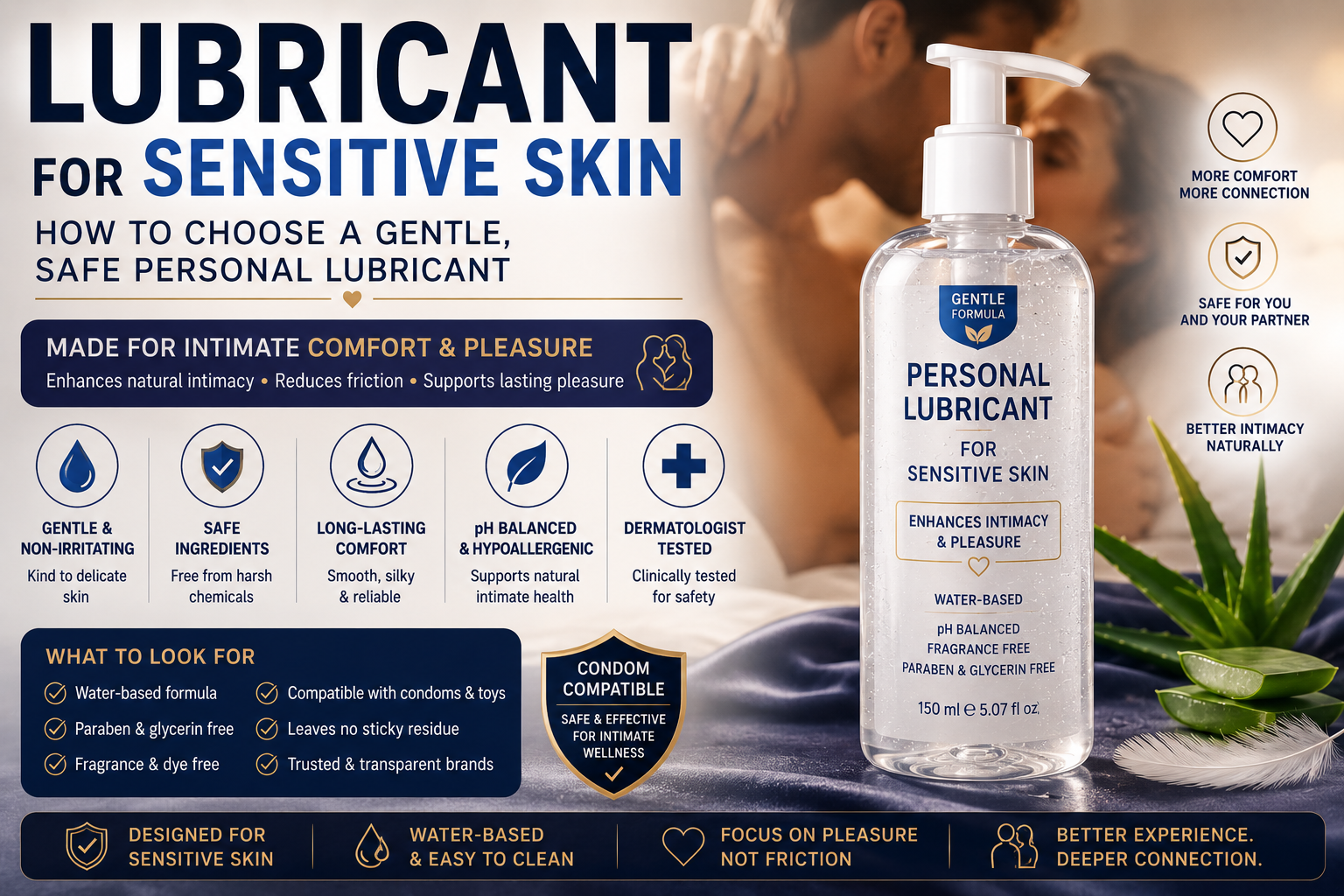
A lubricant for sensitive skin should do something deceptively simple: reduce friction without introducing another source of burning, itching or irritation. Yet choosing one can be surprisingly complicated. Personal lubricants vary in their base ingredients, preservatives, flavorings, fragrances, pH, osmolality and compatibility with condoms.
For someone who has previously experienced irritation, simply buying a bottle labeled “gentle,” “natural” or “sensitive” may not be enough.
The better approach is to understand why some lubricants irritate sensitive tissue, which ingredients deserve closer inspection, how water-based and silicone-based formulas differ, and when recurring irritation may indicate something other than the lubricant itself.
That distinction matters. The American College of Obstetricians and Gynecologists (ACOG) notes that lubricants can help with vaginal dryness and painful sex, while also identifying lubricants among substances that can trigger contact dermatitis in some people.
This TestoVerdict guide examines how to choose a lubricant for sensitive skin based on formulation and evidence rather than front-label marketing.
Quick Verdict: What Should You Look for?
For many people with sensitivity, a sensible starting point is a relatively simple water-based or silicone-based lubricant without unnecessary fragrance, flavoring or warming/cooling additives.
ACOG describes water-soluble lubricants as a good option for people experiencing vaginal irritation or sensitivity, while noting that silicone lubricants generally remain slippery longer.
But “water-based” alone does not guarantee gentleness.
When comparing products, TestoVerdict would prioritize:
| Feature | What to Look For |
|---|---|
| Formula | Relatively simple ingredient list |
| Fragrance | Preferably fragrance-free if irritation-prone |
| Flavoring | Usually unnecessary for sensitive users |
| Warming/cooling agents | Consider avoiding if previously irritating |
| Condom compatibility | Explicitly stated on product labeling |
| pH | Appropriate for intended use |
| Osmolality | Manufacturer transparency is valuable |
| Ingredients | Fully disclosed |
| Claims | Specific rather than vague “natural” marketing |
| Previous reactions | Avoid known personal triggers |
The best lubricant for sensitive skin is not necessarily the product with the shortest ingredient list, but unnecessary extras provide more variables when you’re trying to identify what your body tolerates.
What Does “Sensitive Skin” Mean With Personal Lubricants?
Sensitive skin isn’t one single medical diagnosis.
Someone searching for a lubricant for sensitive skin may actually be dealing with:
- irritation after sex;
- vaginal dryness;
- vulvar sensitivity;
- penile skin irritation;
- contact dermatitis;
- menopause-related dryness;
- sensitivity to fragrance;
- sensitivity to particular preservatives;
- discomfort caused mainly by friction;
- an underlying infection or dermatological condition.
This is important because changing lubricants will not solve every cause of genital discomfort.
ACOG explains that vulvar contact dermatitis can result from exposure to irritating substances, including perfumed soaps, douches and lubricants, and may cause itching, burning and pain.
Therefore, if irritation persists even after switching products—or occurs when no lubricant is being used—it is worth considering whether the lubricant is really the cause.
Why Lubricant Can Help Sensitive Skin
Friction itself can be irritating.
A lubricant reduces friction between surfaces during sexual activity. The FDA describes personal lubricants as products intended to moisturize and lubricate penile and/or vaginal tissue, supplement natural lubrication and improve comfort during intimate activity.
This creates an important paradox:
A poorly tolerated lubricant can cause irritation, but insufficient lubrication can also contribute to discomfort.
The goal when choosing a lubricant for sensitive skin is therefore not necessarily to use as little lubricant as possible.
It is to find an adequately slippery formulation that the individual tolerates well.
Best Type of Lubricant for Sensitive Skin
There are three broad categories consumers encounter most often:
- water-based;
- silicone-based;
- oil-based.
Each has advantages and disadvantages.
Water-Based Lubricant for Sensitive Skin
Water-based products are usually the easiest starting point.
Potential advantages include:
- widely available;
- generally easy to wash away;
- typically compatible with latex condoms when labeled accordingly;
- many simple formulations available;
- broad choice of textures and viscosities.
ACOG specifically describes water-soluble lubricants as a good choice for people experiencing vaginal irritation or sensitivity.
The disadvantage is longevity.
Water-based lubricants can dry out more quickly than silicone formulas and may require reapplication.
Importantly, not every water-based lubricant for sensitive skin has the same formulation. Humectants, preservatives, fragrance and other ingredients can vary substantially.
So don’t evaluate a product based solely on the words “water based.”
Silicone-Based Lubricant for Sensitive Skin
Silicone-based lubricants are another strong option for some sensitive users.
ACOG notes that silicone lubricants tend to last longer and remain more slippery than water-soluble lubricants.
That longevity can potentially mean less reapplication.
Silicone formulations also tend to contain fewer water-dependent preservation requirements than conventional water-based products.
However, compatibility with silicone sex toys should be checked according to the toy and lubricant manufacturers’ instructions because some combinations may affect the toy’s material.
For people who find that water-based products dry too quickly, a silicone lubricant for sensitive skin may therefore be worth considering.
Oil-Based Lubricant for Sensitive Skin
“Natural” oils can sound particularly appealing to consumers with sensitive skin.
But natural does not automatically mean suitable.
There is an especially important problem when condoms are involved.
FDA guidance warns against using oil-based lubricants such as petroleum jelly, mineral oil, vegetable oil and cold cream with natural-rubber latex condoms because oils may damage the condom.
ACOG likewise advises avoiding oil-based lubricants when condom integrity is relevant.
Therefore, someone choosing a lubricant for sensitive skin should consider both skin tolerance and barrier-method compatibility.
Water-Based vs Silicone Lubricant for Sensitive Skin
Neither category universally wins.
| Factor | Water-Based | Silicone-Based |
|---|---|---|
| Sensitive-skin options | Many | Many |
| Longevity | Moderate | Usually longer |
| Cleanup | Easy | Can require more washing |
| Latex condoms | Usually compatible when labeled | Often compatible; verify label |
| Silicone toys | Usually easier choice | Compatibility should be checked |
| Reapplication | May be needed more often | Usually less frequent |
| Ingredient complexity | Varies greatly | Often different/simpler base system |
| Best choice | Depends on individual tolerance | Depends on individual tolerance |
For a first experiment, a straightforward fragrance-free water-based formula is a reasonable place to start.
If frequent drying or reapplication creates friction, silicone may be worth comparing.
Ingredients in Lubricant for Sensitive Skin: What Actually Matters?
This is where consumers should look beyond advertising.
A label may say:
SENSITIVE
NATURAL
CLEAN
PURE
GENTLE
Those terms do not tell you everything about the formula.
A better evaluation examines the actual ingredients.
Fragrance
Fragrance is rarely necessary for lubrication.
For someone already prone to irritation, eliminating unnecessary fragrance is a sensible way to reduce variables.
ACOG specifically identifies perfumed products among potential vulvar irritants.
This doesn’t mean every fragranced lubricant causes irritation in every person.
It means that if your goal is finding a lubricant for sensitive skin, fragrance provides little functional benefit while introducing another potential exposure.
Flavors
Flavored lubricants are designed primarily for sensory experience rather than sensitive-skin simplicity.
Flavoring does not automatically make a product unsafe, but someone who repeatedly experiences irritation may prefer to start with a simpler unflavored formula.
The principle is straightforward:
Don’t add ingredients you don’t need while trying to identify ingredients you tolerate.
Warming and Cooling Ingredients
Warming, cooling and tingling lubricants intentionally create additional sensations.
Some consumers enjoy them.
For a person already experiencing burning or sensitivity, however, a product designed to create sensation may make it harder to determine whether discomfort is expected or represents irritation.
TestoVerdict would generally start sensitive users with a conventional lubricant before experimenting with sensation-enhancing formulas.
What About Glycerin?
Glycerin is common in water-based personal lubricants because it functions as a humectant.
It is frequently portrayed online as an ingredient that everyone should avoid.
The evidence is more nuanced.
One important technical issue involves osmolality, which describes the concentration of dissolved particles in a solution.
WHO guidance has discussed glycerol and propylene glycol because higher concentrations of glycols can contribute to high lubricant osmolality. WHO’s technical guidance has recommended an interim maximum osmolality of 1,200 mOsm/kg for procurement and notes that an ideal lubricant would be closer to physiologic osmolality.
This does not mean:
glycerin = dangerous.
It means formulation matters.
The concentration and overall composition of a lubricant for sensitive skin matter more than whether a familiar ingredient appears somewhere on the label.
What Is Lubricant Osmolality?
Osmolality is one of the most technically important—and least understood—issues in personal lubricant formulation.
It describes the concentration of dissolved particles relative to the amount of solvent.
Why does this matter?
Laboratory and limited human research has raised concern that highly hyperosmolar lubricants may affect epithelial tissue.
WHO guidance notes that normal vaginal secretions are approximately 260–290 mOsm/kg and semen approximately 250–380 mOsm/kg. Its technical guidance describes 380 mOsm/kg as an ideal upper target, while using 1,200 mOsm/kg as an interim procurement threshold because many commercial products exceed the ideal level.
Updated WHO consultation material likewise specifies less than 1,200 mOsm/kg for water-based lubricant procurement.
This makes osmolality a meaningful consideration when evaluating a lubricant for sensitive skin.
But consumers face a practical problem:
Many brands don’t display osmolality prominently on retail packaging.
What About pH?
pH is another formulation characteristic worth understanding.
The appropriate pH depends partly on where a product is intended to be used.
WHO’s 2025 consultation document for water-based lubricants specifies a pH range of 4.0–7.0, with a stated tolerance, for the products covered by that procurement specification.
But consumers should resist turning one number into a universal buying rule.
A lubricant’s intended use, formulation and testing matter together.
When TestoVerdict eventually compares individual products, manufacturer transparency regarding pH and osmolality will count positively.
Is “Hypoallergenic” the Same as Safe for Everyone?
No.
There is no personal lubricant that can guarantee zero irritation for every user.
Individual sensitivity varies.
A person can react to an ingredient that thousands of other consumers tolerate perfectly well.
Therefore, when evaluating a lubricant for sensitive skin, TestoVerdict places more weight on:
- ingredient transparency;
- appropriate testing;
- intended use;
- condom compatibility;
- absence of unnecessary irritants;
- manufacturer documentation;
than on a single front-label adjective.
Natural Lubricant for Sensitive Skin: Is Natural Better?
Not automatically.
This is one of the biggest misconceptions in the category.
“Natural” is primarily a description or marketing position—not proof of superior tissue compatibility.
Plant-derived ingredients can cause reactions.
Essential oils can irritate.
Natural oils can be incompatible with latex condoms.
A synthetic ingredient can be extremely well characterized and well tolerated.
Therefore, TestoVerdict does not automatically give a higher rating to a natural lubricant for sensitive skin.
We care about the finished formulation, not whether the ingredient names sound botanical.
Lubricant for Sensitive Skin and Condoms
This deserves its own section because the wrong combination can undermine protection.
FDA guidance for natural-rubber latex condoms recommends water-based lubricant and warns that oil-based products such as petroleum jelly, mineral oil and vegetable oil can damage latex condoms.
The FDA also recognizes an ASTM standard specifically designed to assess compatibility between personal lubricants and natural-rubber latex condoms.
Meanwhile, FDA’s personal-lubricant classification explicitly acknowledges that individual products may or may not be compatible with latex, polyisoprene and/or polyurethane condoms.
That means consumers shouldn’t simply assume.
TestoVerdict rule:
Read the lubricant label AND the condom instructions.
When using a lubricant for sensitive skin with condoms, explicit compatibility information is better than guesswork.
Best Lubricant for Sensitive Skin With Latex Condoms
A straightforward water-based formula that is explicitly labeled compatible with latex condoms is generally the easiest starting point.
Silicone-based formulas may also be compatible, depending on the product.
Oil-based lubricants should not be paired with natural-rubber latex condoms.
This is one situation where the choice of lubricant for sensitive skin has implications beyond comfort.
Condom integrity matters for pregnancy and STI protection.
Lubricant for Sensitive Skin and Vaginal Dryness
Vaginal dryness is common and can occur for many reasons.
Potential contributors include:
- menopause;
- perimenopause;
- breastfeeding;
- hormonal changes;
- certain medications;
- insufficient arousal;
- medical treatment;
- individual physiology.
ACOG recommends over-the-counter lubricants and vaginal moisturizers as options for vaginal dryness. Lubricants primarily reduce discomfort during intercourse, whereas moisturizers are intended to provide longer-lasting moisture.
That distinction is useful.
A lubricant for sensitive skin can help reduce friction during sex, but it is not necessarily a treatment for the underlying cause of persistent dryness.
Personal Lubricant vs Vaginal Moisturizer
These products are often confused.
Personal lubricant
Primarily used around sexual activity to reduce friction.
Vaginal moisturizer
Typically used regularly to help manage ongoing vaginal dryness.
Someone experiencing occasional friction may only need lubricant.
Someone experiencing persistent dryness outside sexual activity may need a different approach.
ACOG notes that both moisturizers and lubricants can help with vaginal dryness, while other treatment options may be appropriate depending on the cause.
Lubricant for Sensitive Skin During Menopause
Menopause can reduce estrogen levels and contribute to vulvovaginal dryness and discomfort.
ACOG identifies lubricants and vaginal moisturizers as nonprescription options for symptoms associated with genitourinary syndrome of menopause (GSM).
For someone experiencing menopause-related discomfort, choosing a lubricant for sensitive skin may therefore improve comfort during sexual activity.
However, persistent symptoms may warrant discussion with a clinician because other treatments are available.
Lubricant for Sensitive Skin After Childbirth
Hormonal changes after pregnancy—and particularly during breastfeeding—can contribute to vaginal dryness.
ACOG specifically notes that vaginal dryness can occur after childbirth, particularly while breastfeeding, and that lubricants can be used to help.
A gentle lubricant for sensitive skin may therefore be useful when intercourse resumes.
But postpartum pain can also result from healing, perineal injury, pelvic-floor issues and other causes.
Persistent or significant pain deserves medical evaluation rather than repeated experimentation with lubricants.
Lubricant for Sensitive Skin for Men
Sensitive-skin lubrication isn’t exclusively a women’s-health topic.
Men can experience:
- friction;
- penile skin irritation;
- reactions to fragrance;
- reactions to lubricant ingredients;
- reactions to latex;
- irritation from repeated sexual activity.
The same basic principle applies.
A lubricant for sensitive skin for men should provide adequate slip without unnecessary sensory additives when those additives have previously caused discomfort.
If irritation repeatedly occurs after condom use, the lubricant may not necessarily be responsible. Latex sensitivity or another product ingredient could potentially contribute.
Persistent penile irritation, lesions, discharge, swelling or pain warrants appropriate medical evaluation.
Can Personal Lubricant Cause Burning?
Yes, some people experience burning after applying particular lubricants.
But burning doesn’t automatically identify the offending ingredient.
Potential explanations include:
- individual ingredient sensitivity;
- fragrance;
- warming/cooling agents;
- already-irritated tissue;
- contact dermatitis;
- infection;
- another underlying condition.
If a new lubricant for sensitive skin immediately causes significant burning, continuing to use it simply because the bottle says “gentle” makes little sense.
Stop using the suspected product and wash it away according to its instructions.
Persistent or severe symptoms deserve professional assessment.
Can Lubricant Cause Itching?
It can contribute to itching in someone who reacts to the formulation.
ACOG lists lubricants among substances that may trigger vulvar contact dermatitis, which can cause itching, burning and pain.
But itching can also have other causes.
For example, infections and dermatological conditions may produce similar symptoms.
Therefore, repeatedly switching to another lubricant for sensitive skin without investigating ongoing symptoms can delay identification of the actual cause.
Does Lubricant Cause Yeast Infections?
This question requires careful wording.
It is common online to see broad claims that particular lubricant ingredients automatically “cause yeast infections.”
That is too strong.
If someone repeatedly experiences symptoms suggestive of infection after using a particular product, medical evaluation can help distinguish irritation from an actual infection.
Burning and itching are symptoms—not diagnoses.
A responsible lubricant for sensitive skin guide should not encourage self-diagnosis based solely on timing.
Lubricant for Sensitive Skin When Trying to Conceive
This is a special case.
Consumers trying to conceive should not assume that every ordinary personal lubricant is sperm-friendly.
The FDA has a distinct classification for personal lubricants demonstrated to be compatible with sperm, oocytes and embryos and intended for couples trying to conceive or fertility procedures.
Therefore, if pregnancy is the goal, look specifically for a lubricant cleared/labeled for fertility compatibility rather than assuming that “natural,” “sensitive” or “water-based” means sperm-compatible.
A lubricant for sensitive skin and a fertility-compatible lubricant answer two different questions.
Ideally, a consumer needing both characteristics should seek a product documented for both purposes.
Should You Patch-Test a Personal Lubricant?
Patch testing sounds straightforward, but genital tissue differs from ordinary skin.
Testing a tiny amount externally may identify an obvious immediate reaction, but it cannot guarantee that a product will be tolerated during its intended use.
More importantly, don’t apply a product somewhere the manufacturer does not recommend.
The strongest approach when trying a new lubricant for sensitive skin is to:
- follow the product instructions;
- begin conservatively;
- stop if significant irritation occurs;
- avoid repeatedly exposing already-irritated tissue.
How Much Lubricant Should You Use?
There is no universal amount appropriate for every person or every activity.
Use enough to reduce uncomfortable friction and reapply as needed according to the product directions.
Too little lubrication can defeat the purpose.
A lubricant for sensitive skin should make activity more comfortable—not require tolerating increasing friction because you’re afraid to use enough product.
If a water-based lubricant repeatedly dries out too quickly, switching formulation may make more sense than constantly using tiny amounts.
Ingredients We Would Examine When Reviewing Sensitive-Skin Lubricants
TestoVerdict won’t automatically blacklist an ingredient merely because social media calls it “toxic.”
Instead, our product reviews will examine the whole formulation.
Important questions include:
Does it contain fragrance?
Potentially unnecessary for a sensitivity-focused formula.
Is it flavored?
Again, potentially unnecessary.
Does it contain warming or cooling additives?
These may not suit people prone to burning.
What humectants does it use?
Glycerin and propylene glycol can influence formulation properties including osmolality.
What preservatives are used?
Water-containing products require appropriate microbial control. “Preservative-free” should therefore not automatically be treated as superior without considering the entire formulation and packaging.
Does the manufacturer disclose pH?
Useful information.
Does it disclose osmolality?
Even better.
Is condom compatibility documented?
Essential for users relying on condoms.
This approach gives consumers much more useful information than simply labeling one product the best lubricant for sensitive skin based on reviews.
What We Would Avoid in a First Sensitive-Skin Trial
For someone with a history of unexplained lubricant irritation, TestoVerdict would initially simplify.
We would generally avoid starting with a product whose main selling proposition is:
- intense warming;
- cooling;
- tingling;
- strong fragrance;
- elaborate flavoring;
- novelty sensations.
This does not mean those products are inherently unsafe.
It means they complicate the search for a well-tolerated lubricant for sensitive skin.
Once a person knows what basic formulations they tolerate, experimentation becomes easier.
How to Choose a Lubricant for Sensitive Skin
Use this practical checklist.
1. Decide Where and How It Will Be Used
Vaginal use?
Penile use?
With condoms?
With sex toys?
Trying to conceive?
These factors change the requirements.
2. Start With a Straightforward Formula
For sensitivity, simplicity is useful.
3. Read the Full Ingredient List
Don’t rely only on “natural” or “gentle.”
4. Check Condom Compatibility
Especially if using latex or polyisoprene barriers.
5. Consider Water-Based vs Silicone
Water-based is a practical starting point; silicone offers longer-lasting lubrication.
6. Look for Manufacturer Transparency
pH, osmolality, testing and compatibility information are valuable.
7. Pay Attention to Your Own History
A product tolerated by millions can still irritate one person.
8. Stop if a Product Causes Significant Irritation
Don’t force yourself to “get used to it.”
9. Investigate Persistent Symptoms
Not every burning or itching problem is caused by lubricant.
TestoVerdict Sensitive-Skin Buying Checklist
Before purchasing a lubricant for sensitive skin, ask:
- Is the full ingredient list disclosed?
- Is the product intended for the way I plan to use it?
- Is it fragrance-free if fragrance bothers me?
- Does it avoid unnecessary warming/cooling effects?
- Is condom compatibility clearly stated?
- Is toy compatibility stated where relevant?
- Does the manufacturer provide pH information?
- Does the manufacturer provide osmolality information?
- Are safety claims specific and credible?
- Does the company provide genuine contact information?
- Is the product fertility-compatible if I’m trying to conceive?
- Are there fewer unnecessary ingredients than competing formulas?
- Does the price reflect formulation quality rather than marketing?
Sensitive-Skin Lubricant Red Flags
TestoVerdict would scrutinize a product more closely if it:
- claims it can never cause irritation;
- calls itself “100% hypoallergenic” without meaningful context;
- hides the ingredient list;
- makes disease-treatment claims;
- gives no condom-compatibility information;
- claims every natural ingredient is automatically safe;
- uses “chemical-free” marketing;
- implies pH alone proves safety;
- uses fear-based claims about competing ingredients;
- markets itself as fertility-friendly without appropriate evidence;
- makes vague laboratory-testing claims without explaining what was tested.
A credible lubricant for sensitive skin should be sold through transparency, not fear.
Water-Based vs Silicone vs Oil-Based: TestoVerdict Comparison
| Lubricant Type | Sensitive-Skin Potential | Longevity | Latex Condom Consideration | Main Limitation |
|---|---|---|---|---|
| Water-based | Good starting point | Moderate | Usually suitable when labeled compatible | Can dry faster |
| Silicone-based | Potentially excellent | High | Often compatible; verify label | Check silicone-toy compatibility |
| Oil-based | Highly individual | High | Not for latex condoms | Barrier compatibility |
There is no universal winner.
For most first-time sensitive-skin shoppers, however, we would begin our comparison with simple water-based and silicone-based formulas.
Frequently Asked Questions About Lubricant for Sensitive Skin
What is the best lubricant for sensitive skin?
There is no single formula guaranteed to work for everyone. A relatively simple fragrance-free water-based or silicone-based product is a reasonable starting point. Individual tolerance and intended use matter.
Is water-based lubricant good for sensitive skin?
Often, yes. ACOG specifically describes water-soluble lubricants as a good choice for people experiencing vaginal irritation or sensitivity.
Is silicone lubricant good for sensitive skin?
It can be. Silicone lubricants last longer and tend to remain slippery longer than water-based products. Individual tolerance still varies.
Should lubricant for sensitive skin be fragrance-free?
For someone prone to irritation, fragrance-free is a sensible starting point because fragrance provides no lubrication benefit and perfumed products can irritate sensitive vulvar tissue in some people.
Is glycerin bad in lubricant for sensitive skin?
Not automatically. Glycerin contributes to formulation characteristics such as osmolality, so concentration and the overall finished formulation matter more than simply seeing “glycerin” on an ingredient list.
What is the best lubricant for sensitive skin and condoms?
For natural-rubber latex condoms, water-based lubricants are a conventional choice. FDA guidance warns against oil-based lubricants because they can damage latex. Always verify compatibility on the individual product.
Can lubricant cause irritation?
Yes. Some people can develop irritation or contact dermatitis from lubricant or particular ingredients.
Why does lubricant burn?
Possible causes include sensitivity to the formulation, sensory additives, contact dermatitis or already irritated tissue. Persistent burning deserves evaluation rather than repeated exposure.
Is natural lubricant better for sensitive skin?
Not necessarily. “Natural” does not prove that a finished formulation is less irritating or more compatible with condoms.
Can I use coconut oil as lubricant with condoms?
Not with natural-rubber latex condoms. FDA guidance warns that oil-based substances can damage latex condoms.
What lubricant should I use when trying to conceive?
Look for a product specifically demonstrated and labeled for gamete/fertilization compatibility. FDA maintains a separate device classification for such lubricants.
Does lubricant for sensitive skin help vaginal dryness?
Lubricants can reduce friction and discomfort during sexual activity. Persistent vaginal dryness may require a broader approach, including vaginal moisturizers or medical evaluation depending on the cause.
Can lubricant for sensitive skin prevent infections?
No. Personal lubricant should not be treated as protection against sexually transmitted infections or other infections unless a specific regulated product has an independently established indication.
Should I stop using lubricant if it causes itching?
If a particular product repeatedly causes itching or burning, discontinuing it is sensible. Persistent symptoms should be assessed because irritation, infection and dermatological conditions can overlap.
The TestoVerdict Verdict: Choosing a Lubricant for Sensitive Skin
Choosing a lubricant for sensitive skin should be less about finding the bottle with the most reassuring words and more about understanding what is actually inside it.
For many consumers, our starting preference would be a straightforward fragrance-free water-based or silicone-based formula from a manufacturer that clearly discloses ingredients and compatibility information.
Water-based lubricants are widely available, easy to clean and are specifically identified by ACOG as a reasonable option for people experiencing irritation or sensitivity. Silicone-based lubricants can provide longer-lasting slip and may be preferable when repeated reapplication of a water-based product becomes inconvenient.
Neither category is automatically perfect.
A good lubricant for sensitive skin must also be appropriate for how it will be used.
Condom users need to verify compatibility. FDA guidance specifically warns against oil-based products with natural-rubber latex condoms because they can damage latex.
People trying to conceive have another consideration: ordinary personal lubricants should not automatically be assumed to be sperm-friendly. The FDA recognizes a specific category of lubricants demonstrated to be compatible with sperm, oocytes and embryos.
Consumers prone to irritation should also look beyond simplistic ingredient blacklists.
Issues such as pH and osmolality can matter. WHO technical guidance has highlighted concerns surrounding highly hyperosmolar lubricants and uses an interim threshold of 1,200 mOsm/kg for water-based lubricant procurement.
But the biggest lesson is simpler:
Your own response to the finished formulation matters.
A product can have beautiful packaging, a minimalist ingredient list, “natural” certification language and thousands of positive reviews and still be wrong for a particular individual.
Likewise, an ingredient criticized online is not automatically harmful simply because it has an unfamiliar chemical name.
When TestoVerdict begins ranking individual products in this category, we will therefore judge a lubricant for sensitive skin on five core factors:
Formula → Transparency → Compatibility → Evidence → Value
We will reward manufacturers that disclose useful technical information and penalize those that substitute vague “clean,” “pure” or “chemical-free” marketing for meaningful documentation.
And if burning, itching, dryness or pain persists despite changing products, don’t keep buying bottle after bottle in search of the perfect lubricant. Persistent symptoms can have causes that lubrication alone cannot correct.
The best lubricant for sensitive skin isn’t the one with the strongest marketing claim. It’s the one that provides adequate lubrication, suits its intended use, has a transparent formulation and—most importantly—is well tolerated by the person using it.
Research. Compare. Buy Smart.
Sources & References
- American College of Obstetricians and Gynecologists (ACOG) — Experiencing Vaginal Dryness? Here’s What You Need to Know. Guidance discussing lubricants, moisturizers, water-based products and vaginal dryness.
ACOG — Vaginal Dryness and Lubricants - American College of Obstetricians and Gynecologists (ACOG) — When Sex Is Painful. Consumer guidance discussing water-soluble and silicone lubricants, irritation, sensitivity and painful intercourse.
ACOG — When Sex Is Painful - American College of Obstetricians and Gynecologists (ACOG) — Vulvovaginal Health. Clinical consumer guidance discussing vaginal dryness, menopause, postpartum changes, lubricants and moisturizers.
ACOG — Vulvovaginal Health - U.S. Food and Drug Administration — Personal Lubricant Device Classification (Product Code NUC). FDA classification covering personal lubricants for penile and/or vaginal application and condom-compatibility considerations.
FDA — Personal Lubricant Classification - U.S. Food and Drug Administration — Labeling for Natural Rubber Latex Condoms. FDA guidance addressing adequate lubrication and warning against oil-based lubricants with latex condoms.
FDA — Latex Condom and Lubricant Guidance - World Health Organization — Use and Procurement of Additional Lubricants for Male and Female Condoms. Technical guidance discussing lubricant osmolality, glycols, epithelial safety and condom compatibility.
WHO — Personal Lubricant Technical Guidance - World Health Organization — WHO Drug Information, Volume 39, Number 2 (2025). Consultation material specifying technical characteristics including osmolality and pH for water-based lubricants.
WHO — Water-Based Lubricant Specifications - U.S. Food and Drug Administration — Gamete, Fertilization and Embryo-Compatible Personal Lubricant Classification (Product Code PEB). FDA classification for lubricants intended to be compatible with sperm, oocytes and embryos, including use by couples trying to conceive.
FDA — Fertility-Compatible Personal Lubricants - U.S. Food and Drug Administration — ASTM D7661-18 Recognized Consensus Standard. Standard test method addressing compatibility of personal lubricants with natural-rubber latex condoms.
FDA — Lubricant and Latex Condom Compatibility Standard - American College of Obstetricians and Gynecologists — Treatment of Urogenital Symptoms in Individuals With a History of Estrogen-Dependent Breast Cancer. Clinical consensus discussing water-based and silicone-based lubricants, vaginal dryness and dyspareunia.
ACOG — Nonhormonal Lubricants and Vaginal Symptoms
Medical & Sexual Health Disclaimer: This article provides general consumer information and is not a diagnosis or individualized medical recommendation. Persistent genital burning, itching, unusual discharge, sores, swelling, bleeding, significant pain during sex or recurrent symptoms should be evaluated by an appropriately qualified healthcare professional. Personal lubricants do not replace contraception or STI protection unless a specific product is explicitly intended and appropriately regulated for such a purpose.