
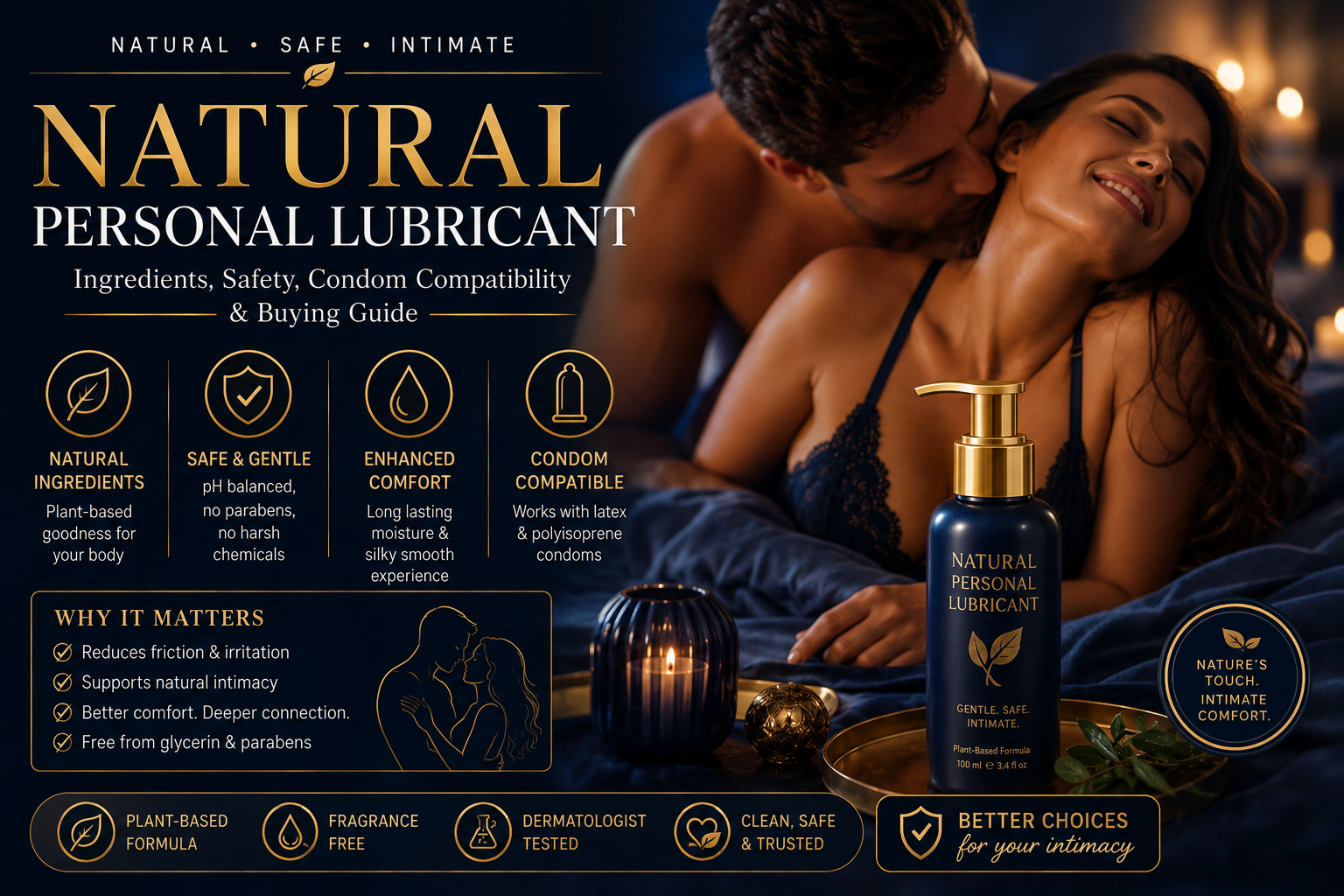
A natural personal lubricant can sound like the obvious choice for anyone trying to avoid harsh ingredients, fragrance, unnecessary additives, or highly processed formulas. But “natural” is not a safety standard, and it does not automatically mean a lubricant is gentler, condom-compatible, fertility-friendly, or appropriate for every type of sexual activity.
That distinction matters because personal lubricants are more than cosmetic products. In the United States, FDA classifies personal lubricants for penile and/or vaginal use as medical devices intended to supplement natural lubrication and reduce friction during intimate activity. FDA also notes that individual products may or may not be compatible with latex, polyisoprene, or polyurethane condoms.
So the best way to evaluate a natural personal lubricant is not to ask whether its ingredients came from plants. The more useful questions are whether the finished formulation provides adequate lubrication, suits the intended tissues, is compatible with any condoms being used, avoids unnecessary irritants, and comes from a manufacturer willing to explain what is actually inside it.
That is the TestoVerdict approach.
What Is a Natural Personal Lubricant?
There is no single universal technical definition of natural personal lubricant that tells consumers exactly what the product contains.
In practice, the term may describe lubricants made primarily with ingredients such as:
- aloe vera
- plant-derived glycerin
- cellulose-based thickeners
- botanical extracts
- coconut-derived ingredients
- natural oils
- water
- naturally derived preservatives
- other plant-origin ingredients
Some brands use “natural” to mean mostly plant-derived.
Others use it to mean organic-certified ingredients.
Some use it simply as a marketing description.
That creates a problem.
Two products can both be marketed as a natural personal lubricant while having completely different bases, pH, osmolality, preservatives, condom compatibility, and tissue tolerance.
The front label therefore tells you less than the ingredient list and product instructions.
Natural Personal Lubricant: Quick TestoVerdict Verdict
For most consumers, TestoVerdict would not choose a lubricant solely because it says “natural.”
We would instead prioritize:
| Factor | What We Want to See |
|---|---|
| Ingredient transparency | Full formula disclosed |
| Intended use | Vaginal, penile, anal, or other use clearly stated |
| Condom compatibility | Explicit rather than assumed |
| Base | Water, silicone, oil, or hybrid clearly identified |
| Fragrance | Preferably absent for sensitive users |
| Flavoring | Optional, not automatically beneficial |
| pH | Useful when disclosed |
| Osmolality | Valuable especially for water-based formulas |
| Fertility claims | Properly supported if marketed for conception |
| Manufacturer claims | Realistic rather than fear-based |
| Quality | Clear regulatory/manufacturing information |
A relatively simple water-based formula can be a good starting point for many people.
A silicone lubricant can be useful when longer-lasting slip is needed.
Oil-based products can feel appealing and may contain familiar natural ingredients, but they create important condom-compatibility issues.
The correct choice depends on how the product will actually be used.
Why Do People Want a Natural Personal Lubricant?
Consumers often look for a natural personal lubricant because they want to avoid something.
Common concerns include:
- fragrance
- parabens
- glycerin
- propylene glycol
- synthetic preservatives
- warming ingredients
- dyes
- flavorings
- perceived “chemicals”
- irritation from previous lubricants
Other consumers simply prefer products marketed as natural, organic, vegan, or plant-derived.
Those preferences are understandable.
But a label that says “natural” does not independently prove:
- lower irritation risk
- better vaginal compatibility
- safer condom use
- lower osmolality
- fertility compatibility
- better microbiological quality
- superior lubrication
The finished formulation matters more than whether individual ingredients sound familiar.
Natural Does Not Mean Chemical-Free
This deserves explicit attention because “chemical-free” is common wellness marketing.
Everything in a lubricant is composed of chemicals.
Water is a chemical substance.
Aloe contains many chemical compounds.
Plant oils contain mixtures of fatty acids and other molecules.
The relevant consumer question is not:
Does this natural personal lubricant contain chemicals?
It is:
Are the ingredients appropriate for the intended use, present at sensible concentrations, well tolerated, and supported by adequate product testing?
Fear-based marketing around the word “chemical” usually tells consumers very little about product quality.
What Types of Natural Personal Lubricant Are Available?
A natural personal lubricant can fall into several formulation categories.
The most common are:
- water-based
- oil-based
- silicone-based
- hybrid formulas
Not every product in each category is marketed as natural, but naturally positioned formulas can exist within more than one base type.
Water-Based Natural Personal Lubricant
Water-based formulas are among the most practical choices for general use.
Advantages can include:
- easy cleanup
- broad availability
- compatibility with many condoms when appropriately labeled
- compatibility with many sex toys
- wide variety of viscosities
- relatively light feel
WHO recommends making lubricants available as a sexual-health self-care option and notes that water- and silicone-based lubricants are commonly condom-compatible choices.
A water-based natural personal lubricant may use ingredients such as aloe or plant-derived thickening agents alongside humectants and preservatives.
But again, water-based does not automatically mean gentle.
The formulation’s pH, osmolality, preservative system, and other ingredients still matter.
Oil-Based Natural Personal Lubricant
Oil-based formulas are where “natural” marketing is particularly common.
Consumers may encounter:
- coconut oil
- sweet almond oil
- olive-derived oils
- seed oils
- botanical oil blends
These products can provide durable lubrication.
But they raise one of the most important safety considerations in the entire category:
oil can damage natural-rubber latex condoms.
WHO advises against oil-based lubricants with condoms because they may contribute to breakage or slippage, while water- and silicone-based lubricants are commonly appropriate alternatives.
Therefore, a natural oil should never be assumed superior simply because the ingredient is familiar.
If latex condoms are part of the user’s contraception or STI-prevention strategy, oil compatibility becomes more important than natural branding.
Silicone-Based Natural Personal Lubricant
Silicone itself would not ordinarily fit a strict botanical definition of “natural,” but some products marketed toward natural-conscious consumers use very simple silicone formulations and avoid fragrance or numerous additives.
Silicone lubricants offer a major practical advantage:
longevity.
WHO notes that silicone oil-based lubricants are compatible with natural-rubber latex condoms.
However, users of silicone sex toys should check compatibility recommendations from the toy and lubricant manufacturers.
The key lesson is that a simple silicone product may be more appropriate for some sensitive users than an elaborate “100% natural” oil blend.
Naturalness and suitability are not the same metric.
Natural Personal Lubricant vs Conventional Lubricant
The difference may be smaller than the marketing suggests.
| Natural-positioned lubricant | Conventional lubricant |
|---|---|
| Often emphasizes plant-derived ingredients | May emphasize functional formulation |
| Frequently markets minimalism | May contain similar functional ingredients |
| May avoid fragrance/additives | Could also be fragrance-free |
| Can be water or oil based | Can be water, silicone, oil or hybrid |
| “Natural” appeal | Broader formulation choices |
| Not automatically safer | Not automatically harsher |
A high-quality natural personal lubricant should be judged by performance and safety characteristics, not identity politics around ingredient origin.
What Ingredients Are Common in Natural Personal Lubricant?
Different formulas can contain very different components.
Water
Water is the base of many personal lubricants.
Aloe vera
Aloe is common in naturally marketed formulas because it has a familiar botanical identity and provides a gel-like consumer experience.
Its presence alone does not establish the product’s overall pH, osmolality, preservative quality, or tissue compatibility.
Cellulose gums
Plant-derived cellulose materials may be used as thickening agents.
Glycerin
Glycerin can be plant-derived and is frequently used as a humectant.
This creates an interesting marketing contradiction: some “natural” lubricants advertise plant-derived glycerin proudly, while other natural brands market themselves as glycerin-free.
Neither claim alone tells consumers whether the finished product is appropriate.
Plant oils
These may form the base of oil-based formulas.
Preservatives
Water-containing products require an effective strategy to limit microbial growth.
A natural personal lubricant should not automatically be considered superior merely because it advertises “preservative-free.”
A poorly protected water-rich formulation would not be a consumer advantage.
Is Glycerin Bad in Natural Personal Lubricant?
Glycerin is one of the most debated lubricant ingredients online.
It is often portrayed as inherently problematic.
That is an oversimplification.
One important technical issue is that glycerin contributes to osmolality, which refers to the concentration of dissolved particles in a solution.
WHO technical guidance notes that glycerol and propylene glycol are common humectants and that high glycol concentrations can increase lubricant osmolality. WHO recommends, on an interim procurement basis, lubricants with osmolality not exceeding 1,200 mOsm/kg, while describing a value closer to physiologic levels—approximately 380 mOsm/kg—as ideal.
So the right question is not:
Does this natural personal lubricant contain glycerin?
It is:
How does the entire finished formulation behave?
Ingredient concentration matters.
What Is Osmolality and Why Does It Matter?
Osmolality is one of the most valuable technical concepts consumers rarely see on lubricant packaging.
WHO notes that typical vaginal secretions have osmolality around 260–290 mOsm/kg, while semen is roughly 250–380 mOsm/kg. It further notes that many commercial personal lubricants have historically measured far higher, sometimes in the 2,000–6,000 mOsm/kg range.
Highly hyperosmolar lubricants have raised concerns about epithelial-cell effects.
For a natural personal lubricant, this matters because a botanical ingredient list does not tell you the osmolality.
A product can be:
natural + very hyperosmolar
or:
synthetic-looking + closer to physiologic osmolality.
The technical specification may matter more than the branding.
Does pH Matter in Natural Personal Lubricant?
Yes, although pH should not be turned into one universal magic number.
The appropriate pH partly depends on intended use and formulation.
A lubricant designed primarily for vaginal use may be optimized differently from one intended for another anatomical site.
Consumers researching a natural personal lubricant should appreciate manufacturers that disclose meaningful formulation data rather than simply saying “pH balanced.”
Balanced to what?
For which intended use?
According to what specification?
Specific information is more useful than reassuring terminology.
Fragrance-Free Natural Personal Lubricant
Fragrance contributes little to the actual mechanical job of lubrication.
Someone choosing a natural personal lubricant for sensitive skin may therefore reasonably prefer fragrance-free products.
This isn’t because every fragrance is harmful.
It is because eliminating unnecessary ingredients reduces the number of potential triggers when a person already knows they are irritation-prone.
A similar logic applies to:
- flavoring
- warming compounds
- cooling compounds
- tingling additives
- dyes
These can be enjoyable product features, but they are not necessary for lubrication.
Is Aloe-Based Natural Personal Lubricant Better?
Not automatically.
Aloe-based formulas can be perfectly reasonable.
But the presence of aloe tells us little about the rest of the product.
Aloe does not automatically mean:
- condom-compatible
- isotonic
- ideal pH
- fragrance-free
- irritation-free
- fertility-compatible
TestoVerdict would never rank a natural personal lubricant highly merely because aloe appears on the front label.
We would still examine the entire ingredient list and technical claims.
Coconut Oil as Natural Personal Lubricant
Coconut oil is probably the best-known do-it-yourself natural lubricant.
Its advantages are obvious:
- inexpensive
- widely available
- long-lasting
- familiar ingredient
Its limitation is equally important.
Oil-based products should not be paired with natural-rubber latex condoms.
WHO recommends water- or silicone-based lubricant with condoms rather than oil-based lubricants.
Therefore, coconut oil is not a universally appropriate natural personal lubricant.
Its suitability depends partly on whether latex barriers are being used.
Olive Oil as Natural Personal Lubricant
The same fundamental condom issue applies.
Olive oil may sound simple and natural, but that does not establish it as appropriate for every sexual-health context.
If latex condoms are involved, oil-based lubrication is inappropriate.
Consumers should also remember that household food products were not necessarily formulated, packaged, or tested for intimate use.
The fact that something is edible does not automatically make it the ideal genital lubricant.
Natural Personal Lubricant and Latex Condoms
This is one of the most important buying questions.
FDA classifies personal lubricants as products that may or may not be compatible with natural-rubber latex, polyisoprene, or polyurethane condoms.
FDA also recognizes ASTM D7661-18, a standard specifically addressing compatibility between personal lubricants and natural-rubber latex condoms.
That means condom compatibility should be demonstrated or explicitly stated, not guessed from ingredient origin.
A plant oil can be natural and completely wrong for latex.
A water-based product can sound synthetic and be entirely appropriate.
Natural Personal Lubricant and Polyisoprene Condoms
Users should be careful here too.
WHO guidance notes that some synthetic condom materials such as polyisoprene can also be sensitive to oil-based lubricants.
Therefore, consumers should never assume:
non-latex = oil compatible.
When using a natural personal lubricant with polyisoprene condoms, check both manufacturers’ instructions.
Natural Personal Lubricant and Polyurethane Condoms
Polyurethane behaves differently from latex and polyisoprene.
WHO guidance notes that many lubricants suitable for human use can be compatible with polyurethane condoms, but again, product-specific instructions should be followed.
The broader lesson remains:
know the condom material before choosing the lubricant.
Natural Personal Lubricant for Sensitive Skin
Sensitive-skin users are one of the biggest audiences for naturally positioned lubricants.
A simple natural personal lubricant may appeal because it avoids fragrance or elaborate sensory ingredients.
That can be sensible.
But irritation can have many causes, including:
- friction
- latex exposure
- lubricant ingredients
- preservatives
- infection
- dermatitis
- hormonal dryness
- another medical condition
A product advertised as natural is not guaranteed to solve any of these.
If one formulation repeatedly causes burning or itching, stop using it.
If symptoms persist across several products or occur independently of lubricant use, professional assessment becomes more valuable than continuing to buy new formulas.
Can Natural Personal Lubricant Cause Burning?
Yes.
Natural ingredients can still irritate susceptible tissue.
Botanical extracts, essential oils, flavorings, acids, and other compounds can produce unwanted sensations in some people.
A natural personal lubricant should not intentionally create painful burning unless the product is explicitly designed for a warming sensation—and even then, significant discomfort is a reason to stop use.
Naturalness does not eliminate individual sensitivity.
Is Organic Personal Lubricant Better?
Organic certification can provide information about how particular agricultural ingredients were produced.
It does not establish:
- superior lubrication
- lower osmolality
- ideal pH
- condom compatibility
- fertility compatibility
- zero irritation risk
An organic natural personal lubricant can be excellent.
A non-organic lubricant can also be excellent.
TestoVerdict views organic status as a secondary characteristic, not a primary performance criterion.
Natural Personal Lubricant for Vaginal Dryness
Lubricants can help reduce friction during sexual activity when natural lubrication is insufficient.
WHO recognizes lubricants as tools that can improve ease and comfort during sexual activity.
However, persistent vaginal dryness can have several possible causes, including hormonal changes, medications, postpartum changes, menopause, or medical treatment.
A natural personal lubricant can help with friction.
It does not necessarily treat the underlying cause of chronic dryness.
Someone with persistent symptoms may benefit from medical assessment or consideration of vaginal moisturizers and other approaches.
Natural Personal Lubricant for Men
Men may also prefer a natural formulation because of:
- penile sensitivity
- friction
- reactions to fragrance
- preference for minimalist products
- masturbation
- condom use
- partner sensitivity
The same buying framework applies.
For a natural personal lubricant for men, evaluate:
- ingredient transparency
- condom compatibility
- viscosity
- ease of cleanup
- longevity
- sensitivity
- intended use
There is nothing inherently gender-specific about whether a lubricant formulation is well designed.
Natural Personal Lubricant for Anal Sex
Anal sex deserves separate consideration because the rectum does not self-lubricate in the same way as vaginal tissue.
WHO notes that plentiful lubricant should be used during anal sex and that condom-compatible lubricant can reduce the likelihood of condom breakage or slippage.
For this use, a natural personal lubricant must provide adequate and sustained slip.
A formula that dries quickly and requires constant reapplication may be less practical.
If condoms are used, compatibility remains essential.
Natural Personal Lubricant When Trying to Conceive
This is one of the places where buyers need to look beyond generic natural claims.
Ordinary lubricants should not automatically be assumed compatible with sperm.
FDA maintains a separate device category for lubricants specifically demonstrated to be compatible with sperm, oocytes, and embryos and intended for couples trying to conceive or for fertility interventions.
That is a meaningful distinction.
A bottle can say:
natural
organic
gentle
fertility friendly
but consumers should verify whether its fertility compatibility is actually supported.
When conception is the goal, choose a product specifically intended and cleared for that use rather than assuming a general natural personal lubricant is sperm-safe.
Natural Personal Lubricant vs Fertility-Friendly Lubricant
These categories can overlap, but they are not identical.
| Natural Personal Lubricant | Fertility-Compatible Lubricant |
|---|---|
| Focuses on ingredient origin or positioning | Focuses on sperm/oocyte/embryo compatibility |
| May or may not be sperm compatible | Specifically intended for conception context |
| May be oil or water based | Must meet relevant intended-use requirements |
| Natural claim may be marketing-led | Compatibility should be documented |
For a couple trying to conceive, fertility compatibility matters more than natural branding.
Is a Homemade Natural Personal Lubricant a Good Idea?
Homemade recipes are popular online.
Common suggestions include:
- aloe mixtures
- oils
- cornstarch gels
- household plant ingredients
The problem is that home formulations introduce uncertainty.
Questions include:
- microbial contamination
- pH
- concentration
- osmolality
- condom compatibility
- ingredient purity
- storage
- shelf life
A commercial product is not automatically superior, but a properly manufactured personal lubricant has the advantage of being formulated for intimate use.
For TestoVerdict, a homemade natural personal lubricant is difficult to recommend when its safety and stability characteristics are unknown.
Preservatives: Are They Always Bad?
No.
This is another area where clean-label marketing can mislead consumers.
Water-based products can support microbial growth if they are not appropriately preserved or otherwise protected.
Preservatives exist for a reason.
The objective should be an effective, well-tolerated preservation system, not the automatic elimination of every preservative.
A natural personal lubricant that contains water needs a credible approach to microbiological safety.
“Preservative-free” is not inherently superior.
What About Essential Oils?
Essential oils are natural.
That does not mean they belong in every personal lubricant.
Many are biologically active and some can be irritating to sensitive tissues.
For consumers looking for simplicity or dealing with unexplained burning, TestoVerdict would generally prefer a straightforward natural personal lubricant without unnecessary essential oils unless there is a clear reason for their inclusion and appropriate formulation evidence.
Botanical complexity should not be confused with quality.
Natural Personal Lubricant and Sex Toys
Compatibility depends on the material of both the lubricant and the toy.
Water-based products are often the easiest broad-compatibility option.
Silicone-based lubricant may require more caution with silicone toys.
Oil-based formulas can interact differently with different toy materials.
Check manufacturer instructions.
A natural personal lubricant isn’t automatically toy-safe simply because it is plant-based.
How Much Natural Personal Lubricant Should You Use?
There is no universal quantity.
Use enough to reduce friction comfortably and reapply when needed according to product directions.
The purpose of lubricant is to lubricate.
Using too little because the formula is expensive or because a consumer is worried about ingredients can defeat the objective.
If a natural personal lubricant consistently dries out quickly, choosing a longer-lasting formulation may be more practical than constant reapplication.
How Long Should Natural Personal Lubricant Last?
This varies significantly by formula.
Water-based products may absorb or evaporate and require reapplication.
Silicone products generally last longer.
Oil-based products can also be long lasting.
The best duration depends on activity and preference.
There is no scientific reason to assume that a natural personal lubricant should last longer or shorter simply because it is natural.
What Marketing Doesn’t Tell You About Natural Personal Lubricant
“Natural” is not a performance standard
The word says little about friction reduction or compatibility.
“Organic” does not establish genital tolerance
Certification of ingredient production is different from clinical tolerance.
“Chemical-free” is meaningless
All ingredients are chemical substances.
“Preservative-free” is not automatically better
Water-containing products require microbiological protection.
Coconut oil is not universally condom-safe
Oil can damage latex.
Aloe does not prove a complete formula is gentle
Other ingredients still matter.
Glycerin-free does not prove low osmolality
The entire formulation determines osmolality.
“Fertility friendly” should be substantiated
Trying-to-conceive products deserve specific compatibility evidence.
A serious natural personal lubricant review should examine all of these claims.
Red Flags When Buying Natural Personal Lubricant
TestoVerdict would be cautious if a product:
- does not provide a full ingredient list
- claims to be “chemical-free”
- claims no one can react to it
- makes infection-treatment claims
- implies it prevents STIs
- fails to disclose condom compatibility
- tells latex-condom users that all plant oils are safe
- claims sperm compatibility without meaningful support
- relies entirely on “organic” or “natural” branding
- contains many sensory additives despite being marketed for sensitivity
- provides no manufacturer contact details
- makes vague laboratory-testing claims without explaining what was tested
A credible natural personal lubricant should make it easier to understand the product, not harder.
How TestoVerdict Will Evaluate Natural Personal Lubricants
When we compare individual products, our evaluation will focus on:
Formula
What is actually inside the product?
Transparency
Are ingredients, intended use, and compatibility clearly disclosed?
Friction reduction
Does the formulation actually provide useful lubrication?
Sensitive-skin considerations
Are fragrance and unnecessary sensory additives minimized where appropriate?
Condom compatibility
Has the manufacturer clearly stated which barrier materials are compatible?
Technical information
Does the company disclose useful data such as pH or osmolality?
Fertility claims
Are conception-related claims appropriately supported?
Value
Does the formula justify its price?
Marketing accuracy
Does the manufacturer explain its product realistically rather than attacking “chemicals” or using fear-based natural-health messaging?
That framework is more meaningful than simply ranking whichever natural personal lubricant has the most botanical ingredients.
TestoVerdict Natural Personal Lubricant Buying Checklist
Before buying, ask:
- Is the complete ingredient list available?
- Is the lubricant water-, silicone-, oil-, or hybrid-based?
- Is the product intended for my planned use?
- Is condom compatibility clearly stated?
- Is my condom made from latex, polyisoprene, or polyurethane?
- Are unnecessary fragrances or flavors included?
- Does the manufacturer disclose pH?
- Does it disclose osmolality?
- Is the product adequately preserved?
- Is it toy-compatible if that matters?
- Is fertility compatibility documented if trying to conceive?
- Are “natural” claims specific rather than vague?
- Does the company provide useful technical information?
- Does the price reflect actual formulation quality?
Frequently Asked Questions About Natural Personal Lubricant
What is the best natural personal lubricant?
There is no single best product for everyone. A relatively simple, transparent formula that suits the intended use and any condom or fertility requirements is generally a better starting point than choosing by “natural” branding alone.
Is natural personal lubricant safer?
Not automatically. Natural ingredients can still irritate, interact with condom materials, or create formulation issues. Safety depends on the finished product.
Is coconut oil a good natural personal lubricant?
It can provide lubrication, but it should not be used with natural-rubber latex condoms because oil can compromise latex.
Can I use olive oil as natural personal lubricant?
It is oil-based, so the same latex-condom compatibility problem applies. Household oils also are not necessarily formulated or tested for intimate use.
Is aloe vera a good natural personal lubricant?
Aloe is commonly used in water-based lubricants, but its presence alone does not establish that a product is well tolerated or condom-compatible.
Is water-based natural personal lubricant good for sensitive skin?
It can be a sensible starting point, particularly when the formula is simple and fragrance-free. Individual responses still vary.
Is glycerin bad in natural personal lubricant?
Not automatically. Glycerin can contribute to osmolality, but the full formulation and concentration matter more than its simple presence.
What does osmolality mean in personal lubricant?
It describes the concentration of dissolved particles in the formula. WHO has expressed concern about highly hyperosmolar lubricants and recommends an interim procurement limit of 1,200 mOsm/kg.
Can natural personal lubricant be used with condoms?
Some can and some cannot. FDA explicitly notes that individual lubricants may or may not be compatible with latex, polyisoprene, or polyurethane condoms.
Is natural personal lubricant safe with latex condoms?
Water- and silicone-based products are commonly appropriate when labeled compatible. Oil-based products should not be used with latex condoms.
Is natural personal lubricant safe with polyisoprene condoms?
Do not assume oil is safe merely because the condom is non-latex. WHO notes that polyisoprene can be sensitive to oil-based lubricants.
Is natural personal lubricant fertility friendly?
Not necessarily. FDA has a separate classification for lubricants specifically compatible with sperm, oocytes, and embryos.
Can natural personal lubricant cause irritation?
Yes. Plant-derived ingredients and other natural compounds can still trigger individual reactions.
Should a natural personal lubricant be preservative-free?
Not necessarily. Water-rich formulas require appropriate microbial protection. Effective preservation is a product-quality feature.
Is organic lubricant better than regular lubricant?
Organic status does not by itself establish better lubrication, tissue tolerance, condom compatibility, or fertility compatibility.
Can natural personal lubricant prevent STIs?
No ordinary personal lubricant should be treated as a substitute for appropriate barrier protection.
The TestoVerdict Verdict on Natural Personal Lubricant
A natural personal lubricant can be an excellent product.
But the word natural tells us far less than most marketing suggests.
The ingredients still have to work together as a formulation.
The product still needs to provide adequate lubrication.
It still needs to be appropriate for the intended tissue.
It still needs to be compatible with any condoms being used.
And if a manufacturer makes fertility-related claims, those claims still need appropriate support.
FDA’s classification of personal lubricants captures this reality well: these products are intended to moisturize and lubricate intimate tissues and may or may not be compatible with latex, polyisoprene, or polyurethane condoms.
In other words, ingredient origin does not answer compatibility questions.
WHO guidance reinforces the same consumer lesson. Water- and silicone-based lubricants are common condom-compatible options, while oil-based products can create problems with condoms, particularly latex and some synthetic materials.
That is why TestoVerdict would choose a transparent, well-formulated conventional lubricant over a poorly documented natural product every time.
We would rather see:
full ingredient disclosure + appropriate preservation + condom compatibility + useful technical information + realistic claims
than:
organic imagery + “chemical-free” language + no technical documentation.
Osmolality also demonstrates why appearances can be misleading. A completely plant-derived water-based natural personal lubricant can still have a highly concentrated formula. WHO’s technical guidance recommends paying attention to osmolality rather than assuming that botanical ingredients guarantee physiologic compatibility.
The same logic applies to trying to conceive.
A lubricant marketed as natural should not automatically be treated as sperm-friendly. FDA maintains a distinct classification for products specifically compatible with sperm, oocytes, and embryos.
So our buying position is straightforward:
Choose a natural personal lubricant because the complete product makes sense—not because “natural” appears in large letters on the bottle.
When TestoVerdict begins comparing specific brands, we will prioritize:
Formula → Compatibility → Transparency → Tolerance → Technical Quality → Value
A great natural lubricant should survive that examination easily.
A weak product should not receive a free pass simply because its ingredients sound familiar.
Research. Compare. Buy Smart.
Sources & References
- U.S. Food and Drug Administration — Personal Lubricant Product Classification (NUC). Defines personal lubricants intended for penile and/or vaginal use and notes that products may or may not be compatible with latex, polyisoprene, and polyurethane condoms.
FDA — Personal Lubricant Classification - World Health Organization — Recommendations on Self-Care Interventions: Availability of Lubricants During Sexual Activity. WHO guidance describing lubricants as tools for sexual comfort and sexual-health support and discussing condom-compatible lubrication.
WHO — Lubricants During Sexual Activity - WHO/UNFPA/FHI360 — Use and Procurement of Additional Lubricants With Male and Female Condoms. Technical guidance addressing lubricant osmolality, glycerol, propylene glycol, condom-material compatibility, and epithelial-safety concerns.
WHO — Lubricant and Condom Technical Guidance - World Health Organization — Condoms: Questions and Answers. WHO consumer guidance stating that lubricant can help reduce condom breakage or slippage and recommending water- or silicone-based lubricant with condoms.
WHO — Condom and Lubricant Guidance - U.S. Food and Drug Administration — Gamete, Fertilization and Embryo-Compatible Personal Lubricant Classification (PEB). Defines products intended to be compatible with sperm, oocytes, and embryos for couples trying to conceive and fertility interventions.
FDA — Fertility-Compatible Personal Lubricants - U.S. Food and Drug Administration — ASTM D7661-18 Recognized Consensus Standard. FDA-recognized standard addressing compatibility between personal lubricants and natural-rubber latex condoms.
FDA — Personal Lubricant and Latex Condom Compatibility Standard
Medical & Sexual Health Disclaimer: This article is for general consumer education and is not individualized medical advice. Stop using a lubricant that causes significant burning, swelling, itching, rash, pain, or other concerning symptoms. Persistent genital discomfort, unusual discharge, sores, bleeding, recurrent irritation, or pain during sex should be evaluated by an appropriately qualified healthcare professional. Personal lubricants do not replace contraception or STI prevention, and condom compatibility should always be verified for the specific lubricant and barrier material.