
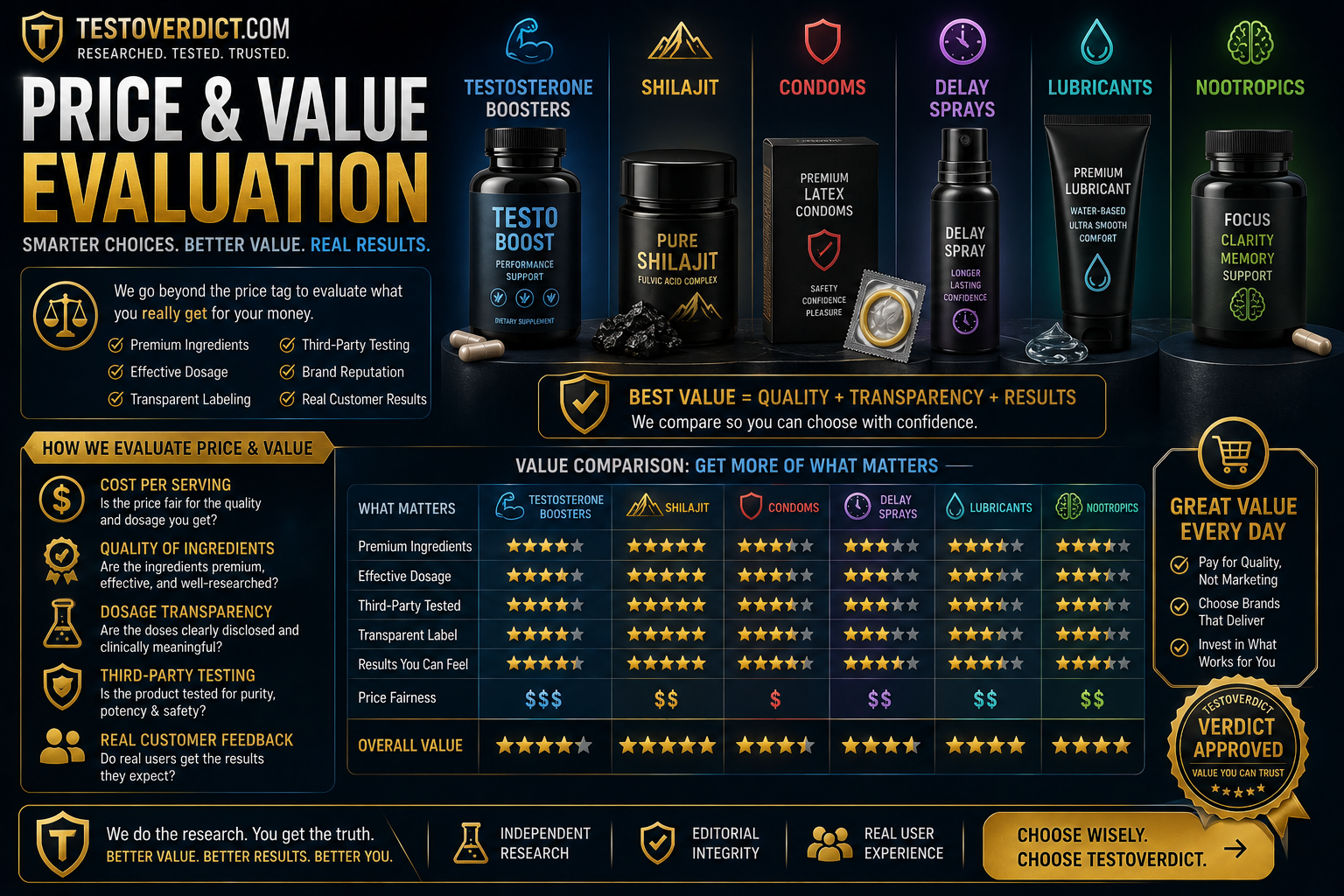
How Testo Verdict Evaluates Product Pricing, Cost Per Serving, Formula Quality & Real Consumer Value
At TestoVerdict, the cheapest product does not automatically represent the best value—and the most expensive product does not automatically represent the highest quality.
Price is easy to compare.
Value is much harder.
Two supplements may both cost $40, yet one provides a full month’s supply while the other lasts only fifteen days. One may contain transparent, appropriately dosed ingredients while the other hides small amounts inside a proprietary blend.
Similarly, two condoms, delay sprays, lubricants, Shilajit products, testosterone boosters, or nootropics can have similar prices while offering very different quantities, formulations, quality controls, and practical usefulness.
That is why Price & Value is one of the six pillars of the TestoVerdict review methodology.
We look beyond the number printed beside the Buy Now button.
Our objective is to determine:
What is the consumer actually getting for the money?
1. Price and Value Are Not the Same Thing
A low price is simply a low price.
Good value means the consumer receives an appropriate combination of:
- Product quantity
- Ingredient quality
- Relevant dosage
- Testing transparency
- Manufacturing quality
- Evidence
- Convenience
- Product performance
- Customer protections
Consider two hypothetical testosterone boosters.
Product A: $29.99
Product B: $44.99
At first glance, Product A appears to be the better deal.
But suppose Product A lasts 20 days and contains several undisclosed proprietary blends, while Product B provides 30 servings with transparent ingredient amounts and stronger quality documentation.
The cheaper bottle may actually provide poorer value.
This is why TestoVerdict does not rank products simply from cheapest to most expensive.
2. We Calculate Cost Per Serving
One of the simplest ways to compare supplements fairly is cost per serving.
Suppose:
Product A costs $30 and contains 30 servings.
Cost per serving = $1.00
Product B costs $45 and contains 60 servings.
Cost per serving = $0.75
Although Product B has the higher purchase price, its daily cost is lower.
This calculation can reveal value differences that bottle prices hide.
Whenever practical, TestoVerdict considers:
Purchase Price ÷ Number of Servings = Cost Per Serving
But even that calculation does not tell the whole story.
3. Serving Size Can Be Misleading
A manufacturer determines what it calls a serving.
That means consumers need to examine whether the labeled serving corresponds with realistic use.
For example, a bottle may advertise:
60 capsules
That sounds like a two-month supply if someone assumes one capsule per day.
But if the recommended serving is two capsules twice daily, the bottle lasts only 15 days.
TestoVerdict therefore examines:
- Capsules per bottle
- Capsules per serving
- Servings per container
- Suggested daily use
- Actual expected duration
We prefer comparing realistic daily cost rather than relying on front-label quantity.
4. Cost Per Day
For products used daily, cost per day can be even more useful than cost per serving.
A supplement may require:
- One serving daily
- Two servings daily
- Multiple capsules per dose
The consumer ultimately needs to know:
How much will this product cost me each day if I use it according to the manufacturer’s directions?
That figure can dramatically change how an apparently inexpensive supplement compares with competitors.
5. Cost Per Effective Dose
This is where TestoVerdict’s value analysis becomes more rigorous.
Imagine two products containing the same ingredient.
Product A costs less but provides a very small amount.
Product B costs more but provides an amount reasonably aligned with relevant human research.
Simply comparing bottle prices could make Product A look superior.
But consumers are not buying ingredient names.
They are buying usable formulations.
Where reliable evidence allows it, we therefore consider whether the price reflects a meaningful dose rather than simply the presence of an ingredient.
6. Underdosed Products Can Be Expensive at Any Price
A $20 supplement is not good value if its formulation gives consumers little reason to expect the advertised result.
This is particularly relevant with large multi-ingredient formulas.
A manufacturer may advertise:
- 15 ingredients
- 20 ingredients
- 25 ingredients
while fitting all of them into a relatively small proprietary blend.
The formula looks impressive.
But the individual ingredients may be present in amounts too small to resemble the research used in the marketing.
TestoVerdict does not reward ingredient count as value.
We reward meaningful formulation.
7. Ingredient Quality Affects Value
Two products containing the same ingredient name may not provide equivalent value.
Differences may include:
- Ingredient form
- Standardized extract
- Purity
- Sourcing
- Testing
- Traceability
- Manufacturing controls
A higher-quality ingredient may legitimately cost more.
Therefore, TestoVerdict does not automatically penalize premium pricing when there is a credible quality reason behind it.
The important question is:
What is the consumer paying extra for?
If the answer is better ingredients, meaningful testing, stronger documentation, or superior formulation, the premium may be justified.
If the answer appears to be mostly branding, the value proposition becomes weaker.
8. Standardized Extracts and Value
Standardized botanical extracts can cost more than generic raw botanical material.
That additional cost may sometimes be justified when the standardized extract provides:
- Defined constituents
- Better consistency
- Traceability
- Research specific to the extract
- More predictable specifications
However, a branded or standardized extract is not automatically worth any price.
We still evaluate:
Evidence + Dose + Quality + Cost
Premium ingredients should contribute something meaningful to the finished product.
9. Proprietary Blends Reduce Value Transparency
Proprietary blends create a particular problem for value assessment.
Suppose a product costs $60 and advertises eight premium ingredients.
If the manufacturer does not disclose individual amounts, consumers cannot easily determine how much of each ingredient they are purchasing.
This makes it difficult to calculate whether the formula justifies the price.
For that reason, full dose transparency generally improves our ability to assess value.
A company asking consumers to pay premium prices should ideally provide enough information to understand what that premium is buying.
10. Testosterone Booster Value
Testosterone boosters frequently range from relatively inexpensive vitamin-and-mineral formulas to expensive multi-extract products.
When evaluating their value, we may consider:
- Ingredient quality
- Ingredient doses
- Standardized extracts
- Number of daily servings
- Supply duration
- Testing
- Evidence
- Formula transparency
A formula containing zinc, magnesium and vitamin D should not necessarily command the same premium as one containing expensive standardized botanical extracts.
But expensive ingredients do not automatically make a formula effective either.
The correct question remains:
Does the evidence and formulation justify the price?
11. Shilajit Value
Shilajit pricing can vary dramatically.
Products may be sold as:
- Resin
- Capsules
- Tablets
- Powder
- Gummies
- Liquid preparations
Comparing them solely by package price can be misleading.
TestoVerdict may consider:
- Amount of Shilajit per serving
- Number of servings
- Form
- Purification
- Testing
- Source transparency
- Standardization
- Fulvic-acid information where relevant
A tiny premium-looking jar is not automatically better value than a larger capsule product.
Likewise, a very inexpensive Shilajit product may deserve additional scrutiny if its pricing seems inconsistent with the sourcing and purification claims being made.
12. Nootropic Value
Nootropic products create another challenge because formulas can contain many ingredients.
A consumer may pay a premium for:
- Caffeine
- L-theanine
- Bacopa
- Rhodiola
- Citicoline
- Alpha-GPC
- Lion’s Mane
- Vitamins
- Other compounds
The number of ingredients does not determine value.
We examine whether those ingredients:
- Have a rational purpose
- Are disclosed
- Are appropriately dosed
- Have relevant evidence
- Duplicate one another unnecessarily
A simple caffeine plus L-theanine product may sometimes offer better value for a particular consumer than an expensive 20-ingredient “ultimate brain formula.”
Complexity should not be confused with quality.
13. Condom Value
Condom pricing requires a different approach.
Cost per condom is useful, but value also depends on:
- Material
- Fit options
- Reliability
- Packaging
- Lubrication
- Expiration
- Intended use
- Brand/manufacturer confidence
A consumer should not choose condoms based on the lowest unit price alone.
The correct condom is one that can be used consistently and correctly while meeting the consumer’s protection and comfort requirements.
Saving a few cents per unit is not meaningful value if the product is unsuitable for the user.
14. Delay Spray Value
Delay sprays can vary in:
- Bottle size
- Number of applications
- Active ingredient
- Concentration
- Recommended amount
- Packaging
- Formula
- Brand support
Simply comparing milliliters may therefore be misleading.
A larger bottle is not necessarily better value if the formulation is poorly disclosed or difficult to use.
Likewise, a smaller product may provide many applications depending on the recommended dose.
We consider both quantity and practical use.
15. Personal Lubricant Value
Lubricants are often easy to compare by bottle size, but volume alone is not enough.
Water-based and silicone-based lubricants can behave very differently.
Silicone lubricants often require smaller quantities and may last longer during use.
Water-based products may cost less initially but sometimes require reapplication.
Value therefore depends on:
- Volume
- Formula
- Longevity
- Intended use
- Condom compatibility
- Toy compatibility
- Skin sensitivity
- Ease of cleanup
The cheapest bottle is not necessarily the least expensive product in practical use.
16. Bigger Packages Are Not Always Better Value
Buying larger quantities often reduces unit cost.
But that does not automatically make bulk purchasing the right choice.
Consumers should consider:
- Expiration
- Storage
- Frequency of use
- Whether they have tried the product
- Return policy
Purchasing six bottles of an unfamiliar supplement simply because the per-bottle price is lower can create poor value if the product proves unsuitable.
TestoVerdict therefore distinguishes unit economics from consumer practicality.
17. Subscription Discounts
Subscription programs are increasingly common.
A company may offer:
- 10% off
- 15% off
- 20% off
- Free shipping
- Automatic monthly delivery
These discounts can improve value for repeat users.
But subscriptions also create questions.
We look for:
- Clear billing frequency
- Easy cancellation
- Ability to pause
- Transparent renewal terms
- Price changes
- Shipping costs
A subscription discount is only a benefit when the consumer actually wants recurring delivery.
18. Introductory Pricing
Some companies offer attractive first-order discounts.
That can be useful.
But TestoVerdict distinguishes between:
First-order price
and
Normal recurring price.
A product may look exceptionally inexpensive because the landing page advertises a 30% introductory discount.
If subsequent orders cost considerably more, consumers should know that.
Long-term value should not be judged solely by the first purchase.
19. Coupon Codes and Discounts
Coupons can improve consumer value.
But our underlying product verdict should not depend entirely on temporary promotions.
Prices change.
Discounts expire.
Affiliate codes change.
Seasonal sales come and go.
Therefore, TestoVerdict may discuss current offers while separately considering the product’s normal pricing structure.
A good product should not become a bad formula the day a coupon expires.
20. Shipping Costs Matter
A $29 product with $12 shipping costs the consumer $41.
A competing $35 product with free shipping costs $35.
Headline pricing can therefore be misleading.
Where relevant, our value analysis may consider:
- Standard shipping
- Free-shipping threshold
- Expedited shipping
- International shipping
- Handling fees
The meaningful number is closer to the delivered cost, not simply the advertised product price.
21. International Pricing
Consumers outside the manufacturer’s home market may face additional costs.
These can include:
- International shipping
- Customs
- Duties
- Taxes
- Currency conversion
- Longer delivery times
A product offering excellent value in the United States may be much less competitive for a consumer in Europe, the Middle East, Asia, Canada, Australia, or another region.
Availability and regional economics therefore interact with value.
22. Returns Affect Value
Return policies are another part of the purchase.
A slightly more expensive product may offer:
- 30-day returns
- 60-day guarantees
- 90-day guarantees
- Satisfaction policies
Another may be final sale.
That difference affects consumer risk.
However, we examine the actual terms.
A “100% money-back guarantee” may contain conditions such as:
- Only unopened products
- Return shipping paid by customer
- Short request windows
- Exclusions
- Restocking fees
We look beyond the headline.
23. Money-Back Guarantees Are Not Evidence of Effectiveness
A guarantee can reduce financial risk.
It does not prove that a product works.
This distinction is important.
Marketing sometimes implies:
“We offer a 90-day guarantee because we’re confident it works.”
The guarantee may demonstrate confidence in the company’s commercial policy.
It is not clinical evidence.
TestoVerdict evaluates effectiveness under our Evidence Standards, not through refund policies.
24. Free Gifts
Free gifts can make offers look more valuable.
Examples include:
- Free bottles
- Sample packs
- Accessories
- E-books
- Memberships
We consider whether these extras provide genuine consumer value or simply make the offer appear larger.
A free product is not valuable if the consumer does not need it.
The core product remains the priority.
25. Buy-One-Get-One Offers
BOGO promotions can dramatically reduce unit cost.
But consumers should still ask:
- Do I need two?
- Will both be used before expiration?
- Is the base price inflated?
- Does the product itself meet my needs?
TestoVerdict does not allow promotional mathematics to replace product evaluation.
26. Premium Branding
Packaging, website design, celebrity endorsements, influencer campaigns, and luxury positioning all cost money.
Those expenses can contribute to the retail price.
Consumers may legitimately enjoy premium branding.
But TestoVerdict separates brand experience from product quality.
A beautiful bottle does not increase the dose.
A celebrity endorsement does not improve clinical evidence.
An expensive advertising campaign does not strengthen a COA.
We focus on what the consumer receives inside—or functionally from—the product.
27. Direct-to-Consumer vs Marketplace Pricing
Products may be sold through:
- Manufacturer websites
- Major marketplaces
- Retailers
- Pharmacies
- Specialty stores
Prices can differ substantially.
The cheapest listing is not always the safest purchasing option.
Consumers should also consider:
- Seller authenticity
- Storage
- Product age
- Return policies
- Counterfeit risk
- Manufacturer guarantees
A slightly higher price from an authorized source can sometimes represent better overall value.
28. Price Should Be Compared Within the Correct Category
Comparing unrelated products can produce meaningless conclusions.
For example, a simple zinc supplement should not necessarily be price-compared directly with a multi-ingredient testosterone formula without accounting for the difference in formulation.
Likewise:
- Water-based lubricant vs silicone lubricant
- Standard condom vs premium ultra-thin condom
- Shilajit resin vs Shilajit capsules
may require more nuanced comparisons.
TestoVerdict attempts to compare products with realistic alternatives, not arbitrary price points.
29. Value Changes With the Consumer
There is no universal value winner for every person.
A product may represent excellent value for one consumer and poor value for another.
For example:
A premium silicone lubricant may be worthwhile for someone prioritizing longevity.
A less expensive water-based lubricant may be better for someone prioritizing easy cleanup and broad toy compatibility.
A complex nootropic stack may be unnecessary for someone who simply wants caffeine and L-theanine.
Value therefore depends partly on use case.
30. We Penalize “Marketing Weight”
Some products devote considerable attention to features that sound impressive but add little meaningful consumer value.
Examples can include:
- Excessive packaging
- Meaningless proprietary terminology
- Unsupported superlatives
- Huge ingredient lists
- Celebrity endorsements
- “Secret formulas”
- Artificial scarcity
We refer to this concept as marketing weight.
Consumers should not have to pay substantially more simply because a product has been wrapped in more aggressive advertising.
31. What Can Justify a Premium Price?
Higher pricing can be reasonable when it corresponds with meaningful advantages.
These may include:
- Better ingredient sourcing
- Standardized extracts
- Clinically relevant doses
- Stronger testing
- Batch-specific documentation
- Better manufacturing controls
- More useful formulation
- Superior product materials
- Better customer protections
- Reliable fulfillment
Premium price should ideally correspond with premium substance, not merely premium presentation.
32. When Cheap Becomes a Red Flag
Low prices are not inherently suspicious.
Efficient companies can provide excellent products at competitive prices.
However, an unusually low price can justify additional questions when the product simultaneously claims:
- Rare ingredients
- Expensive extracts
- Extensive third-party testing
- Premium sourcing
- Exceptional concentrations
The economics should make reasonable sense.
We do not declare a product poor simply because it is inexpensive.
We investigate whether the price appears consistent with the claims.
33. How We Handle Changing Prices
Prices change frequently.
Therefore, TestoVerdict distinguishes between:
Product evaluation
and
Current commercial offer.
A product may receive a strong quality assessment while its current price becomes less competitive.
Likewise, a temporary sale may make a previously expensive product more attractive.
Where appropriate, we encourage consumers to verify the current price before purchasing.
34. Affiliate Commissions and Price
TestoVerdict may earn a commission when readers purchase certain products through links on our website.
That commission should not increase the price consumers pay unless clearly disclosed otherwise.
More importantly, commission size does not determine our value verdict.
A product offering TestoVerdict a larger commission should not receive a higher score because it is more profitable for us.
Likewise, a lower-paying or non-affiliate product should not be disadvantaged when it offers consumers better value.
Editorial ranking and affiliate compensation must remain separate.
35. How We Compare Value Between Products
When comparing competing products, we may evaluate:
Purchase Price
What does the consumer initially pay?
Quantity
How much product is included?
Servings
How many realistic servings are provided?
Daily Cost
What does normal use cost?
Dose
Are important ingredients meaningfully dosed?
Ingredient Quality
Are standardized or well-characterized ingredients used?
Testing
What quality documentation is available?
Manufacturing
Does the company demonstrate appropriate quality controls?
Evidence
Does the formulation have credible support?
Shipping
What does the delivered product actually cost?
Returns
How much financial protection does the buyer receive?
Practical Use
Does the product solve the consumer’s actual problem?
This produces a much more meaningful comparison than simply sorting by price.
36. Our Value Categories
Rather than pretending value can always be reduced to a perfect mathematical score, TestoVerdict may broadly describe products as:
Excellent Value
Strong combination of quality, formulation, transparency, quantity, and competitive cost.
Good Value
Price is reasonable for what the product provides, with relatively minor compromises.
Fair Value
Product may be worthwhile for certain consumers, but meaningful alternatives exist at similar or lower cost.
Weak Value
Pricing appears difficult to justify relative to formulation, quantity, transparency, or competitors.
Poor Value
A substantial price premium exists without corresponding evidence of additional consumer benefit.
These categories are comparative assessments, not guarantees of individual satisfaction.
37. The TestoVerdict Price & Value Checklist
Before reaching a value verdict, we may ask:
Retail Price
What does one purchase cost?
Servings
How many realistic servings are included?
Daily Cost
What does normal use cost per day?
Effective Dose
Is the consumer receiving meaningful amounts?
Ingredient Quality
Does the formulation justify its price?
Testing
Is part of the premium supporting stronger quality control?
Supply Duration
How long does the product realistically last?
Shipping
What is the actual delivered cost?
Subscription
Are recurring discounts transparent and easy to manage?
Returns
What financial protection exists?
Competition
How does the product compare with credible alternatives?
Use Case
Does the product provide value for the person it is intended to serve?
Marketing Premium
Is the consumer paying for product substance or primarily advertising?
Those questions determine far more than the sticker price.
The TestoVerdict Price & Value Standard
Our value philosophy can be summarized simply:
We do not ask which product costs the least. We ask which product gives consumers the strongest combination of quality, evidence, useful formulation and practical value for the money spent.
Sometimes the cheapest product wins.
Sometimes the premium product genuinely justifies its price.
And sometimes neither is the best choice.
Our evaluation follows the chain:
Price → Quantity → Dose → Quality → Evidence → Practical Use → Total Cost → Consumer Value
This prevents discounts, oversized bottles, proprietary blends, celebrity endorsements, and premium packaging from distorting the underlying comparison.
Consumers deserve to know not merely:
“How much does it cost?”
but:
“What am I actually getting for my money?”
That is why Price & Value is one of the six pillars behind the TestoVerdict verdict.
The lowest price can save money. The best value should make the money worth spending.
Editorial & Commercial Disclosure
TestoVerdict provides independent consumer education and product analysis. Prices, discounts, shipping charges, subscriptions, promotions, availability, and return policies can change without notice and should be verified with the seller before purchase.
TestoVerdict may earn commissions from qualifying purchases made through certain links. Affiliate compensation does not determine our assessment of product quality, scientific evidence, price, or value. Product discussions are informational and should not be interpreted as individualized medical advice.