
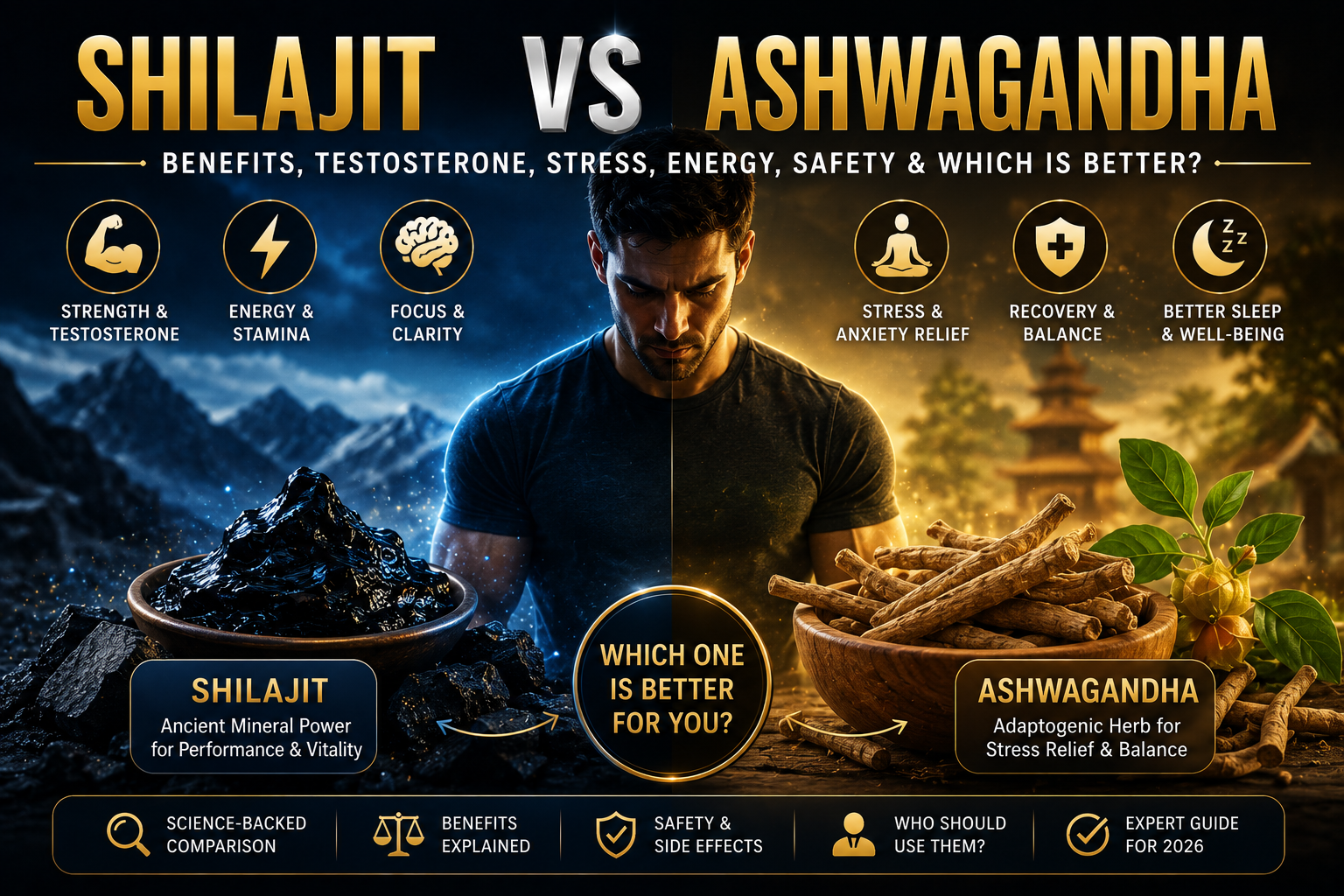
Shilajit vs Ashwagandha is one of the most useful supplement comparisons for people interested in testosterone, stress, energy, exercise, fertility and general men’s wellness. Both substances come from long traditional-use histories, both are now heavily marketed as “natural performance” supplements, and both appear in products aimed at men who want more energy, better recovery or hormonal support.
But they are not interchangeable.
Shilajit is a complex phyto-mineral substance whose composition varies by origin and processing. Ashwagandha (Withania somnifera) is a botanical whose root and other extracts contain withanolides and related constituents. Human research exists for both, but the evidence is stronger for different outcomes.
The most useful way to compare Shilajit vs Ashwagandha is therefore not to ask which is “more powerful.” It is to ask:
Which supplement has the better evidence for the outcome you actually care about, and which product has the better safety and quality profile?
That is the TestoVerdict approach.
Shilajit vs Ashwagandha: Quick Verdict
If the goal is primarily stress and anxiety support, Ashwagandha currently has the broader human evidence base. Recent meta-analyses of randomized controlled trials report reductions in stress-related outcomes and cortisol, although heterogeneity and evidence limitations remain.
If the goal is testosterone support in men, both have human evidence. A randomized placebo-controlled trial of purified Shilajit in healthy men aged 45–55 reported increases in total and free testosterone after 90 days. A recent systematic review and meta-analysis of Ashwagandha trials also reported a testosterone increase in men, though effects depend on extract, population and study design.
If the goal is product simplicity and contamination control, Ashwagandha may be easier to evaluate because standardized extracts can be more straightforward than a mineral-rich natural exudate such as Shilajit. Shilajit requires especially careful attention to purification and heavy-metal testing.
TestoVerdict bottom line
| Goal | Better-supported option |
|---|---|
| Stress support | Ashwagandha |
| Anxiety-related support | Ashwagandha |
| Testosterone in men | Both have evidence |
| Male fertility | Shilajit has direct clinical evidence |
| Exercise/fatigue | Both are plausible; evidence differs |
| Simplest quality evaluation | Ashwagandha usually |
| Heavy-metal testing importance | Especially important for Shilajit |
| Traditional rejuvenation positioning | Both |
| Strongest overall evidence base | Ashwagandha currently broader |
That does not mean Ashwagandha is automatically “better.” It means the answer depends on the objective.
What Is Shilajit?
Shilajit is a naturally occurring dark material associated with mountainous regions and long used in traditional medicine.
Its composition is complicated.
A recent comprehensive review found that Shilajit contains humic substances, minerals, amino acids, fatty acids and numerous other compounds, and that its composition can vary substantially between geographic sources.
That variability is important in any Shilajit vs Ashwagandha comparison.
A standardized Ashwagandha extract may contain a defined percentage of withanolides, while an unstandardized Shilajit resin may have a much more variable chemical profile.
That makes product quality particularly important.
What Is Ashwagandha?
Ashwagandha (Withania somnifera) is a plant traditionally used in Ayurvedic medicine.
Modern supplements typically use root extract, root-and-leaf extract or powdered plant material.
The compounds most frequently discussed are withanolides, steroidal lactones used as standardization markers in many commercial extracts.
Ashwagandha is most commonly marketed for:
- stress
- anxiety
- sleep
- testosterone
- exercise recovery
- strength
- fertility
- cognitive support
The strongest modern research is generally around stress-related outcomes, with additional evidence involving hormonal and physical-performance effects.
Shilajit vs Ashwagandha for Testosterone
This is one of the biggest reasons consumers compare them.
Shilajit and Testosterone
A randomized, double-blind, placebo-controlled trial evaluated purified Shilajit in healthy men aged 45–55.
Participants received 250 mg twice daily for 90 days.
Researchers reported significant increases in:
- total testosterone
- free testosterone
- DHEAS
compared with placebo.
That is legitimate human evidence.
But it is still only one important part of the evidence base.
Ashwagandha and Testosterone
A 2026 systematic review and meta-analysis of randomized placebo-controlled trials found that Ashwagandha increased testosterone in men, with a reported mean difference of about 57 ng/dL in the pooled male analysis.
A broader systematic review of ingredients marketed as testosterone boosters also concluded that Withania somnifera may be possibly effective in healthy men, while purified Shilajit may be possibly effective in certain male populations.
TestoVerdict verdict: Testosterone
Shilajit vs Ashwagandha is roughly a draw on current testosterone evidence.
Both have promising human data.
Ashwagandha has a broader pool of randomized-trial evidence overall, while Shilajit has a notable controlled trial specifically in middle-aged men.
Neither should be treated as equivalent to testosterone replacement therapy.
Shilajit vs Ashwagandha for Stress
Here Ashwagandha has the clearer advantage.
A 2024 systematic review and meta-analysis of nine randomized controlled trials involving 558 participants found improvements in perceived stress, anxiety and cortisol compared with placebo.
Another recent meta-analysis found a significant reduction in cortisol, though effects on perceived stress were less consistent.
A 2026 systematic review examining 22 studies also reported improvements in stress, anxiety and depression-related outcomes, while noting the need for better-quality trials and attention to heterogeneity.
Shilajit does not currently have a comparable breadth of randomized human evidence for stress reduction.
TestoVerdict verdict: Stress
Winner: Ashwagandha
If stress is the primary reason for supplementing, Ashwagandha is better supported.
Shilajit vs Ashwagandha for Anxiety
Again, Ashwagandha has stronger direct evidence.
A 2022 systematic review and meta-analysis covering 12 studies and more than 1,000 participants reported reductions in anxiety and stress, though the authors rated the certainty of evidence as low and emphasized the need for higher-quality trials.
Shilajit is not supported by the same level of clinical evidence for anxiety.
TestoVerdict verdict: Anxiety
Winner: Ashwagandha
But important caution: neither supplement should be presented as a replacement for appropriate mental-health care.
Shilajit vs Ashwagandha for Male Fertility
This comparison becomes more interesting.
Shilajit has direct clinical evidence involving men with oligospermia.
A small clinical study reported improvements in sperm concentration, total sperm count, sperm motility and related reproductive parameters after processed Shilajit supplementation.
Ashwagandha has also been studied in male reproductive health, but results vary according to population and extract.
For someone specifically focused on sperm parameters, Shilajit’s direct fertility study makes it scientifically interesting.
TestoVerdict verdict: Male fertility
Slight edge: Shilajit, but the evidence remains limited and should not be treated as an infertility treatment recommendation.
Shilajit vs Ashwagandha for Energy
Neither is a stimulant like caffeine.
That distinction matters.
Shilajit
Shilajit has been investigated in relation to physical performance, fatigue and cellular-energy concepts.
A recent open-label pilot study of Shilajit resin examined physical-performance and blood-biomarker outcomes over 28 days, though the single-arm design means the results should be interpreted cautiously.
Ashwagandha
Ashwagandha may influence perceived energy indirectly by reducing stress, supporting sleep or affecting exercise performance.
TestoVerdict verdict: Energy
No clear winner.
If fatigue is strongly stress-related, Ashwagandha may make more sense.
If the interest is more focused on traditional “rejuvenation,” physical performance or male vitality, Shilajit may be the more relevant product to investigate.
Shilajit vs Ashwagandha for Exercise Performance
Both have research interest in athletic performance.
Ashwagandha has been studied in relation to strength, recovery and exercise adaptation.
Shilajit has been studied in relation to fatigue-related performance and biochemical markers.
But commercial claims often exceed what these studies establish.
Neither should be treated as a replacement for:
- resistance training
- adequate protein intake
- sleep
- overall calories
- hydration
- structured recovery
TestoVerdict verdict: Exercise
Too close to call without defining the goal.
Ashwagandha may be more relevant to stress/recovery.
Shilajit may be more relevant to fatigue or vitality-oriented positioning.
Shilajit vs Ashwagandha for Libido
Both are heavily marketed for libido.
The clinical evidence is less straightforward than the advertising.
Testosterone changes do not automatically prove improved sexual desire.
Likewise, reduced stress can improve sexual wellbeing indirectly without proving that Ashwagandha is a direct aphrodisiac.
TestoVerdict verdict: Libido
No clear winner.
The evidence is not strong enough to recommend either specifically as a proven libido enhancer.
Shilajit vs Ashwagandha for Erectile Function
Neither should be considered a proven treatment for erectile dysfunction.
Persistent erectile dysfunction can have:
- cardiovascular causes
- metabolic causes
- hormonal causes
- neurological causes
- medication-related causes
- psychological causes
A supplement comparison should not substitute for appropriate evaluation.
TestoVerdict verdict: Erectile function
Neither wins.
Evidence is insufficient for treatment-level claims.
Shilajit vs Ashwagandha for Men Over 40
This is one area where Shilajit’s testosterone trial becomes particularly relevant because the studied group was aged 45–55.
Ashwagandha also has relevant adult hormonal evidence and broader stress-related research.
For a man over 40, the choice may depend on the main concern.
If the primary concern is:
Stress / sleep / anxiety → Ashwagandha
Testosterone / male vitality → either may be worth evaluating
Heavy-metal exposure concerns → Ashwagandha is usually easier to vet
Fertility → Shilajit has direct clinical evidence
Shilajit vs Ashwagandha for Men Over 50
Neither supplement has enough evidence to make a universal recommendation for everyone over 50.
At this age, medication use and health conditions become increasingly relevant.
A man considering Shilajit vs Ashwagandha should be more cautious if he:
- takes several prescription medications
- has liver disease
- has thyroid disease
- has autoimmune disease
- has kidney disease
- is undergoing fertility treatment
- has diagnosed hormonal disorders
This is especially important because Ashwagandha and Shilajit have very different safety considerations.
Shilajit vs Ashwagandha for Cortisol
Ashwagandha is the obvious winner here.
Multiple meta-analyses have found reductions in cortisol with Ashwagandha supplementation.
Shilajit does not have comparable evidence for cortisol reduction.
TestoVerdict verdict: Cortisol
Winner: Ashwagandha
Shilajit vs Ashwagandha for Sleep
Ashwagandha is more commonly studied and used in stress/sleep-oriented formulas.
Shilajit is generally marketed more around energy, vitality and testosterone.
Someone seeking nighttime relaxation would usually find Ashwagandha more logically aligned with that goal.
TestoVerdict verdict: Sleep
Likely edge: Ashwagandha
Shilajit vs Ashwagandha for Cognitive Support
Both are marketed in cognitive-health contexts.
But neither has evidence strong enough to be treated as a proven nootropic in the same sense as established stimulant effects from caffeine.
Ashwagandha’s stress reduction may indirectly support cognition when stress is impairing performance.
Shilajit’s cognitive claims are more preliminary.
TestoVerdict verdict: Cognition
Slight edge: Ashwagandha, particularly when stress is the bottleneck.
Shilajit vs Ashwagandha: Which Is More “Natural”?
Both.
This is a meaningless deciding factor.
Ashwagandha is a plant.
Shilajit is a natural phyto-mineral substance.
But “natural” does not automatically mean:
- safer
- more effective
- contamination-free
- appropriate for everyone
A serious Shilajit vs Ashwagandha comparison should focus on evidence and product quality rather than naturalness.
Shilajit Safety: The Heavy-Metal Issue
This is one of the biggest differences between the two products.
A 2024 review examining Shilajit’s metal profile reported the presence of numerous metals, including potentially toxic metals such as lead, arsenic, cadmium and mercury. Most reported values in reviewed studies were below referenced limits, but some studies found exceedances. The authors concluded that consuming Shilajit without knowing its metal levels could pose health risks.
The broader chemistry review also emphasizes how much Shilajit’s composition can vary by source.
TestoVerdict rule
For Shilajit, we strongly prefer:
purified product + batch-level heavy-metal testing + transparent documentation
over:
“authentic Himalayan” marketing with no lab report.
Ashwagandha Safety
Ashwagandha has a different safety profile.
Recent meta-analyses generally report mild-to-moderate adverse events across trials, but long-term safety is less certain.
Consumers should also be cautious with Ashwagandha if they have certain medical conditions or take medications, especially when thyroid or sedative effects could matter.
The important point in Shilajit vs Ashwagandha is that the risks are different.
Shilajit’s standout quality-control concern is contamination.
Ashwagandha’s concerns are more related to biological effects, interactions, extract quality and individual tolerance.
Shilajit vs Ashwagandha and Thyroid Function
Ashwagandha deserves special caution here.
The 2026 hormonal meta-analysis reported no significant effect on TSH or T3 overall, but did find a modest increase in T4.
That does not mean Ashwagandha is inherently dangerous to people with thyroid conditions.
But anyone with diagnosed thyroid disease or thyroid medication should avoid casually treating it like an inert wellness supplement.
Shilajit does not have an equivalent thyroid evidence profile.
TestoVerdict verdict: Thyroid considerations
Ashwagandha requires greater attention to this issue.
Which One Has Better Human Research?
Overall:
Ashwagandha.
There are more randomized controlled trials and more recent systematic reviews/meta-analyses across stress, anxiety, cortisol and hormonal outcomes.
Shilajit has interesting human trials, particularly in testosterone and male reproductive health, but the evidence base is smaller.
TestoVerdict evidence verdict
Ashwagandha = broader evidence
Shilajit = narrower but interesting evidence
That is different from saying one supplement is universally better.
Shilajit vs Ashwagandha: Which Is Better for Testosterone?
Let’s answer this precisely.
Shilajit:
- controlled human testosterone trial
- men aged 45–55
- 90-day intervention
- total and free testosterone increased
Ashwagandha:
- several randomized trials
- pooled meta-analysis suggests testosterone increase in men
- systematic review of testosterone boosters considers Withania possibly effective in healthy men
Verdict
Ashwagandha has broader evidence.
Shilajit has a particularly relevant controlled middle-aged-men trial.
For pure testosterone interest, this is closer than many online comparisons suggest.
Shilajit vs Ashwagandha: Which Is Better for Stress?
Ashwagandha by a clear margin.
Its stress evidence includes multiple randomized trials and meta-analyses.
Shilajit does not currently compete at the same evidence level in this outcome.
Verdict
Ashwagandha
Shilajit vs Ashwagandha: Which Is Better for Fertility?
Shilajit’s direct male-fertility study makes it particularly relevant.
Ashwagandha has broader reproductive-health interest but should not automatically be assumed superior.
Verdict
Slight edge to Shilajit for male sperm-related evidence.
Still preliminary overall.
Can You Take Shilajit and Ashwagandha Together?
Products often combine them.
But a commercially logical combination is not the same as a clinically validated combination.
Taking Shilajit vs Ashwagandha separately has individual evidence.
Taking them together creates a different intervention.
Possible reasons people combine them include:
- testosterone support
- stress management
- vitality
- exercise
- men’s wellness
But there is not enough high-quality evidence to say the combination is superior to either ingredient alone.
Combining products also makes side-effect attribution harder.
If someone develops a reaction, it becomes more difficult to know which supplement caused it.
Shilajit and Ashwagandha Together for Testosterone
This is commercially appealing.
Shilajit has testosterone data.
Ashwagandha has testosterone data.
Therefore:
Shilajit + Ashwagandha must boost testosterone even more.
That conclusion has not been established.
Effects from two separate studies cannot simply be added mathematically.
A direct randomized trial of the combination would be needed.
TestoVerdict does not treat theoretical synergy as clinical proof.
Shilajit vs Ashwagandha Dosage
This article is not a personalized dosing recommendation.
Different studies use different extracts and doses.
For Shilajit, the well-known testosterone study used 250 mg twice daily for 90 days.
Ashwagandha trials use many different formulations and withanolide concentrations, making raw milligram comparisons misleading.
This is especially important.
A 300 mg standardized extract cannot necessarily be compared directly with 300 mg of ordinary root powder.
The specific extract matters.
How Long Does Shilajit Take to Work vs Ashwagandha?
Neither should be treated as an instant transformation supplement.
Shilajit’s testosterone trial ran for 90 days.
Ashwagandha stress studies generally evaluate repeated supplementation over several weeks.
Consumers should be skeptical of promises like:
- feel testosterone rise immediately
- eliminate stress in one dose
- dramatic results overnight
Those are not representative of the clinical evidence.
Shilajit Resin vs Ashwagandha Capsules
This is not really an apples-to-apples comparison.
Shilajit can be sold as:
- resin
- capsules
- powder
- gummies
Ashwagandha commonly appears as:
- standardized capsules
- tablets
- powders
- gummies
Form matters less than:
- identity
- standardized amount
- purity
- testing
- evidence relevance
A high-quality capsule can be superior to a poorly tested resin.
Traditional appearance does not guarantee better performance.
Shilajit vs Ashwagandha Quality Control
For Shilajit, prioritize:
- heavy-metal testing
- purification
- authenticity
- standardized amount
- batch documentation
For Ashwagandha, prioritize:
- species identity
- root vs root-and-leaf disclosure
- extract standardization
- withanolide content
- contaminant testing
- dose transparency
Both require quality control.
But the specific concerns differ.
Shilajit vs Ashwagandha for Sensitive Stomachs
Either could cause gastrointestinal symptoms in susceptible users.
Possible issues include:
- nausea
- loose stools
- stomach upset
Individual tolerance matters.
Someone who reacts poorly to one should not assume the other is automatically safe.
Taking a supplement with food may or may not be appropriate depending on product instructions.
Which One Is Better for Beginners?
For a supplement beginner, Ashwagandha may be easier to evaluate because standardized extracts are widely available and the research base is broader.
However, if the consumer’s specific interest is Shilajit’s testosterone or male-fertility evidence, a purified, fully tested Shilajit product can still be a rational choice.
TestoVerdict beginner rule
Choose according to the goal—not according to which ingredient is trendier.
Shilajit vs Ashwagandha Buying Checklist
Before buying either one, ask:
| Question | Shilajit | Ashwagandha |
|---|---|---|
| Ingredient identity clear? | Essential | Essential |
| Standardized amount? | Preferable | Very important |
| Heavy-metal test? | Critical | Important |
| Batch-specific COA? | Strongly preferred | Preferred |
| Clinical extract match? | Important | Important |
| Medical claims realistic? | Essential | Essential |
| Full ingredient list? | Essential | Essential |
| Manufacturer identifiable? | Essential | Essential |
| Interactions disclosed? | Important | Important |
| Price justified? | Important | Important |
Shilajit vs Ashwagandha: Evidence Scorecard
| Outcome | Shilajit | Ashwagandha |
|---|---|---|
| Testosterone | 🟢 Promising | 🟢 Promising |
| Stress | 🟡 Limited | 🟢 Stronger |
| Anxiety | 🔴 Limited | 🟢 Stronger |
| Cortisol | 🟡 Limited | 🟢 Stronger |
| Male fertility | 🟢 Promising | 🟡 Some interest |
| Fatigue | 🟢 Some evidence | 🟢 Some evidence |
| Exercise | 🟡 Emerging | 🟢 Broader evidence |
| Libido | 🟡 Unclear | 🟡 Unclear |
| Erectile function | 🔴 Not established | 🔴 Not established |
| Cognition | 🟡 Preliminary | 🟡/🟢 Broader |
| Product-quality complexity | 🔴 Higher | 🟡 Moderate |
This is why Shilajit vs Ashwagandha should not end with one simplistic winner.
Marketing Claims to Question
Be cautious when either product promises:
- guaranteed testosterone increases
- instant libido
- cure for erectile dysfunction
- permanent anxiety treatment
- dramatic anti-aging
- infertility cure
- prescription-like effects
- “FDA approved” herbal supplementation
- guaranteed results for every user
The stronger the claim, the stronger the evidence should be.
Frequently Asked Questions About Shilajit vs Ashwagandha
Which is better, Shilajit or Ashwagandha?
It depends on the goal. Ashwagandha has stronger evidence for stress, anxiety and cortisol. Shilajit has interesting evidence for testosterone and male fertility.
Is Shilajit better than Ashwagandha for testosterone?
Not clearly. Both have human evidence. Shilajit has a notable randomized testosterone trial in men aged 45–55, while Ashwagandha has broader pooled trial evidence.
Is Ashwagandha better than Shilajit for stress?
Yes, based on current evidence. Multiple meta-analyses support Ashwagandha for stress-related outcomes.
Which is better for male fertility?
Shilajit has direct clinical research involving sperm parameters and may have the edge for this specific outcome, although evidence remains limited.
Can you take Shilajit and Ashwagandha together?
They are commonly combined commercially, but there is not enough high-quality evidence to prove that the combination is superior to either ingredient alone.
Does Shilajit increase testosterone?
A randomized placebo-controlled trial reported increases in total and free testosterone after 90 days of purified Shilajit in healthy men aged 45–55.
Does Ashwagandha increase testosterone?
A recent meta-analysis found an increase in testosterone in men across randomized trials.
Which is better for anxiety?
Ashwagandha has much stronger direct evidence.
Which is better for cortisol?
Ashwagandha. Multiple analyses report cortisol reduction.
Which is safer?
Neither is automatically safer. Shilajit requires particular attention to heavy-metal testing, while Ashwagandha has different concerns involving biological effects and interactions.
Which is better for men over 40?
If stress is the main issue, Ashwagandha is better supported. For testosterone-related interest, both deserve consideration.
Which is better for men over 50?
There is insufficient evidence to recommend one universally. Medication use and health conditions become increasingly important.
Is Shilajit safer if it is Himalayan?
No. Geographic branding does not replace heavy-metal and purity testing.
Is Ashwagandha safe for thyroid conditions?
People with thyroid conditions should seek appropriate advice because Ashwagandha has demonstrated hormonal effects, including a modest T4 increase in a recent meta-analysis.
Should I buy both?
Not automatically. Start with the outcome you’re trying to improve and choose the ingredient with the most relevant evidence.
The TestoVerdict Verdict: Shilajit vs Ashwagandha
The winner in Shilajit vs Ashwagandha depends almost entirely on what the consumer wants to accomplish.
For stress, anxiety and cortisol, Ashwagandha wins.
It has the broader modern evidence base, including multiple randomized trials and recent meta-analyses reporting benefits for stress-related outcomes.
For testosterone, the comparison is much closer.
Purified Shilajit has a controlled human trial showing increases in total and free testosterone in men aged 45–55. Ashwagandha also has pooled randomized-trial evidence supporting testosterone increases in men.
For male fertility, Shilajit deserves serious attention because of direct clinical evidence involving sperm parameters.
For general stress-heavy modern lifestyles, Ashwagandha is probably the easier evidence-based recommendation.
But TestoVerdict would never decide Shilajit vs Ashwagandha based only on efficacy.
Product quality changes the calculation.
A Shilajit product without credible contaminant testing is difficult for us to recommend regardless of how attractive its research sounds. Analytical evidence shows that Shilajit’s composition varies and potentially toxic metals can occur.
Likewise, an Ashwagandha product with vague extract identity, undisclosed withanolide standardization and exaggerated disease claims is not automatically trustworthy merely because Ashwagandha has clinical research.
So our final decision framework is:
Choose Shilajit when:
the goal is especially aligned with testosterone, male fertility or vitality, and the product provides excellent purification and heavy-metal documentation.
Choose Ashwagandha when:
the primary goal is stress, anxiety, cortisol management or stress-related wellbeing, and the extract is transparent and appropriately standardized.
Choose neither when:
the goal is to self-treat a medical condition, the product lacks quality documentation, or the marketing promises results well beyond the evidence.
And if you’re considering combining them, remember that two individually interesting supplements do not automatically create an evidence-based stack.
Research the outcome. Evaluate the product. Then buy.
That is the TestoVerdict verdict.
Sources & References
- Pandit S, et al. — Clinical Evaluation of Purified Shilajit on Testosterone Levels in Healthy Volunteers. Andrologia. Randomized, double-blind, placebo-controlled trial in healthy men aged 45–55.
PubMed — Purified Shilajit Testosterone Trial - Arumugam V, et al. — Effects of Ashwagandha on Stress and Anxiety: A Systematic Review and Meta-Analysis. Analysis of randomized controlled trials evaluating stress, anxiety and cortisol.
PubMed — Ashwagandha Stress & Anxiety Meta-Analysis - Hormonal Modulation With Withania somnifera: Systematic Review and Meta-Analysis of Randomized-Controlled Trials. Recent meta-analysis examining cortisol, thyroid hormones and testosterone.
PubMed — Ashwagandha Hormonal Meta-Analysis - Dual Impact of Ashwagandha: Significant Cortisol Reduction but No Effects on Perceived Stress — Systematic Review and Meta-Analysis. Recent randomized-trial synthesis examining cortisol and stress.
PubMed — Ashwagandha Cortisol Meta-Analysis - Does Ashwagandha Supplementation Have a Beneficial Effect on the Management of Anxiety and Stress? Systematic Review and Meta-Analysis. Twelve studies involving 1,002 participants; authors rated certainty of evidence low despite favorable pooled results.
PubMed — Ashwagandha Anxiety & Stress Review - Do “Testosterone Boosters” Really Increase Serum Total Testosterone? A Systematic Review. Review of 52 studies involving 27 proposed testosterone-boosting ingredients, including Shilajit and Withania somnifera.
PubMed — Testosterone Booster Systematic Review - Hussain A, Saeed A — Hazardous or Advantageous: Uncovering the Roles of Heavy Metals and Humic Substances in Shilajit. Review examining heavy-metal content and safety considerations.
PubMed — Shilajit Heavy Metals Review - A Comprehensive Review on Shilajit: What We Know About Its Chemical Composition. Review describing Shilajit’s complex and geographically variable chemical composition.
PubMed — Shilajit Chemical Composition Review - Effects of Ashwagandha on Mental Health in Adults: Systematic Review and Dose-Response Meta-Analysis of Randomized Controlled Trials. Recent evidence synthesis examining stress, anxiety and related outcomes.
PubMed — 2026 Ashwagandha Mental Health Meta-Analysis - Safety and Efficacy of Shilajit Resin Supplementation on Physical Performance and Blood Biomarkers in Healthy Adults. Recent open-label pilot study evaluating Shilajit resin in healthy men; useful as emerging evidence but limited by its uncontrolled design.
PubMed — Shilajit Resin Pilot Study
Medical Disclaimer: This article provides general consumer education and is not individualized medical advice. Shilajit and Ashwagandha are not substitutes for diagnosis or treatment of low testosterone, infertility, anxiety disorders, depression, thyroid disease, erectile dysfunction or another medical condition. People using prescription medications, managing chronic health conditions, undergoing fertility treatment, or experiencing persistent symptoms should discuss supplementation with an appropriately qualified healthcare professional.