
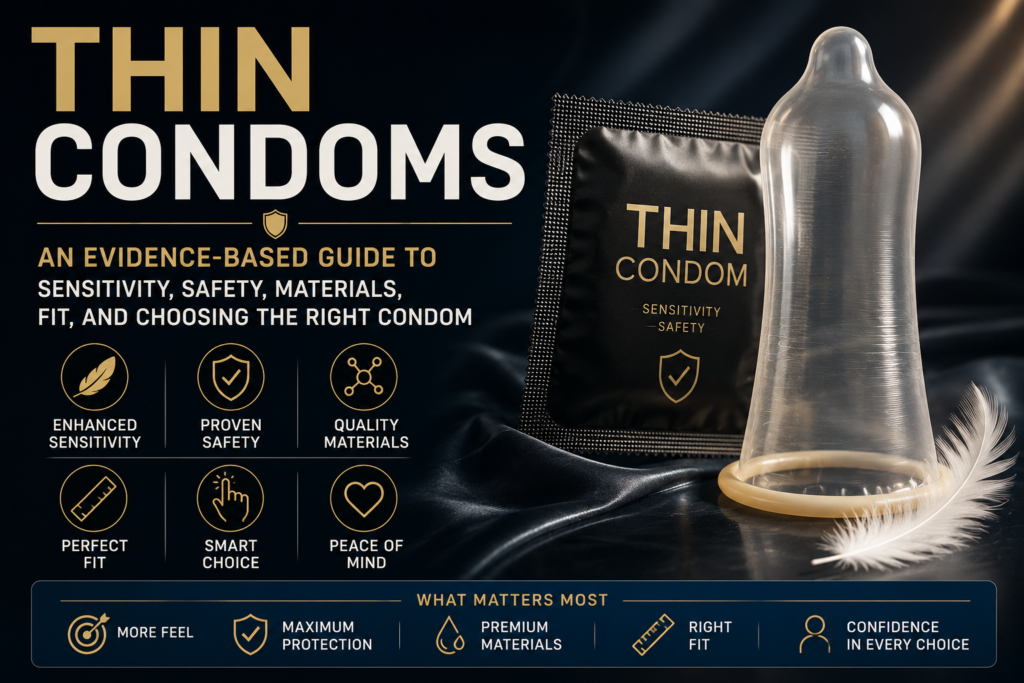
Thin condoms are designed to reduce the amount of material between partners while still functioning as barrier contraception when manufactured, stored and used correctly. Their main appeal is straightforward: many consumers want greater sensitivity and a more natural sensation without giving up the pregnancy and sexually transmitted infection (STI) risk reduction associated with condom use.
But “thinner” should not automatically be interpreted as “better,” nor should it automatically be interpreted as “weaker.”
Condom performance depends on much more than thickness. Material, manufacturing quality, correct fit, storage, expiration date, lubrication and correct use all matter. The CDC states that correct condom use can reduce the risk of pregnancy and STIs, while also emphasizing that condoms must be used correctly every time to provide their intended protection.
For TestoVerdict, that makes the central question more useful than simply asking which condom is thinnest:
Can a thin condom provide the sensation and comfort a consumer wants while still offering appropriate fit, material quality, compatibility and dependable barrier performance?
This guide examines exactly that.
What Are Thin Condoms?
Thin condoms are external condoms manufactured with a reduced wall thickness compared with some conventional condoms.
They may be marketed using terms such as:
- thin
- ultra thin
- sensitive
- extra sensitive
- barely there
- natural feel
- close feel
These terms are largely commercial descriptions rather than a universal thickness classification.
That distinction matters.
A product labeled “ultra thin” by one manufacturer isn’t necessarily the same thickness as another manufacturer’s “thin” condom.
WHO/UNFPA technical specifications demonstrate that condom thickness is a measurable manufacturing characteristic. Technical specifications can define nominal thickness and allowable tolerances, while quality testing also evaluates characteristics such as dimensions, bursting performance and freedom from holes.
So consumers should not judge condom quality from a front-of-package phrase alone.
Why Do People Choose Thin Condoms?
The principal reason is sensation.
Condoms introduce a physical barrier between partners. Some users feel that reducing the amount of material improves tactile sensation.
Other reasons consumers may investigate thin condoms include:
- greater perceived sensitivity
- less noticeable barrier sensation
- improved comfort
- more natural-feeling intimacy
- dissatisfaction with thicker condoms
- trying to find a condom a partner prefers
- finding a combination of fit and material that feels better
This creates an important consumer trade-off.
People understandably want a condom that feels unobtrusive, but contraception and STI protection are the reasons many people are using one in the first place.
The objective therefore shouldn’t be:
“Find the absolute thinnest condom possible.”
It should be:
“Find an appropriately manufactured condom that fits properly, feels comfortable and is used correctly.”
Are Thin Condoms Safe?
This is probably the most important question surrounding the category.
A thin condom should not be assumed unsafe simply because it contains less material.
Condom manufacturing involves specifications and performance testing rather than thickness alone.
WHO/UNFPA guidance on male latex condoms includes technical procedures addressing characteristics such as:
- length
- width
- thickness
- bursting volume
- bursting pressure
- stability and shelf life
- freedom from holes
- seal integrity
This is important because thickness alone is not a complete measure of condom quality or reliability.
A properly manufactured thinner condom may perform appropriately, whereas a poorly stored, expired, incorrectly fitted or incorrectly used condom may have problems regardless of how thick it feels.
The TestoVerdict position
Consumers should prioritize:
quality + fit + material + correct use
over simply choosing the smallest thickness number on a package.
Are Thin Condoms More Likely to Break?
It is tempting to reason:
thinner material = easier to break.
But condom performance is more complicated.
Breakage can be affected by:
- incorrect size
- inadequate lubrication
- incompatible lubricant
- damaged packaging
- improper storage
- expiration
- incorrect application
- manufacturing defects
- excessive friction
- using multiple condoms simultaneously
CDC guidance specifically warns against oil-based products with latex condoms because oils can weaken latex and contribute to breakage. CDC also recommends water- or silicone-based lubricants with latex condoms.
Therefore, choosing a thicker condom does not compensate for incorrect use.
Similarly, choosing a thin condom doesn’t automatically mean it will fail.
Thin Condoms vs Regular Condoms
The biggest practical difference is usually the amount of material and the resulting sensation.
| Feature | Thin Condoms | Regular Condoms |
|---|---|---|
| Primary appeal | Increased sensation | Familiar balance |
| Barrier material | Reduced thickness | Conventional thickness |
| Sensation | Often marketed as higher | Standard |
| Available materials | Latex and some synthetics | Wide variety |
| Fit importance | Very high | Very high |
| Correct-use importance | Essential | Essential |
| Lubrication compatibility | Depends on material | Depends on material |
| STI protection | Depends on appropriate material and correct use | Same principle |
Consumers shouldn’t assume a regular condom is automatically safer solely because it feels thicker.
Likewise, they shouldn’t assume an ultra-thin condom is superior simply because it feels less noticeable.
Thin Condoms vs Ultra Thin Condoms
This terminology causes considerable confusion.
There is no simple consumer rule saying:
Thin = X millimeters
and:
Ultra thin = Y millimeters.
Manufacturers can use different marketing terminology.
Therefore, consumers comparing thin condoms vs ultra thin condoms should look beyond the product name.
Check:
- stated material
- nominal width
- length where disclosed
- thickness where disclosed
- lubrication
- expiration date
- regulatory/manufacturing information
- intended use
A product labeled “ultra thin” may not necessarily be dramatically thinner than another company’s “thin” product.
Does Condom Thickness Affect Sensitivity?
Thickness can plausibly influence perceived sensation because the condom creates a physical layer between partners.
However, sexual sensation is highly individual.
A person’s experience can also depend on:
- fit
- material
- lubrication
- texture
- tightness
- erection quality
- sexual activity
- individual sensitivity
- partner preference
That means a consumer who wants greater sensitivity shouldn’t focus exclusively on thickness.
A poorly fitting ultra-thin condom may feel worse than a properly fitting standard condom.
What Materials Are Thin Condoms Made From?
Material is one of the most important variables when comparing condoms.
Common external-condom materials include natural rubber latex and several synthetic or alternative materials.
Latex Thin Condoms
Latex remains a widely used condom material.
Its advantages include established use as a barrier method and broad availability.
CDC states that latex condoms provide protection against HIV and other STIs when used consistently and correctly.
But latex has one important practical limitation:
Oil-based lubricants should not be used with latex condoms.
CDC specifically advises using water-based or silicone-based lubricants because oil-based products can weaken latex.
Consumers with latex allergies also need an alternative material.
Polyurethane Condoms
Polyurethane is a synthetic material used in some non-latex condoms.
It can be useful for consumers who cannot use latex.
However, material differences matter.
CDC notes that plastic condoms can break more often than latex condoms, so consumers shouldn’t assume every non-latex material has exactly the same performance characteristics as latex.
The exact product and material should therefore be evaluated rather than treating “non-latex” as one uniform category.
Polyisoprene Condoms
Synthetic polyisoprene condoms provide another latex-free option.
Consumers may choose them because of latex sensitivity or because they prefer their feel.
Again, lubricant compatibility should be checked against the manufacturer’s instructions rather than assumed.
Lambskin and Natural-Membrane Condoms
This category requires a particularly important safety distinction.
Natural-membrane condoms may help prevent pregnancy, but CDC states that natural-membrane condoms such as lambskin contain small pores and should not be used for prevention of HIV or other STIs.
That means someone shopping specifically for STI protection should not choose a product merely because it feels thinner or more natural.
Material matters.
Thin Latex vs Non-Latex Condoms
There isn’t one universal winner.
The decision depends partly on why the consumer is avoiding latex.
Thin latex may make sense for someone who:
- has no latex allergy
- wants broad product availability
- prefers established latex condom options
- understands latex-compatible lubrication
Non-latex may deserve consideration for someone who:
- has a latex allergy or sensitivity
- prefers a particular synthetic material
- dislikes the characteristics of latex
However, consumers should investigate the specific non-latex material, because polyurethane, polyisoprene and natural membrane condoms aren’t interchangeable.
What Is the Best Thickness for a Condom?
There is no universal best thickness.
This is one of the most important conclusions in this guide.
A consumer might naturally think:
Thinnest = best sensation.
But that ignores fit, comfort, material and personal preference.
WHO condom specifications also demonstrate why thickness should be understood as just one measurable product characteristic within a much larger quality framework.
Instead of searching for a magical thickness number, consumers should identify the thinnest appropriately manufactured condom that still fits comfortably and suits their intended use.
Condom Fit May Matter More Than Thickness
This deserves particular emphasis.
A condom that doesn’t fit correctly can undermine both comfort and user confidence.
If it is excessively tight, it may feel uncomfortable.
If it is excessively loose, slippage becomes a concern.
CDC guidance specifically recommends holding the condom at the base during withdrawal to help prevent slipping.
Consumers therefore shouldn’t jump directly from a standard condom to an ultra-thin option without considering whether their real complaint is fit rather than thickness.
How to Choose the Right Size Thin Condom
Condom sizing terminology can be frustrating.
Manufacturers may use descriptions such as:
- snug
- regular
- standard
- large
- XL
These words don’t always tell the whole story.
One of the more useful package specifications is nominal width, when provided.
Consumers comparing products should look at actual measurements rather than relying only on labels such as “large.”
For TestoVerdict, this is an important principle:
Measurements are more informative than marketing adjectives.
Thin Condoms for Men: What Should Buyers Actually Compare?
When comparing thin condoms, we recommend evaluating at least seven factors.
1. Material
Latex?
Polyisoprene?
Polyurethane?
Natural membrane?
This can materially affect suitability.
2. Fit
Look at width rather than simply “regular” or “large.”
3. Thickness
Useful when manufacturers disclose it, but don’t evaluate it alone.
4. Lubrication
Is the condom lubricated?
What type of additional lubricant is compatible with the material?
5. Expiration Date
CDC recommends checking the expiration date before use.
6. Package Integrity
Don’t use a condom from visibly damaged packaging.
7. Intended Protection
If STI prevention matters, material selection becomes particularly important because natural-membrane condoms are not recommended for HIV/STI prevention.
Thin Condoms for Sensitivity
Consumers searching for the best condoms for sensitivity often gravitate toward thin products.
That’s reasonable, but thickness is only one part of perceived sensation.
Consider:
Lubrication
Insufficient lubrication can create friction and discomfort.
Fit
An overly tight condom can distract from sensation.
Material
Different materials can feel different to different users.
Texture
Some consumers prefer smooth condoms while others prefer ribbed or dotted products.
Psychological comfort
A condom someone trusts and finds easy to use may create a better overall experience than a product that technically measures thinner but feels unreliable to them.
This is why TestoVerdict will not rank condoms solely by micrometer measurements.
Are Thin Condoms Good for Long-Lasting Sex?
Thin condoms are primarily designed around sensation rather than delay.
Someone specifically looking to reduce sensitivity and prolong intercourse may instead investigate delay condoms, which are a different product category.
Those may contain desensitizing agents or use design characteristics intended to alter sensation.
Therefore:
Thin condoms → generally aimed at greater sensation
Delay condoms → generally aimed at reduced sensation/delayed climax
Consumers shouldn’t confuse the two categories.
Thin Condoms vs Delay Condoms
These products often serve nearly opposite consumer goals.
| Thin Condom | Delay Condom |
|---|---|
| Designed around sensitivity | Designed around delaying sensation |
| Less material may be emphasized | Desensitizing feature may be emphasized |
| Natural-feel marketing common | Long-lasting marketing common |
| Good candidate for sensation-focused buyers | Different use case |
This distinction will become especially important as TestoVerdict builds its condom and delay-product comparison library.
Thin Condoms vs Ribbed Condoms
Thinness describes material thickness.
Ribbing describes surface texture.
A condom can theoretically be both thin and textured.
Consumers choosing between the two should identify what they’re trying to change:
Barrier sensation? → investigate thinness
Surface stimulation? → investigate texture
Again, product categories overlap, but their intended design objectives differ.
Thin Condoms vs Dotted Condoms
The same principle applies.
Dotted condoms use raised surface features.
Thin condoms emphasize reduced barrier thickness.
Neither feature automatically makes a condom “better.”
The appropriate choice depends on comfort and preference while maintaining appropriate protection and fit.
Thin Condoms vs Non-Latex Condoms
This comparison is slightly misleading because these categories can overlap.
“Thin” describes thickness.
“Non-latex” describes material.
A condom can therefore be:
thin + latex
or
thin + non-latex.
When comparing products, consumers should separate these variables instead of treating them as competing categories.
Best Thin Condoms for Sensitive Skin: What Matters?
People experiencing irritation should avoid assuming that thinness itself solves the problem.
Potential issues may involve:
- latex sensitivity
- lubricant ingredients
- spermicide
- fragrances
- flavoring
- other additives
CDC specifically advises against nonoxynol-9 for routine condom use because it can cause irritation.
Persistent burning, rash, swelling or other reactions deserve appropriate medical evaluation rather than repeated trial-and-error with increasingly specialized products.
Lubrication and Thin Condoms
Lubrication deserves much more attention than it usually receives in condom reviews.
Adequate lubrication can reduce friction.
CDC advises using water-based or silicone-based lubricants with latex condoms and warns that oil-based products such as petroleum jelly, body lotion and cooking oils can weaken latex and contribute to condom breakage.
This becomes particularly important when someone is concerned about condom durability.
Instead of simply buying a thicker condom, ask:
Are we using enough lubricant—and is that lubricant compatible with the condom material?
Can You Use Silicone Lubricant With Thin Condoms?
For latex condoms, CDC identifies both water-based and silicone-based lubricants as appropriate options.
For other condom materials, consumers should check the manufacturer’s instructions.
The rule should be:
Never assume lubricant compatibility solely from the word “condom.”
Read the package.
Can You Use Oil With Thin Condoms?
Not with latex condoms.
CDC specifically warns that oil-based products can weaken latex and cause condoms to break.
Examples include:
- petroleum jelly
- baby oil
- body lotion
- massage oil
- cooking oils
For non-latex materials, compatibility can differ, so manufacturer instructions should be followed.
How to Use Thin Condoms Correctly
Thickness does not change the fundamental rules of correct condom use.
CDC recommends:
- Use a new condom for each act of sex.
- Carefully open the wrapper.
- Put the condom on the tip of the erect penis with the rolled side outward.
- Pinch air from the tip while leaving space.
- Unroll the condom completely to the base.
- After ejaculation, hold the rim/base during withdrawal.
- Remove carefully to prevent semen spilling.
- Dispose of it in the trash.
If the condom breaks during sexual activity, CDC advises stopping and replacing it with a new condom.
Common Mistakes That Can Make Thin Condoms Less Reliable
Using Two Condoms at Once
More barriers do not mean more protection.
CDC advises against using more than one condom at a time.
Reusing a Condom
Condoms are single-use products.
Never reuse one.
Using Oil-Based Lubricant With Latex
This can weaken the material.
Putting the Condom On Too Late
A condom should be used before genital contact rather than only immediately before ejaculation.
Incorrect Storage
CDC advises against storing condoms in a wallet because heat and friction can damage them.
Ignoring Expiration Dates
Check the package before use.
Ignoring Fit
A condom that slips or feels excessively tight may indicate that another size is more appropriate.
How Should Thin Condoms Be Stored?
Condom quality doesn’t depend only on how the product left the factory.
Storage matters.
Heat, friction and age can affect product integrity.
CDC specifically cautions against wallet storage because of heat and friction.
WHO also maintains technical guidance regarding stability, shelf life, storage and shipping of natural rubber latex condoms.
Consumers should therefore:
- follow package storage instructions
- avoid excessive heat
- check expiration dates
- inspect packaging
- avoid using visibly damaged condoms
Do Thin Condoms Protect Against Pregnancy?
Condoms are used as a barrier contraceptive method, but no contraceptive method should be presented as offering absolute protection.
Correct and consistent use matters.
CDC states that correct condom use can reduce the risk of pregnancy and sexually transmitted infections.
The important point for consumers considering thin condoms is that the product’s thickness is not the only determinant of protection.
Proper use remains essential.
Do Thin Condoms Protect Against STIs?
Appropriate condom use can reduce STI risk, but material matters.
CDC states that latex condoms provide a barrier against HIV and other STIs when used consistently and correctly.
However, natural-membrane condoms such as lambskin should not be used for HIV/STI prevention because of pores in the material.
Therefore, consumers should never choose solely according to sensation.
If STI protection is an important objective, check the material first.
Can Thin Condoms Expire?
Yes.
Condoms have expiration dates.
Manufacturers establish shelf-life, and WHO guidance describes stability testing requirements used in establishing shelf-life claims for natural rubber latex condoms.
Do not use a condom merely because the wrapper appears intact.
Check the expiration date.
Should You Buy the Thinnest Condom Available?
Not necessarily.
This is where marketing and consumer interest can diverge.
The thinnest numerical specification may sound like the obvious winner, but buying decisions should account for:
Fit
Material
Lubrication
Quality
Intended protection
Comfort
Expiration
Package integrity
Manufacturer transparency
Thickness is one characteristic—not the entire product.
What Should You Look for When Buying Thin Condoms Online?
Buying condoms online provides access to more sizes and materials, but consumers should evaluate sellers carefully.
Check the exact product
Avoid listings that don’t clearly identify the manufacturer and model.
Check sizing information
Look for nominal width or other dimensions.
Check material
Especially important for people with latex allergies and those seeking STI protection.
Check packaging
Products should arrive sealed and undamaged.
Check seller credibility
Condoms are health-related products. Unknown or questionable sellers are not worth the risk merely to save a small amount of money.
Check storage concerns
Products exposed to inappropriate temperatures or poor storage conditions may be undesirable.
Check expiration dates after delivery
Never assume newly purchased stock automatically has a long remaining shelf life.
Cheap Thin Condoms vs Premium Thin Condoms
Price doesn’t automatically predict protection or comfort.
Premium products may offer:
- specialized materials
- thinner construction
- different lubrication
- more sizing options
- premium packaging
- stronger brand recognition
But a high price doesn’t prove better performance.
Likewise, a lower price doesn’t automatically indicate poor quality.
TestoVerdict’s eventual product rankings will therefore look beyond price and branding.
How TestoVerdict Will Evaluate Thin Condoms
As TestoVerdict begins reviewing individual products, we intend to use a transparent evaluation framework.
Material
What is the condom actually made from?
Thickness
Does the manufacturer disclose it?
How meaningful is the difference compared with competitors?
Fit
What dimensions are available?
Lubrication
What type is provided and what additional lubricants are compatible?
Manufacturing and Quality Information
Does the manufacturer provide useful product and quality information?
Sensitivity
Does the design genuinely address consumers looking for reduced barrier sensation?
Consumer Suitability
Who is the product appropriate for?
Who may need another material or size?
Safety Communication
Does the manufacturer clearly explain limitations, proper use and compatibility?
Value
Does the product justify its price?
Marketing Accuracy
Does the brand make realistic claims—or rely on exaggerated language?
This is important because the best thin condoms aren’t necessarily the products with the most aggressive “ultra-thin” marketing.
Thin Condoms Buying Checklist
Before purchasing, ask:
| Question | Why It Matters |
|---|---|
| What material is it? | Determines allergy and protection considerations |
| What is the nominal width? | Helps assess fit |
| Is thickness disclosed? | Allows meaningful comparison |
| Is it lubricated? | Influences comfort/friction |
| Which lubricants are compatible? | Particularly important with latex |
| Is the seller credible? | Important for storage/product authenticity |
| Is packaging intact? | Helps protect product integrity |
| Is it expired? | Shelf life matters |
| Is it appropriate for STI prevention? | Natural membrane requires special caution |
| Does it actually fit? | Fit affects comfort and correct use |
This checklist is more useful than simply sorting products from thinnest to thickest.
Frequently Asked Questions About Thin Condoms
Are thin condoms safe?
Properly manufactured condoms can be thin while still being designed to meet applicable performance requirements. Safety and effectiveness depend on factors including material, fit, storage and correct use—not thickness alone.
Do thin condoms break more easily?
You should not assume that a condom will break simply because it is marketed as thin. Breakage risk can also be influenced by incorrect use, inadequate lubrication, incompatible lubricants, storage and fit.
Do thin condoms feel better?
Some consumers prefer them because they perceive greater sensitivity, but sensation is subjective. Fit, material and lubrication can be equally important.
What are ultra thin condoms?
“Ultra thin” is generally a product-marketing description indicating reduced material thickness. Consumers should compare actual specifications where available rather than assuming every product carrying that phrase has the same thickness.
Are thin condoms effective against pregnancy?
Condoms are barrier contraceptives, and correct, consistent use reduces pregnancy risk. No condom should be presented as providing absolute protection.
Do thin condoms protect against STIs?
Appropriate condom materials can reduce STI transmission risk when used correctly and consistently. Natural-membrane condoms such as lambskin are not recommended for HIV/STI prevention.
Are latex or non-latex thin condoms better?
Neither is universally better. Latex is widely used, while non-latex materials can be important for people with latex allergies. The specific material should be considered.
Can I use lubricant with thin condoms?
Yes, but lubricant compatibility matters. CDC recommends water- or silicone-based lubricants with latex condoms and advises against oil-based lubricants with latex.
Can I use Vaseline with thin latex condoms?
No. Petroleum jelly is oil-based and can weaken latex.
Can I wear two thin condoms for extra protection?
No. CDC advises against using more than one condom at a time.
Can thin condoms be reused?
No. Use a new condom each time.
What size thin condom should I buy?
Look at manufacturer sizing information, particularly nominal width where available. The best size is one that fits securely and comfortably rather than simply being labeled “regular” or “large.”
Are lambskin condoms good thin condoms?
They may appeal to some consumers for sensation or pregnancy prevention, but CDC states that natural-membrane condoms should not be used for HIV or STI prevention.
Does a thicker condom provide better protection?
Thickness alone shouldn’t be treated as a proxy for overall quality or protection. Manufacturing quality, material, fit, storage and correct use are all important.
How should thin condoms be stored?
Follow the manufacturer’s instructions and avoid damaging heat or friction. CDC specifically advises against storing condoms in wallets because heat and friction can damage them.
TestoVerdict Conclusion: Our Position on Thin Condoms
Thin condoms can be a sensible option for consumers who want greater sensitivity without abandoning barrier protection.
But TestoVerdict does not believe consumers should choose condoms by chasing the smallest thickness number.
The better buying decision considers the entire product:
material + fit + manufacturing quality + lubrication compatibility + storage + intended protection + correct use.
That distinction is particularly important in a category filled with phrases such as “ultra thin,” “barely there,” and “natural feel.”
Those descriptions may help explain a product’s intended experience, but they do not independently establish its quality.
A trustworthy thin condom should provide clear information about what it is made from, how it fits, how it should be used and what limitations consumers need to understand.
And there is one distinction consumers should remember above all:
A product intended to feel more natural is not necessarily appropriate for every protection objective.
Natural-membrane condoms are the clearest example. A consumer may choose them for particular characteristics, but CDC specifically says they should not be relied upon for HIV or STI prevention.
As TestoVerdict builds its condom review library, we will therefore evaluate products based on evidence and practical consumer value rather than simply rewarding whichever manufacturer can print “THINNEST EVER” most prominently on its package.
Before we recommend a condom, we want to understand:
What is it made from?
Does it fit properly?
What does “thin” actually mean for this product?
Is the lubrication appropriate?
Are the safety limitations communicated clearly?
Does the product justify its price?
And most importantly: does the product make sense for the consumer’s actual needs?
That is the TestoVerdict standard.
Sources
- U.S. Centers for Disease Control and Prevention — Condom Use: An Overview. CDC guidance covering correct condom use, pregnancy/STI risk reduction and lubricant compatibility.
CDC Condom Use Overview - U.S. Centers for Disease Control and Prevention — Preventing HIV with Condoms. Guidance covering latex, synthetic and natural-membrane condoms, correct use and lubricant considerations.
CDC Preventing HIV with Condoms - U.S. Centers for Disease Control and Prevention — How to Use a Condom. Consumer instructions covering application, storage, expiration, lubrication and common mistakes.
CDC How to Use a Condom - CDC STI Treatment Guidelines — Primary Prevention Methods. Clinical guidance regarding condom use and compatible lubricants.
CDC STI Prevention Guidelines - World Health Organization / UNFPA — Male Latex Condom Specification, Prequalification and Guidelines for Procurement. Technical framework for condom quality and procurement.
WHO Male Latex Condom Guidance - WHO/UNFPA — Guidance on Testing of Male Latex Condoms. Technical guidance covering measurements, bursting performance, stability and freedom from holes.
- WHO/UNFPA — Natural Rubber Latex Male Condom Stability Studies. Guidance covering shelf-life assessment and stability testing.
WHO Condom Stability Guidance
Medical/sexual-health disclaimer: This article provides general consumer education and is not individualized medical advice. Condoms reduce but do not eliminate pregnancy or STI risk. Follow the product instructions, use a new condom for each act of sex, and seek appropriate healthcare advice for contraception, STI exposure, persistent irritation, latex allergy concerns, or other sexual-health questions.